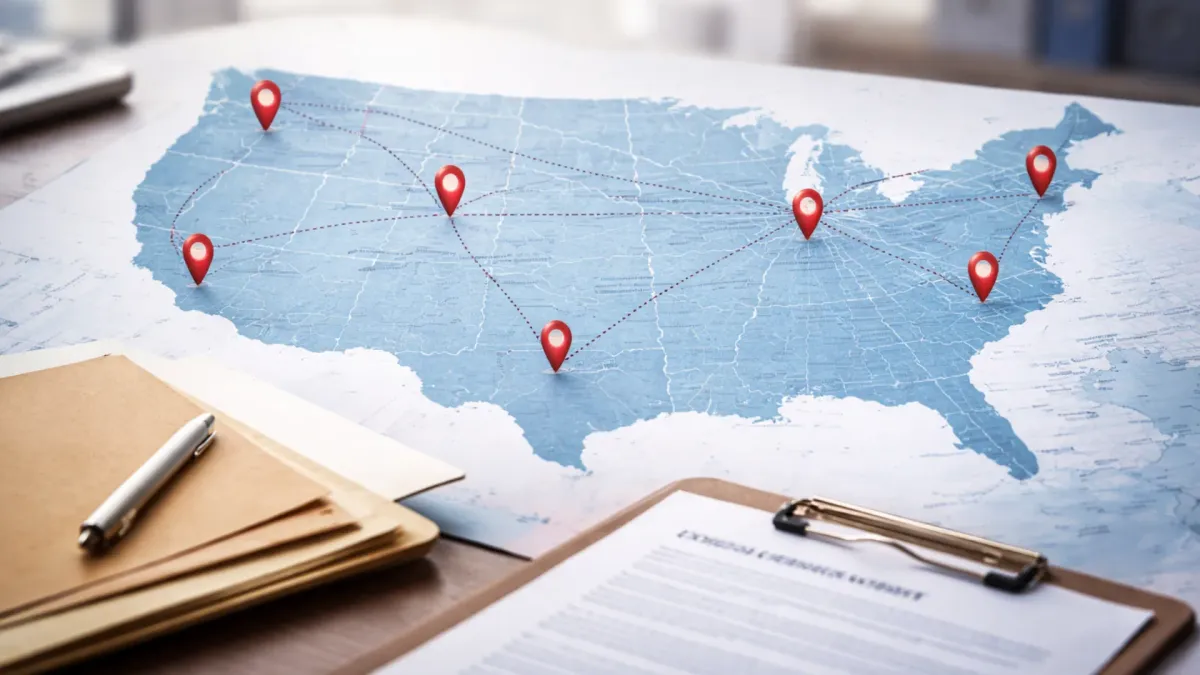
Can You Serve Legal Papers Across State Lines?
Article version in Mike's voice for Process Server Daily. Not legal advice.
Yes. In most situations, legal papers can be served across state lines when you follow the rules of the court that issued the documents and the rules of the state where the recipient is located. The hard part is not whether interstate service is allowed. The hard part is doing it correctly the first time.
I built my process serving company in Northern California, in Redding. Over the years I have handed off plenty of jobs to servers in other states, and I have taken jobs that originated somewhere else and needed to land in my area. Attorneys and fellow servers ask me the same question all the time: can we serve these papers out of state, and how do we keep the service from getting challenged later?
This is not legal advice. Court rules, licensing and qualification requirements, subpoena procedures, and UIDDA adoption all vary. Verify the current statutes and local rules for the issuing court and the destination state before you arrange service.
What interstate service actually means
Interstate service of process is what happens when documents tied to a case in one state need to be delivered to a person or business in another state.
A simple example: a lawsuit is filed in California, and the defendant now lives in Texas. The case is pending in California. The papers still have to be served where the recipient can be found, which may be Texas. The reverse happens every week too. A case starts in another state, and the person who needs notice is living, working, or running a business in Northern California.
The same pattern shows up with witnesses, records custodians, employers, registered agents, and family members. Geography does not freeze a lawsuit. People move. Businesses operate across borders. Courts still need valid notice.
Which rules can control the job
Interstate service is not one national procedure. Before you ship a packet or assign a server, you usually need to understand several layers of rules:
Who is legally allowed to serve the documents in the destination state
Which methods of service are permitted (personal, substituted, posted, mailed, or another authorized method)
Deadlines for completing service
What the proof or affidavit of service must say
Whether the issuing court requires extra authorization, a special process server appointment, or a particular form
Ignore any of those pieces and you can end up with disputed service, wasted attempts, and a delayed case. I treat every out-of-state job as its own checklist. Assumptions travel poorly across state lines.
Documents that often need out-of-state service
Plenty of document types can require service outside the filing state. Common examples include:
Summonses and complaints
Subpoenas
Divorce and other family law papers
Small claims documents
Eviction-related notices and filings
General civil lawsuit papers
Court orders and formal notices
Post-judgment papers
Business and corporate litigation documents
The document type matters. A summons and complaint does not automatically follow the same path as a subpoena. Family law papers can carry extra sensitivity and timing pressure. Eviction-related work can be deadline heavy. Read the papers, the case caption, and the court instructions before you decide how to serve.
Out-of-state subpoenas are a different animal
Serving a subpoena across state lines is often harder than serving ordinary civil initiating papers.
A subpoena issued by a court in one state does not automatically carry the same force in another state. Depending on the facts, counsel may need additional steps before a witness or records custodian in the destination state can be properly commanded and before that command can be enforced there.
Many states have adopted procedures based on the Uniform Interstate Depositions and Discovery Act (UIDDA). Where UIDDA (or a similar interstate discovery framework) applies, it can simplify getting discovery from a person or entity in another state. Adoption and procedure are not identical everywhere. Some states have quirks, local forms, or clerk practices that matter.
Hard hedge: do not treat a blog summary, including this one, as confirmation that UIDDA applies to your destination state or that a particular clerk will accept a given packet. Attorneys and servers should verify current statutes, local rules, and court procedures before arranging out-of-state subpoena service.
Why a local server in the destination state is usually the practical choice
Could you personally drive to another state and attempt service? Sometimes the law allows a nonresident to serve if that person meets the destination state's eligibility rules. In day-to-day practice, hiring a qualified local process server where the recipient is located is usually the cleaner move.
Local servers already know their counties, their apartment complexes, their business parks, and the quirks of their courts. They also know who is allowed to serve there, what forms the clerks expect, and how picky local counsel can get about affidavits.
Always verify destination-state qualification, registration, licensing, appointment, or age requirements. Do not assume your home-state credentials travel with you.
Advantages of using a local out-of-state server
When I send work out of state, I look for a local professional for reasons that show up on almost every tough job:
Rules familiarity. They are more likely to know what methods are accepted where they work.
Geography. Neighborhood knowledge saves attempts and reduces wild goose chases.
Speed. Electronic handoff to someone already near the address beats shipping paper and hoping.
Documentation. Experienced servers know how to write a clear proof of who, what, when, where, and how.
Updates. Good servers communicate attempts, gate codes, employer pushback, and completion without you having to chase them.
Those advantages matter most when a deadline is tight, the address is imperfect, or the recipient may be avoiding service.
How long out-of-state service can take
There is no honest one-size timeline. Duration depends on factors such as:
Whether the address is current and complete
Distance, gated communities, rural routes, and workplace access rules
How many attempts are needed
Whether the recipient is home, at work, traveling, or avoiding service
Local server availability
Court deadlines and any special instructions
Extra steps for subpoenas or court authorizations
Straightforward jobs with a solid address can finish quickly. Hard locates and evasive recipients can take multiple attempts or additional lawful locate work. The best way to speed things up is still the boring one: give the server clean documents, a verified address, and clear instructions up front.
What happens after the papers are served
After a successful serve, the process server typically completes a proof of service or affidavit of service. Depending on the court and the destination state's practice, that document may need to cover:
Name of the person served
Date and time of service
Location of service
Method of service
Description or identity details for the person served
List of documents delivered
Server name, contact information, and qualification details when required
Signature, declaration, or sworn statement in the form the court accepts
Then the proof usually gets filed with the issuing court or returned to the attorney, firm, or party who ordered the job. Accurate paperwork is the record that notice happened. Sloppy affidavits create expensive arguments later.
Common mistakes on interstate serves
Most interstate problems I see come from assuming every state works like the one where the case was filed. Frequent mistakes include:
Using someone who is not qualified to serve in the destination state
Choosing a method of service that is not authorized for that document and court
Serving the wrong person or the wrong business representative
Missing a service deadline while documents sit in transit or in an inbox
Failing to document attempts clearly
Using the wrong proof of service form
Treating subpoena service like ordinary summons service
Checking only the issuing court's rules and ignoring destination-state requirements (or the reverse)
Fixing bad service costs time and money. It can also collide with hearing dates and default timelines. Build the checklist before the first attempt.
Tips checklist for successful interstate service
Before you send documents across state lines:
Verify the recipient's most current address and any workplace details you can lawfully provide.
Confirm the service deadline with the issuing court and the attorney's calendar.
Read any special instructions, orders, or form requirements from the issuing court.
Check destination-state qualification rules for who may serve.
Send complete, legible copies of every document that must be served.
Share useful identifying information when appropriate (photos when available, vehicle descriptions, work hours, gate codes from the client, and so on).
Confirm what proof or affidavit form will be required after completion, and who will file it.
If the matter looks complicated, especially with subpoenas or contested family cases, have counsel confirm the procedure before the first attempt.
Frequently asked questions
Can a process server from one state serve papers in another state?
Possibly, but it depends on the destination state's laws and qualification rules. Some jurisdictions limit who may serve process. Using a qualified server who already works in the destination state is usually the simplest way to stay compliant.
Do the papers have to be served in the state where the lawsuit was filed?
No. The recipient may live or work outside the filing state. When the applicable court rules and laws allow it, service can be completed where the person or business is located.
Can I just mail the papers to someone in another state?
Mail can be an authorized method in some situations, but it is not a universal solution. Whether mailing works depends on the document type, the court, the jurisdiction, and the procedural rules that apply. Do not assume a certified letter replaces personal service unless the rules clearly allow it.
What if the person refuses to take the papers?
Refusal to physically accept documents does not always defeat valid service. What counts as proper service depends on the applicable law and the exact facts of the attempt. An experienced server should document what was said, what was done with the papers, and who was present.
What if I do not know where the person lives?
You may need lawful locate work before service can begin. Many process serving companies coordinate skip tracing or other investigative steps within the limits of the law. Do not invent addresses, and do not use pretext or illegal access methods. Confirm what is allowed in the relevant jurisdictions.
Is interstate service of process legal?
Yes. Serving legal documents across state lines is a routine part of litigation when the service complies with the rules and laws that apply to that case. The legality question is almost always about compliance details, not about whether crossing a state line is forbidden.
Finding a local server when the job is out of state
If you need a qualified process server in another state, start with people who already work that geography every day. The Mighty Process Server Directory is built to help you find local servers for out-of-state jobs. You can create a free Mighty Process Server account and get up to 25 free jobs every month, with no requirement to upgrade to a paid plan.
Interstate service does not have to become a fire drill. Identify the issuing-court rules, confirm the destination-state requirements, hand the job to a qualified local server, and insist on clean documentation. That is how cases keep moving when the defendant is two states away.
Sources and verification
This remake covers the same themes as the live Process Server Daily article at https://mightyprocessserver.com/blog/can-you-serve-legal-papers-across-state-lines. Court rules, process server qualification requirements, authorized service methods, proof-of-service content, subpoena procedures, and UIDDA adoption change. Readers must verify current law and local rules for the issuing court and the destination state. This article is not legal advice.
Stay sharp. Stay informed. Live Mighty!
Read the full article at www.mightyprocessserver.com
This article is published by Process Server Daily, powered by MightyAutomation.ai, the leader in legal support intelligence.