Civil vs. Criminal Process Serving: Key Differences Explained
Process serving plays an essential role in the U.S. legal system by ensuring that defendants, witnesses, businesses, and other parties receive proper notice of legal proceedings. Proper service of process supports due process by giving people an opportunity to respond to lawsuits, subpoenas, hearings, and other court actions.
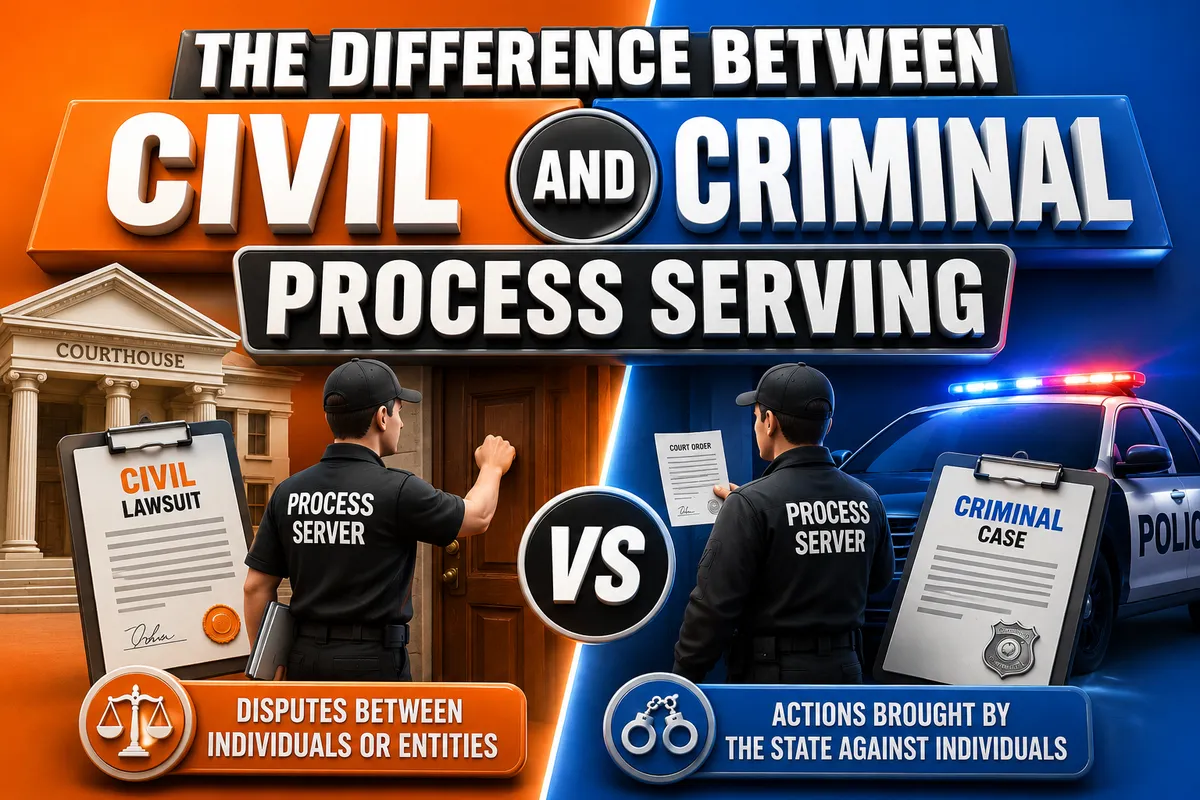
However, not every type of process serving works the same way. One important distinction is the difference between civil process serving and criminal process serving. Civil cases generally involve disputes between private parties, while criminal cases involve alleged violations of criminal law prosecuted by government authorities. Those differences affect the documents served, who may serve them, and the procedures that must be followed.
This guide explains civil vs. criminal process serving, including common documents, responsibilities, legal requirements, and when professional process servers may be involved.
What Is Process Serving?
Process serving is the formal delivery of legal documents to a person or organization involved in a court proceeding. The purpose is to provide legally sufficient notice while complying with applicable court rules and jurisdiction-specific requirements.
Depending on the case, documents may be delivered to defendants, plaintiffs, witnesses, businesses, government agencies, or other interested parties.
Common documents associated with service of process include:
Summonses
Complaints
Subpoenas
Court orders
Writs
Notices to appear
Eviction documents
Family law documents
Restraining or protective orders
After completing service, the person who performed the service may be required to prepare an affidavit or proof of service documenting when, where, how, and upon whom the documents were served.
The precise requirements vary by jurisdiction and type of proceeding.
What Is Civil Process Serving?
Civil process serving involves the delivery of legal documents connected to non-criminal court proceedings. These cases typically involve disputes between individuals, businesses, landlords and tenants, creditors and debtors, or other private parties.
The objective is to provide parties with legally sufficient notice of a lawsuit or proceeding so they have an opportunity to respond.
Common Civil Process Documents
A civil process server may be asked to serve documents such as:
Civil summonses and complaints
Small claims documents
Divorce papers
Child custody and support documents
Civil subpoenas
Eviction notices and related court documents
Debt collection lawsuits
Temporary restraining orders
Orders to appear
Post-judgment documents
The exact documents a private process server may handle depend on state law, court rules, and the nature of the case.
How Civil Process Serving Works
A typical civil service assignment begins after legal documents have been filed or issued as required. An attorney, law firm, government agency, business, or individual may then hire an authorized process server to deliver the documents.
The server must follow the applicable rules regarding issues such as:
Who may serve the documents
Who must receive them
Where service may occur
Applicable deadlines
Permitted methods of service
Documentation required after service
Once service is completed, the server generally prepares a proof or affidavit of service for filing or submission to the appropriate party.
Example of Civil Process Serving
Suppose a landlord files an eviction action against a tenant. The appropriate documents must be served according to the jurisdiction's applicable landlord-tenant and civil procedure rules.
A qualified process server may deliver the documents and prepare proof documenting the service attempt or completion.
That record can become important if the tenant later challenges whether proper notice was provided.
What Is Criminal Process Serving?
Criminal process serving concerns the delivery or execution of certain documents associated with criminal proceedings.
Criminal cases differ fundamentally from civil cases because the government prosecutes an individual or entity accused of violating criminal law. As a result, different rules may govern who is authorized to serve or execute particular documents.
Private process servers do not automatically have authority to serve every type of criminal document.
Common Documents in Criminal Proceedings
Depending on the jurisdiction and circumstances, documents requiring delivery may include:
Witness subpoenas
Criminal summonses
Notices to appear
Court orders
Hearing notices
Other criminal-court documents authorized for service
Some documents—particularly arrest warrants and other law-enforcement processes—are generally executed by authorized law enforcement personnel rather than ordinary private process servers.
This is an important distinction for attorneys and clients deciding who should handle a criminal-related service assignment.
Who Can Serve Civil Court Documents?
Rules governing who can serve civil process vary significantly by jurisdiction.
Depending on state and local law, service may be performed by:
Private process servers
Sheriffs or deputies
Marshals
Court-appointed individuals
Other adults who meet jurisdiction-specific eligibility requirements
Some states or local jurisdictions require process servers to obtain licenses, registrations, certifications, or appointments. Others permit adults who are not parties to the case to serve certain documents.
Because the rules vary, attorneys and litigants should verify the requirements that apply to the specific court and type of document involved.
Who Can Serve Criminal Court Documents?
Authority to serve documents in criminal proceedings can be more restricted.
Certain documents, such as witness subpoenas, may be served by private process servers or other authorized individuals in some jurisdictions. Other forms of criminal process may be reserved for:
Police officers
Sheriffs and deputies
U.S. Marshals or other federal officers
Court officers
Other officials authorized by law
An arrest warrant, for example, should not be treated like an ordinary civil summons. The authority to execute warrants is governed by applicable criminal procedure and law-enforcement rules.
Professional process serving companies should confirm their legal authority before accepting criminal-related assignments.
Why Proof of Service Matters
Whether the underlying proceeding is civil or criminal, accurate documentation can be critical.
A proof of service or affidavit of service may document details such as:
Date and time of service
Location of service
Identity or description of the recipient
Documents delivered
Method of service
Name and identifying information of the server
Details regarding unsuccessful attempts, when required
Accurate records help attorneys and courts determine whether applicable service requirements were satisfied.
Poor documentation can create disputes, delays, additional service attempts, or challenges to the validity of service.
Legal Requirements for Process Servers
There is no single nationwide set of rules governing every process server and every type of service. Requirements depend on federal, state, and local law as well as the court and document involved.
Depending on the jurisdiction, process server requirements may include:
Minimum age requirements
Registration
Licensing or certification
Background checks
Bonds or insurance
Court appointment
Continuing education
Identification requirements
Specific affidavit or proof-of-service procedures
Professional process servers should stay current with applicable process serving laws and court rules, particularly when working across multiple jurisdictions.
Why the Difference Between Civil and Criminal Process Matters
Understanding the distinction between civil and criminal process is important because using the wrong service procedure—or an unauthorized person—can create serious problems.
For attorneys and law firms, correctly classifying an assignment helps determine:
Which service rules apply
Who is legally authorized to perform the service
Which deadlines must be followed
What documentation is required
Whether law enforcement involvement is necessary
For process serving companies, these distinctions are equally important for compliance, risk management, and maintaining reliable client relationships.
How to Choose a Professional Process Server
When hiring a process server, look beyond price and turnaround time. The provider should understand the procedural requirements that apply to the specific assignment.
Consider factors such as:
Experience with the relevant type of case
Knowledge of state and local service rules
Licensing or registration where required
Clear communication and status updates
Detailed documentation of attempts
Reliable affidavits and proofs of service
Experience locating difficult-to-serve individuals
Secure handling of sensitive legal information
Ability to meet court and client deadlines
For criminal-related documents, confirm that a private process server is legally permitted to perform the requested service before assigning the job.
Frequently Asked Questions About Civil and Criminal Process Serving
What is the main difference between civil and criminal process serving?
Civil process serving involves documents connected to non-criminal legal disputes, while criminal process serving involves documents associated with government prosecutions and criminal court proceedings.
The rules governing who may serve the documents can also differ substantially.
Can a private process server serve criminal documents?
Sometimes. Private process servers may be authorized to serve certain criminal-related documents, such as subpoenas, depending on applicable law and court rules. Other documents may be restricted to law enforcement or designated officials.
Can a process server serve an arrest warrant?
Private civil process servers generally do not execute arrest warrants merely because they are authorized to serve civil documents. Arrest warrants are typically executed by law enforcement or other officials who have legal authority to make arrests.
What documents do civil process servers serve?
Civil process servers commonly handle summonses, complaints, subpoenas, family law documents, eviction-related papers, small claims documents, restraining orders, and other civil court papers.
What happens after documents are served?
The server typically completes a proof or affidavit of service documenting how service was performed. That documentation may then be filed with the court or returned to the attorney, agency, or client responsible for the case.
Are process serving laws the same in every state?
No. Process serving laws vary by state and sometimes by county, court, and type of proceeding. Anyone handling service should verify the rules applicable to the specific jurisdiction and case.
The Importance of Professional Process Serving
Proper service is more than simply delivering paperwork. It requires knowledge of procedural rules, careful documentation, attention to deadlines, and professional conduct in the field.
In civil cases, proper service helps ensure defendants and other parties receive the notice necessary to exercise their legal rights. In criminal proceedings, authorized delivery of subpoenas, summonses, and other documents helps ensure defendants and witnesses understand their obligations.
In both situations, reliable service supports the integrity and efficiency of the judicial process.
Final Thoughts: Civil vs. Criminal Process Serving
The difference between civil and criminal process serving begins with the nature of the underlying legal proceeding.
Civil process serving primarily supports disputes between private parties and commonly involves summonses, complaints, subpoenas, eviction matters, and family law documents. Criminal process serving relates to government prosecutions and may involve subpoenas, criminal summonses, notices, and other authorized court documents.
Just as importantly, the rules governing who can serve legal documents and how service must be completed vary by jurisdiction and document type.
Attorneys, law firms, businesses, and individuals should work with experienced professionals who understand local service requirements, maintain detailed records, and know when an assignment requires law enforcement or another specially authorized official.
Legal note: Process serving requirements vary by jurisdiction and document type. This article provides general information and is not legal advice.
Conclusion
Understanding the distinctions between civil process serving and criminal process serving helps legal professionals and clients appreciate the critical role process servers play in the justice system. While both involve legal document delivery, they differ in the types of cases, documents served, legal requirements, and procedures followed.
Whether you need a process server for criminal cases or assistance with process serving for civil cases, choosing a knowledgeable and experienced professional helps ensure compliance with applicable laws and supports the efficient administration of justice.
Article provided by MPS (Mighty Process Server), delivering professional, accurate, and dependable process serving solutions for law firms, businesses, and individuals.
Stay sharp. Stay informed. Live Mighty!
Read the full article at www.mightyprocessserver.com
This article is published by Process Server Daily, powered by MightyAutomation.ai, the leader in legal support intelligence.