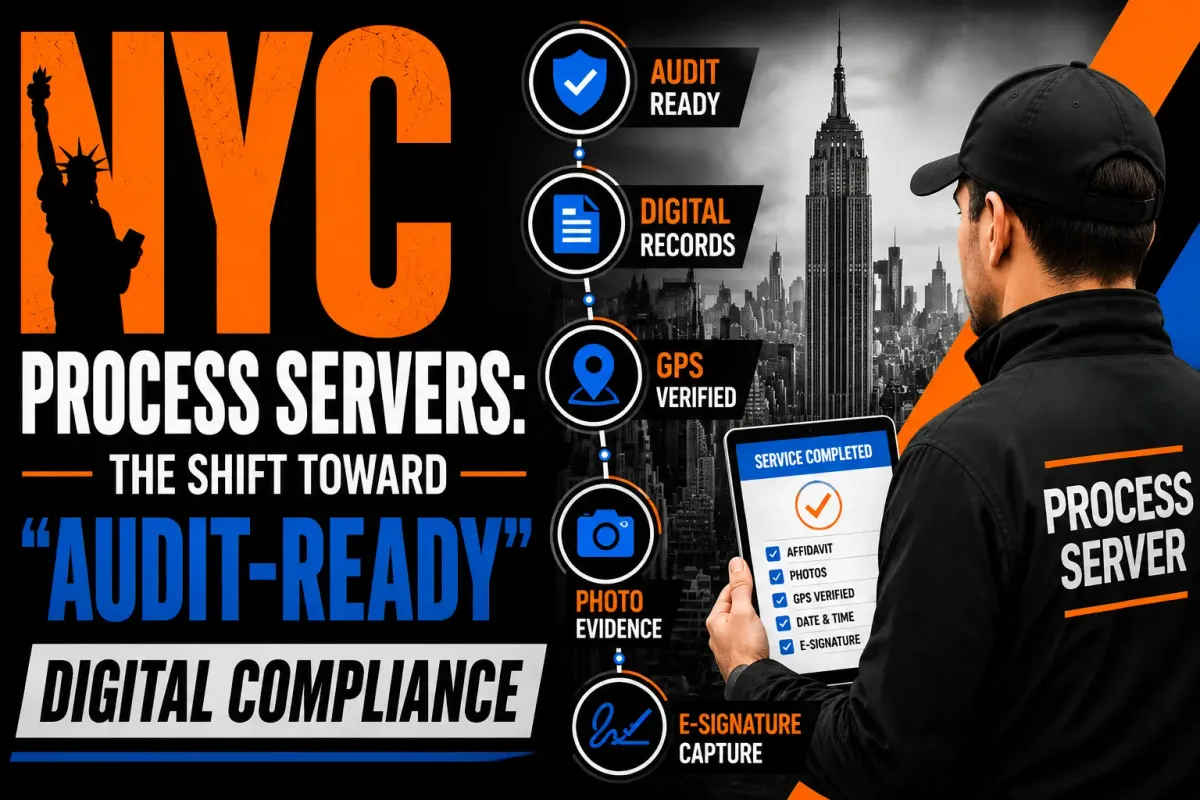
NYC Process Servers: The Shift Toward Audit-Ready Digital Compliance
For NYC process servers, compliance is becoming increasingly digital, data-driven, and documentation-focused. Completing a service attempt is only part of the job. Process servers also need reliable records showing when, where, and how each attempt occurred—and those records may need to withstand scrutiny from courts, clients, regulators, or auditors.
This shift toward audit-ready process serving puts greater emphasis on GPS records, timestamps, secure data storage, standardized reporting, retention policies, and digital audit trails.
For process serving companies operating in New York City, modernizing compliance workflows can help reduce risk and make records easier to retrieve when a service attempt is questioned. And even for process servers outside NYC, these developments are worth watching because they reflect a broader trend toward more verifiable digital documentation throughout the legal services industry.
What Is Audit-Ready Digital Compliance for Process Servers?
Digital compliance for process servers refers to using technology and standardized procedures to create, preserve, and retrieve reliable records of service activity.
An audit-ready system goes one step further. Instead of simply collecting information, it organizes records so they can be reviewed efficiently during a client audit, regulatory inquiry, internal compliance review, or court challenge.
Depending on applicable laws and rules, a digital compliance system may incorporate:
GPS or geolocation records
Date- and time-stamped service attempts
Contemporaneous field notes
Photographs or other permitted supporting documentation
Secure data storage
Digital audit trails
Standardized service-attempt records
Exportable reports
Record-retention controls
Access and modification histories
The objective is straightforward: create records that clearly support what happened in the field and preserve their integrity afterward.
Why Audit-Ready Process Serving Matters in NYC
New York City has long maintained detailed rules governing licensed process servers. As technology becomes more integrated into regulatory oversight and legal-service operations, accurate digital documentation becomes increasingly important.
A well-designed NYC process server compliance system can help answer critical questions such as:
Where did the service attempt occur?
When was the attempt made?
When was the information recorded?
Who created or modified the record?
Has the underlying data been altered?
Can historical records be retrieved quickly?
Can the information be exported for review?
These questions matter when service is challenged.
A process server who can produce organized, contemporaneous records is generally in a stronger position to explain and substantiate an attempt than one relying on fragmented notes or records reconstructed long after the event.
NYC Process Server Requirements: What Firms Should Monitor
Process servers and agencies operating in New York City should closely monitor applicable NYC process server requirements, including relevant provisions of Title 6 of the Rules of the City of New York and guidance issued by the NYC Department of Consumer and Worker Protection (DCWP).
Requirements can change, and the exact rules applicable to an individual server or process serving agency may depend on licensing status, effective dates, and other circumstances.
Several compliance areas deserve particular attention.
1. Digital Documentation Is Becoming More Important
The direction of regulation increasingly favors records that can be independently verified rather than documentation that depends entirely on handwritten notes or manually entered information.
That makes digital recordkeeping an important component of process server compliance in NYC.
Process serving businesses should evaluate whether their systems can reliably document attempts and preserve relevant information in a format that can later be reviewed.
2. Independent Storage Can Strengthen Data Integrity
Where applicable rules require or favor independent handling of electronic records, third-party systems can provide an additional layer of integrity.
Instead of keeping important GPS or attempt information exclusively within an editable internal system, independent storage can make it easier to demonstrate that the original record has been preserved.
A strong storage architecture may include:
Controlled access
Modification histories
Backup procedures
Data-integrity protections
Defined retention periods
Reliable record retrieval
For compliance purposes, the key issue is not simply where data is stored, but whether its authenticity and history can be demonstrated.
3. GPS and Timestamp Accuracy Matter
GPS tracking for process servers can provide valuable supporting evidence regarding the location of a service attempt.
But collecting location information alone is not enough.
The system should accurately associate location information with the relevant attempt, server, date, and time. When applicable rules prescribe specific timing, transmission, or GPS-recording procedures, those requirements should be built directly into the workflow.
Contemporaneous data is particularly valuable because it reduces reliance on information recreated from memory after an attempt.
4. Long-Term Record Retention Requires Planning
Digital records are useful only if they remain accessible for the required period.
Process serving firms should establish a formal record-retention policy addressing:
How long records must be maintained
Which records must be preserved
Where records are stored
Who can access them
How backups are handled
What happens when software vendors change
How records can be exported before an account is closed
Any retention period should be based on the rules actually applicable to the business rather than a generic industry assumption.
Long-term retention deserves particular attention because changing software platforms, expired subscriptions, lost devices, and incompatible file formats can make old records difficult to retrieve.
Key Features of Process Server Compliance Software
When evaluating process server software for NYC operations, firms should look beyond basic job management.
A compliance-oriented platform may need to support:
GPS-verified service attempts
Accurate timestamps
Real-time field documentation
Secure data transmission
Automated audit trails
Controlled user permissions
Long-term record retention
Standardized attempt notes
Searchable historical records
Exportable reports
Backup and recovery procedures
Integration with affidavit or proof-of-service workflows
Technology should reduce administrative work without weakening the integrity of the underlying record.
Why Tamper-Resistant Records Matter
One of the most important principles behind audit-ready compliance is data integrity.
If service records can be freely modified without leaving evidence of the change, their value as supporting documentation may be weakened.
A stronger system preserves information such as:
The original record
Creation timestamp
User responsible for the entry
Subsequent changes
Date and time of modifications
Supporting location information
This does not mean mistakes can never be corrected. It means corrections should be transparent and traceable.
That distinction is critical.
An audit trail allows a reviewer to understand what changed, when it changed, and who made the change.
Common Digital Compliance Challenges for NYC Process Servers
Transitioning to more sophisticated process server technology can create operational challenges.
Software and Storage Costs
Secure storage, GPS systems, mobile applications, backups, and compliance platforms create additional expenses.
However, firms should compare those expenses with the potential cost of missing documentation, failed audits, disputed service, or inefficient manual record retrieval.
Staff Training
Technology only works when process servers use it correctly.
Field staff should understand:
When records must be created
Which information must be captured
How GPS functions should be used
How attempt notes should be written
What information should not be altered
How corrections are documented
When data must be transmitted or synchronized
Data Security
Process serving records can contain sensitive personal and legal information.
Businesses should therefore consider cybersecurity alongside regulatory compliance, including strong passwords, multi-factor authentication where available, appropriate permissions, device security, and reliable backup procedures.
Migrating Historical Records
Changing platforms can create another problem: what happens to old records?
Before moving to new process server software, firms should determine how existing records will be exported, preserved, indexed, and retrieved.
Benefits of Digital Compliance for Process Servers
Strong digital compliance is not merely about satisfying regulators.
It can improve everyday operations.
Potential benefits include:
More accurate service-attempt records
Fewer documentation errors
Faster affidavit preparation
Better client reporting
Easier internal quality control
Faster responses to record requests
Stronger documentation when service is challenged
Improved accountability
Better data security
More consistent processes across multiple servers
For agencies managing significant service volume, standardized digital workflows can also make expansion easier.
Process Server Technology Trends to Watch
Technology will continue reshaping the process serving industry.
Several trends are particularly relevant to compliance.
GPS-Verified Attempts
Location verification is increasingly integrated directly into mobile process serving applications.
Automated Digital Audit Trails
Systems can automatically record when information was created, uploaded, accessed, or modified.
Secure Cloud and Third-Party Storage
Centralized storage can reduce dependence on individual devices while improving record accessibility and backup capabilities.
Automated Proof-of-Service Workflows
Field data can populate affidavits and proofs of service, reducing duplicate data entry and transcription errors.
AI-Assisted Compliance Review
Artificial intelligence may increasingly help agencies identify incomplete fields, inconsistent timestamps, missing documentation, unusual patterns, or other records that warrant human review.
AI should support—not replace—professional judgment and verification.
Standardized Reporting
Clients increasingly expect structured information that can integrate with their own case-management and legal technology platforms.
How NYC Process Servers Can Become More Audit-Ready
Process serving firms do not need to rebuild their entire technology stack overnight. A practical compliance review can begin with the systems already in place.
Consider these steps:
Review applicable NYC regulations. Identify the rules governing your license and operations.
Map your current workflow. Document what happens from assignment intake through final proof of service.
Audit GPS procedures. Determine when location data is collected, transmitted, and stored.
Review data storage. Identify who controls the records and whether modifications are traceable.
Standardize field notes. Establish consistent documentation expectations across servers.
Confirm retention requirements. Make sure records remain accessible for all legally required periods.
Test record retrieval. Choose an older assignment and determine how quickly your team can reconstruct its documentation.
Review user permissions. Limit the ability to modify sensitive records unnecessarily.
Create an export procedure. Ensure records can be provided in a practical format when requested.
Conduct periodic internal audits. Identify missing information before a regulator, client, or opposing party does.
An Audit-Ready Process Server Checklist
Before considering a digital compliance program mature, ask:
Are service attempts consistently time-stamped?
Is required GPS information captured correctly?
Are attempt notes entered contemporaneously?
Can original records be distinguished from later corrections?
Are modifications logged?
Is sensitive information stored securely?
Can records be retrieved years later when required?
Can assignment data be exported efficiently?
Are process servers trained on the same procedures?
Are compliance controls periodically tested?
If several answers are "no," the firm's compliance infrastructure may deserve additional attention.
Why NYC Digital Compliance Matters Beyond New York
Process servers outside New York City should watch these developments closely.
Courts, clients, regulators, and legal technology providers increasingly favor documentation that is structured, verifiable, and easy to audit. As digital tools become less expensive and more sophisticated, expectations surrounding documentation may continue to rise.
A process serving agency that already maintains strong timestamps, GPS records, standardized field notes, secure storage, and searchable audit trails will be better positioned to adapt if its jurisdiction introduces stricter requirements.
In other words, audit-ready process serving can be both a compliance strategy and a competitive advantage.
Frequently Asked Questions About NYC Process Server Compliance
What records should NYC process servers maintain?
The specific records required depend on applicable NYC laws, regulations, licensing requirements, and the type of service performed. Process servers should consult current DCWP requirements and other applicable court rules rather than relying solely on general industry practices.
Why is GPS important for process servers?
GPS information can help document where a service attempt occurred and provide supporting evidence for field activity. NYC process servers should ensure any GPS procedures comply with the requirements currently applicable to their operations.
What is an audit trail in process serving?
An audit trail is a chronological record showing how service-related information was created and, where applicable, accessed or modified. A strong audit trail can help establish the integrity of digital records.
What does tamper-resistant process server documentation mean?
Tamper-resistant documentation uses technical and procedural controls designed to prevent undetectable changes. If a correction is made, a robust system should preserve enough information to identify the modification.
What should process servers look for in compliance software?
Process servers should consider GPS capabilities, timestamping, audit trails, security, permissions, record retention, backups, reporting, data exports, mobile functionality, and compatibility with applicable regulatory requirements.
How can process servers prepare for a compliance audit?
Maintain standardized records, document attempts promptly, follow required GPS procedures, preserve records securely, train personnel, periodically test data retrieval, and conduct internal reviews to identify gaps.
Final Thoughts: The Future Is Audit-Ready
The future of NYC process serving is increasingly connected to reliable digital documentation.
Service itself remains fundamental, but the ability to demonstrate where an attempt occurred, when it occurred, what happened, and how the underlying record was preserved is becoming equally important from a compliance perspective.
For NYC process servers, that means paying close attention to GPS documentation, secure data storage, timestamps, audit trails, retention policies, standardized records, and evolving NYC process server regulations.
The firms best prepared for this environment will not simply collect more data. They will build systems that produce accurate, organized, secure, and defensible records.
That is the foundation of audit-ready process serving—and an increasingly important part of running a modern process serving business.
About Mighty Process Server
Mighty Process Server (MPS) supports process servers, attorneys, law firms, and legal professionals with education, operational guidance, and technology-focused resources. Through best practices, industry insights, and tools that support documentation and reporting, MPS helps process servers build stronger, more compliant, and more defensible service operations.
Source reference: “Top 5 Regulatory Changes NYC Process Servers Must Master in 2026,” The Process Server Center, May 19, 2026.
Stay sharp. Stay informed. Live Mighty!
Read the full article at www.mightyprocessserver.com
This article is published by Process Server Daily, powered by MightyAutomation.ai, the leader in legal support intelligence.