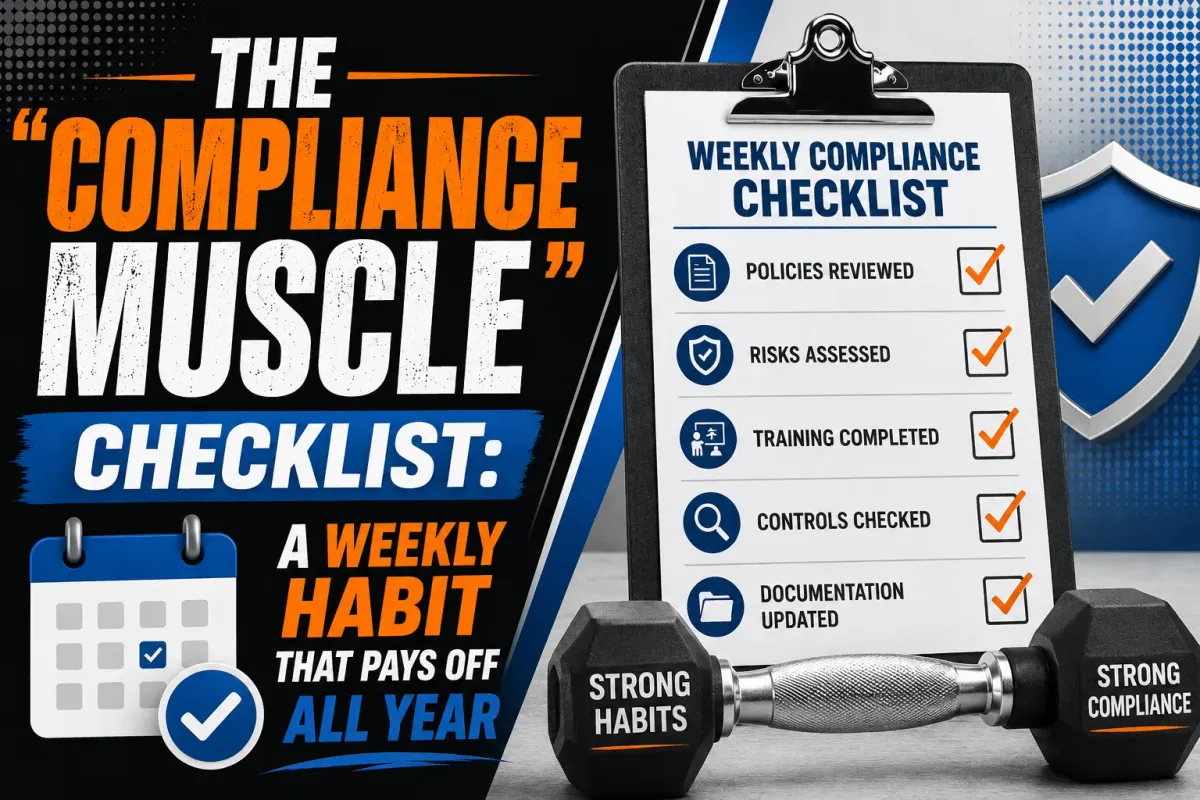
Process Server Compliance Checklist: Build Your “Compliance Muscle” Every Week
For process servers, compliance is not something to think about only when an affidavit is challenged, a client requests records, or a court asks questions. The strongest operations make compliance part of their weekly routine.
A practical process server compliance checklist can help identify documentation gaps, improve affidavit accuracy, protect the integrity of service records, and make client or audit requests easier to handle.
Think of it as building your compliance muscle. Small, consistent reviews performed every week can produce stronger records and more defensible processes throughout the year.
This guide provides a practical weekly checklist for process servers, legal support companies, and operations teams that want to improve documentation, record retention, quality control, and audit readiness.
Important: Process serving laws, licensing requirements, documentation standards, retention rules, and permissible technologies vary by jurisdiction. Always verify current statutes, court rules, licensing requirements, client instructions, and applicable privacy laws before adopting a compliance procedure.
What Is a Process Server Compliance Checklist?
A process server compliance checklist is a repeatable quality-control process used to verify that service attempts and related records comply with applicable requirements and internal standards.
Depending on the jurisdiction and type of assignment, a compliance review may cover:
Service dates, times, and locations
Field notes and attempt histories
Affidavits or proofs of service
Address and identity information
GPS or location data, when applicable and lawful
Photographs, when permitted
Supporting documentation
Client instructions
Court and filing deadlines
Record retention
Data security
Internal escalation procedures
The goal is not simply to create more paperwork. It is to make sure the documentation accurately reflects what happened in the field and can be retrieved when needed.
Why Weekly Process Server Compliance Reviews Matter
Compliance problems are often easier to correct shortly after an assignment than weeks or months later.
A server may remember the details of an unusual interaction today but have difficulty reconstructing them six months from now. A missing attachment may be easy to locate this week and much harder to recover after a case has been archived.
A weekly compliance checklist gives process servers and managers an opportunity to identify potential problems while information is still fresh.
Regular reviews can help:
Identify missing or incomplete records
Improve affidavit and proof-of-service accuracy
Detect inconsistencies between field notes and final reports
Strengthen record retention practices
Reduce unnecessary client follow-up
Improve audit readiness
Identify recurring training needs
Create more consistent workflows
Consistency is particularly important when a service attempt is later questioned.
Building Your “Compliance Muscle”
The idea behind compliance muscle is straightforward: processes that are reviewed repeatedly become easier to follow consistently.
Instead of treating compliance as an occasional project, make it a routine operational habit.
A process serving company might dedicate a short period each week to reviewing a sample of completed assignments, checking high-risk jobs, testing document retrieval, and confirming that important records were properly preserved.
Over time, this can turn compliance from a reactive exercise into a normal part of operations.
1. Review Field Logs for Completeness
Accurate field documentation is one of the foundations of professional process serving.
Review recent service attempts and confirm that records contain the information required by the applicable jurisdiction, company procedures, and client instructions.
Depending on those requirements, records might include:
Date and time of each attempt
Service address
Attempt outcome
Clear narrative notes
Description or identity information when relevant
Access issues or property observations
Statements relevant to the service attempt
Method of service
Person served, when applicable
Avoid vague entries when more specific factual documentation is appropriate.
For example, a note such as "No answer" may provide less useful context than a factual record documenting when the attempt occurred and any relevant observations made at the location.
The objective is accuracy—not embellishment. Field notes should document what the server actually observed, heard, and did.
Check Supporting Records
Where lawful and appropriate, also confirm that supporting records are associated with the correct assignment.
These may include:
GPS or geolocation records
Photographs
Electronic timestamps
Attempt-history records
Client communications
Relevant supporting documents
The documentation should tell a consistent story.
If the affidavit says one thing while the field log or timestamp suggests another, investigate the discrepancy before the file becomes difficult to reconstruct.
2. Verify Affidavits and Proofs of Service
The proof of service or affidavit may become one of the most important records associated with an assignment.
As part of the weekly review, sample recently completed proofs and compare them with the underlying field records.
Check items such as:
Names
Addresses
Dates
Times
Method of service
Recipient information
Attempt history
Required declarations
Signatures or notarization, where applicable
Court- or jurisdiction-specific requirements
Small clerical errors can create unnecessary questions later.
A simple quality-control review before submission can be significantly easier than correcting a problem after filing.
3. Check Record Storage and Retention
Good documentation has limited value if it cannot be found.
A strong process server compliance program should address how records are stored, protected, retained, and eventually disposed of.
Review whether your systems provide appropriate:
Data retention
Access controls
Backup procedures
Information security
Search and retrieval
Audit trails
Data disposal procedures
Retention periods should be based on applicable legal, contractual, licensing, and business requirements rather than a one-size-fits-all rule.
Preserve the Integrity of Original Records
Changes to service records deserve particular attention.
Where corrections or supplemental information are permitted, organizations should use procedures that preserve the original record and create a transparent history of subsequent changes.
An audit trail showing who changed or supplemented information, when it occurred, and why can be much more defensible than silently overwriting the original entry.
4. Test Your Export Readiness
Imagine receiving a request today for the complete record of a service completed several months ago.
How quickly could you produce it?
This is an excellent weekly compliance test.
Select a completed assignment and determine whether authorized staff can efficiently retrieve the relevant records.
Depending on the matter, a complete package could contain:
Assignment details
Attempt history
Field notes
Proof or affidavit of service
Supporting photographs
GPS or timestamp information
Relevant communications
Supplemental records
The exact contents will vary, but the principle remains the same: important records should be organized and retrievable.
Audit readiness is not merely having the data. It is being able to locate and explain it.
5. Review High-Risk Service Attempts
Not every assignment carries the same operational risk.
During the weekly review, identify unusual or potentially high-risk service attempts and confirm that they received appropriate documentation and escalation.
Examples may include:
Threats or hostile encounters
Safety incidents
Gatekeeper interference
Restricted access
Conflicting address information
Questions about identity
Evasive behavior
Unusual substitute-service circumstances
Instructions that may conflict with applicable requirements
High-risk events should be communicated according to established procedures so attorneys, clients, supervisors, or other appropriate parties can make informed decisions.
Early escalation can prevent a small issue from becoming a larger one.
6. Review Client Instructions
Legal compliance and client instructions are related, but they are not necessarily identical.
A client may have additional requirements regarding:
Number or timing of attempts
Status updates
Documentation
Photographs
Affidavit formatting
Escalation
Billing
Return procedures
During the weekly review, compare completed assignments against both applicable legal requirements and authorized client instructions.
If client instructions appear inconsistent with applicable law or court rules, the issue should be escalated rather than followed automatically.
7. Check Deadlines and Open Assignments
Compliance also involves time management.
Review active cases for approaching:
Service deadlines
Court dates
Filing deadlines
Client reporting dates
Affidavit due dates
Follow-up attempts
A well-organized calendar or case-management system can reduce the risk of an assignment being overlooked.
Pay particular attention to cases that have remained open longer than expected.
They may require additional attempts, investigation, client direction, or escalation.
8. Monitor Legal and Regulatory Changes
Process serving regulations can differ substantially among states, counties, courts, and case types.
Requirements may also change.
Build a recurring process for checking reliable sources such as:
Court websites
State statutes
Administrative rules
Licensing authorities
Official government notices
Professional associations
Client compliance communications
Do not rely solely on social media posts, old training materials, or informal industry discussions when determining current legal requirements.
When a rule changes, document how the organization evaluated and implemented the change.
9. Review Technology and Access Controls
Process servers increasingly depend on technology for case management, navigation, communication, documentation, and reporting.
That makes technology governance part of compliance.
Your weekly or periodic review should consider:
Who has access to client and case information?
Have former employees or contractors had access removed?
Are accounts protected appropriately?
Are backups functioning?
Are mobile devices adequately secured?
Are records stored in approved systems?
Can unauthorized changes to important records be detected?
Technology can strengthen compliance, but only when it is configured and used responsibly.
10. Identify Training Opportunities
Compliance reviews should not exist simply to catch mistakes.
They should improve the operation.
If the same problem appears repeatedly—such as incomplete field notes, inconsistent affidavits, missing attachments, or delayed client updates—it may indicate a training or workflow issue.
Track recurring errors and use them to guide:
Staff training
Written procedures
Quality-control checks
Software configuration
Templates
Supervisor reviews
This turns compliance data into operational improvement.
A Simple Weekly Process Server Compliance Checklist
Use this quick checklist as a starting point for your weekly review:
Field Documentation
Review a sample of recent service attempts
Confirm dates, times, addresses, and outcomes
Check narrative notes for factual completeness
Verify supporting records are attached to the correct jobs
Investigate material inconsistencies
Proof of Service
Compare affidavits with underlying field records
Verify names, addresses, dates, and service methods
Check required signatures, declarations, or notarization
Confirm jurisdiction-specific requirements
Records and Retention
Confirm records are stored in approved systems
Check that access controls remain appropriate
Verify required records are being retained
Confirm corrections preserve an appropriate audit history
Test backup or recovery procedures when appropriate
Client Service
Review high-risk or unusual assignments
Confirm important issues were escalated
Check compliance with authorized client instructions
Review overdue status updates
Deadlines
Review approaching service deadlines
Check open and aging assignments
Confirm affidavits or proofs are submitted on time
Escalate cases requiring additional direction
Audit Readiness
Select one completed assignment
Retrieve its complete service record
Confirm supporting documentation is organized
Check whether the record can be explained without reconstructing events from memory
Training and Updates
Review recent court or regulatory updates
Document relevant procedural changes
Identify recurring errors
Assign training or corrective action where appropriate
Common Process Server Compliance Mistakes
Even experienced process servers can develop documentation gaps over time.
Incomplete Field Notes
Sparse notes can make it difficult to explain an attempt months later. Record relevant facts while they are fresh.
Inconsistent Records
Differences among field notes, GPS data, photographs, timestamps, and affidavits should be investigated rather than ignored.
Missed Deadlines
Calendar and case-management controls can reduce the risk of overlooked assignments and late documentation.
Poor Record Organization
A record technically exists but may still be operationally useless if nobody can locate it quickly.
Outdated Procedures
A process that was compliant several years ago may not reflect today's court rules, laws, technology requirements, or client expectations.
Overwriting Original Information
Changing historical records without maintaining an appropriate audit trail can undermine confidence in the documentation.
Conduct a Periodic Process Server Compliance Audit
Weekly reviews are useful for catching routine issues. A more comprehensive process server compliance audit can evaluate whether the entire system is working effectively.
A periodic internal audit may examine:
A representative sample of completed affidavits
Field notes and attempt histories
Record retention practices
Data access and security
Export and retrieval capabilities
Deadline management
Training records
Client communication procedures
High-risk incident handling
Written policies and procedures
Document the findings, assign responsibility for corrective actions, and establish deadlines for resolving material issues.
An audit is most valuable when it produces measurable improvements.
Process Server Compliance Tools
Technology can make compliance easier to manage, particularly for firms handling large volumes of assignments.
Useful process server compliance tools may include:
Process serving or case-management software
Digital field-note systems
GPS verification tools where lawful and appropriate
Secure document storage
Automated deadline reminders
Role-based access controls
Audit logs
Standardized affidavit templates
Reporting and export tools
Quality-control dashboards
Technology should support good procedures rather than replace them.
The best system cannot compensate for inaccurate field notes or poor compliance practices.
How Compliance Can Improve Process Server Efficiency
Compliance and efficiency are not opposites.
Well-designed compliance systems can actually make a process serving operation faster.
Standardized workflows can mean:
Faster document retrieval
Fewer affidavit corrections
More consistent service reports
Fewer client questions
Easier staff training
Better deadline management
Faster responses to challenged service
More predictable quality control
When documentation standards become routine, servers spend less time reconstructing information or correcting avoidable mistakes.
Make Compliance a Weekly Habit
A strong compliance program does not have to begin with a massive policy manual or an expensive software implementation.
Start with a repeatable weekly routine.
Review several service files. Check affidavits against field notes. Examine unusual assignments. Test whether records can be retrieved. Look for approaching deadlines. Identify recurring mistakes. Check for relevant rule changes.
Then do it again next week.
That repetition is what builds the compliance muscle.
For process servers and legal support companies, consistent documentation and quality-control habits can lead to more accurate records, smoother client relationships, stronger audit readiness, and a more professional operation.
Compliance is most effective when it stops being something you prepare for—and becomes something you practice every week.
Frequently Asked Questions About Process Server Compliance
What should be included in a process server compliance checklist?
A process server compliance checklist should generally cover field documentation, affidavits or proofs of service, service deadlines, record retention, client instructions, high-risk assignments, data security, audit readiness, and applicable jurisdiction-specific requirements.
How often should process servers conduct compliance reviews?
A brief weekly review can help catch routine documentation and workflow issues while information is still fresh. More comprehensive internal audits may be appropriate periodically depending on assignment volume, organizational risk, client requirements, and applicable regulations.
Why are accurate field notes important for process servers?
Field notes provide a contemporaneous record of what occurred during a service attempt. Detailed, factual notes can help prepare accurate affidavits, respond to client questions, and explain service activity if an attempt is later challenged.
How can process servers improve audit readiness?
Maintain organized records, preserve supporting documentation, use appropriate access controls and audit trails, follow applicable retention requirements, and periodically test whether complete assignment records can be retrieved efficiently.
What are common process server compliance mistakes?
Common problems include incomplete field notes, inconsistent documentation, missed deadlines, disorganized records, outdated procedures, insufficient access controls, and making changes to historical records without preserving an appropriate audit history.
Can compliance make a process-serving business more efficient?
Yes. Standardized documentation, organized records, deadline controls, and consistent quality checks can reduce corrections, shorten retrieval times, improve staff training, and decrease unnecessary client follow-up.
Why Consistency Wins
Whether using a lightweight software stack or a comprehensive platform, consistency remains the key to long-term success.
Organizations that maintain reliable records, standardized workflows, and strong communication practices are better positioned to earn repeat business and referrals.
This is where solutions like MightyProcessServer.com and MightyWebsites.com can support growth by helping professionals present a more organized, professional, and client-focused operation.
Conclusion
The Compliance Muscle Checklist is not about creating more work. It is about creating better habits.
By implementing a simple weekly review process, legal professionals can improve documentation quality, strengthen compliance, reduce operational risk, and enhance client confidence.
Over time, these small weekly actions compound into stronger operations, better service quality, and a more resilient business.
About Mighty Process Server
Mighty Process Server (MPS) supports process servers, attorneys, law firms, and legal professionals through technology resources, operational guidance, and industry best practices. By promoting consistent documentation, efficient workflows, and strong compliance standards, MPS helps professionals build trusted service operations that are prepared for audits, client reviews, and long-term growth.
Stay sharp. Stay informed. Live Mighty!
Read the full article at www.mightyprocessserver.com
This article is published by Process Server Daily, powered by MightyAutomation.ai, the leader in legal support intelligence.