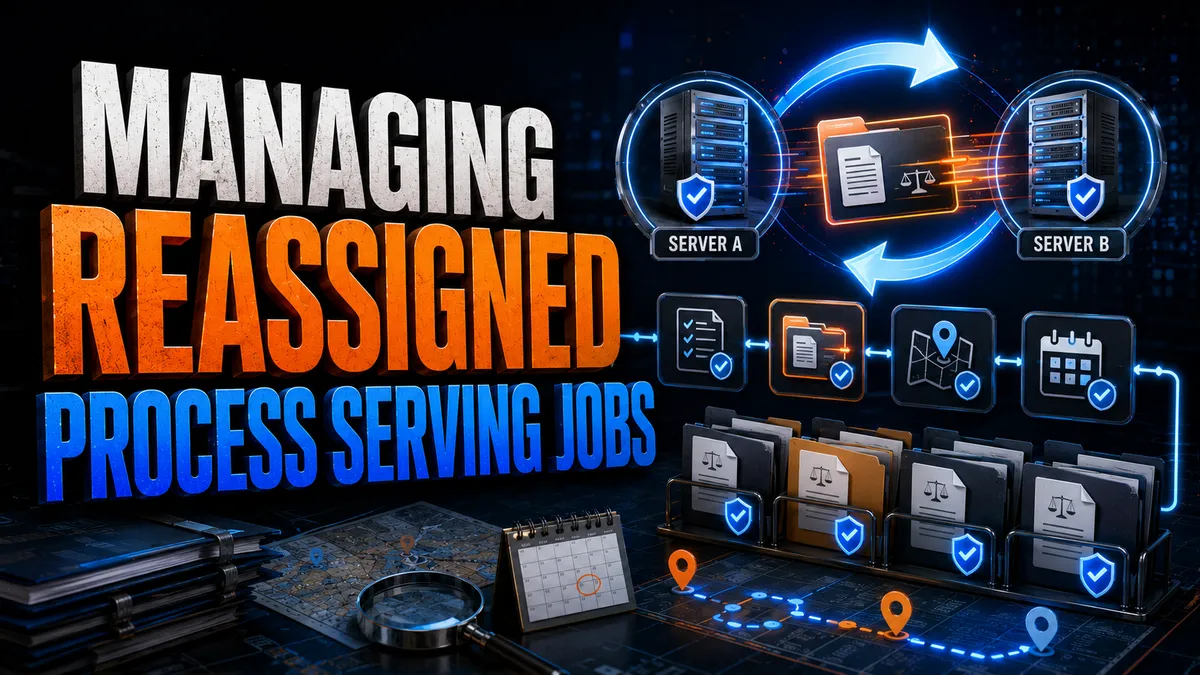
Managing Reassigned Process Serving Jobs
Jobs get reassigned. It happens every week in this business. Your server gets sick, the defendant moves two counties over, the attorney calls with a rush, or the guy on the porch has seen your server's car four times and won't come to the door anymore.
None of that is a failure. What turns it into a failure is a sloppy handoff. A new server who doesn't know what's already been tried. Two servers knocking on the same door on the same night. An affidavit signed by somebody who wasn't there. A bill nobody agreed to.
I built a process serving company that ran 30 or 40 serves a day, and I sent a lot of work out to other servers. Some of those handoffs went great. Some of them taught me lessons the hard way. Here's how to move a job from one server to another without hurting the case, the client, or your reputation.
By Mighty Mike Reid
The Ball's in Your Court Until the Proof Is Filed
Here's the rule I learned building my company. When a client sends you a job and you say "received," the ball's in your court. It stays there until the hearing date, until you hand back a proof of service, ideally a filed proof of service.
Reassigning the job doesn't hand the ball to somebody else. It's still your client and still your name on the line. The new server is doing the serving, but you own the result. Keep that in your head through every step below.
Why Jobs Get Reassigned
The usual reasons:
The original server gets sick or can't work
The recipient moves to another county or state
The address is outside the server's coverage area
A rush deadline needs somebody closer
The server has a conflict of interest
Safety concerns stop further attempts
The client asks for a different server
The job needs a special license, registration, or skill
Bad weather makes the trip impossible in time
The original server can't make the deadline
The server is buried and can't give the job real attention
The recipient knows the original server on sight and is dodging
That last one is more common than people think. Once somebody has your car memorized, a fresh face in a different car can get it done on the first try.
Make the Call Early
The worst time to reassign is two days before the hearing. The new server walks in with no time to plan, no time to learn the subject's schedule, and no room for a second attempt.
As soon as you see a real problem, stop and look at:
The actual service deadline
The hearing date
What attempts are already done
Where the recipient really is now
How confident you are in the address
Why the original server can't keep going
What qualifications the new jurisdiction requires
Whether the client has to approve the change
What it's going to cost
How long it takes to get the documents to the new server
If the time left isn't realistic, call the client today. Don't wait. The attorney may need to ask the court for more time or look at another legal way to serve. They can't do either if you sit on bad news.
Do You Even Have Permission to Hand It Off?
Not every client lets you send their work to another server. Read the client agreement, the dispatch instructions, and any court order before you move a thing.
Confirm:
Whether the client allows subcontracting
Whether they need to approve it in writing
Whether the new server has to be licensed or registered
Whether a special court appointment is required
Whether the documents can be shared with an outside server
Whether the client has to sign off on extra fees
Whether the new server carries the insurance the client requires
Whether the new server has any conflict with the parties
The baseline federal rule is pretty simple. Under Federal Rule of Civil Procedure 4(c)(2), any person who is at least 18 and not a party to the case can serve a summons. But states and counties pile their own rules on top. In New Mexico you basically need to be 18 and not a party. California requires registration once you serve more than 10 papers a year for pay. Texas has statewide certification. In Florida, private servers are generally certified through the circuit's chief judge or appointed by the sheriff, and that's tied to a specific circuit or county. New York City requires a license from the city. So when a job crosses a county or state line, check what the new location requires before you dispatch, not after.
When in doubt, get it in writing. A one-line email from the attorney saying "yes, go ahead and use your server in Tulsa" saves you a lot of grief later.
Picking the Replacement Server
Here's how I ran it once I had help. For less than $1,200 a month, I had virtual assistants taking jobs as they came in and routing them to the right server for each area. A lot of people route by ZIP code. I liked a priority list instead. For each area, server one, server two, server three. I called ahead of time and knew each server's pricing, so the VA wasn't guessing. Maybe server one is $70 and server two is $85. Price isn't always the most important thing, but you want to know it before the job goes out, not after.
What you want to know about every server on your list:
Where they cover
License or registration
Availability right now
Experience
Insurance
Languages
Special skills
Standard rates
Whether they can handle rush work
How to reach them
How they've performed for you before
The closest server isn't always the right one. A tough job might need somebody who knows gated communities, rural property, corporate service, high-risk situations, or a particular courthouse. And make sure they can actually start in time. A great server who can't get there till next Thursday doesn't help you on a Tuesday deadline.
Sometimes the right "server" isn't a private server at all. When I had a job way up in the mountains where I didn't have anybody, I'd hire the sheriff's office for my client. About $40, and they can't charge you more just because it's up in the mountains. Know your options.
Reciprocal Rates and Affiliates
When I was building ABQ Server, a pro per found my online order form and paid $147 for a job. They wanted it e-filed, served, and skip traced, and the addresses were out in the middle of nowhere. Drive two and a half hours to serve one paper? Not happening. My time is the most valuable thing I have.
So I found a server who knew everybody in the state and offered reciprocal rates. I'll do his jobs in my area for $70, he'll do mine in his area for $70. Rule number one is never lose money. But if I can break even, or make $5 or $10 on a paper, and not drive across the state, I'll do that all day. And the jobs he sends me back in the East Mountains, where nobody else serves, keep me busy in my own backyard.
I've got friends running companies in Los Angeles and San Diego who trade with each other at $25 a serve. Sounds low, but they each send the other thousands of jobs, and now each one looks like a big company that covers both cities.
One warning from experience. A reciprocal deal only works if everybody in the other company knows about it. I've called partners, gotten their front desk, and been quoted full rate because nobody told the staff we had an agreement. If you have affiliates, put them on a list your whole office can see. If you're the affiliate, ask to be put on that list.
Audit the File Before It Moves
Every reassignment starts with a file check. Confirm:
The right court and case number
The recipient's full name
The correct set of documents
The service address
Any alternate addresses
The deadline and the hearing date
How many attempts are required, and when
What service methods are allowed
Any mailing requirements
Safety concerns
How the client wants updates
What the affidavit has to say
Any special instructions from the court
Fix anything missing or conflicting before the new server gets the job. Not halfway through the first attempt.
Hand Over the Whole History
The new server needs everything the last one learned. Otherwise they repeat the same dead-end attempts and the client pays for it twice.
The handoff should include:
Date and time of every attempt
What address checks turned up
Cars seen at the property
Descriptions of people who answered or were seen
What residents or neighbors said
Gate codes and access notes
Photos, where allowed
Known work schedules
Safety warnings
Any signs the person is avoiding service
New address leads
Instructions the client already gave
This is where a lot of old-school servers fall down. You'll get notes that say "No answer. No answer. No answer." That's not a history, that's nothing. What did the neighbor say? Did you take pictures of the cars or the house? I've had servers tell me, "Well, you don't pay me to do that." Yes, actually, I do. I pay you to be a good process server who gets the job done.
When I take a job, I want to answer four questions. Do they work? What hours? What car do they drive? Do we have a picture of them? If the original server figured out any of those, the new server needs it on day one.
One more thing. The original server's notes stay labeled as the original server's notes. The new server can use them for planning, but they can't turn around later and swear to things they didn't see themselves.
Draw a Clear Line on When the Handoff Happens
The worst reassignment mess is two servers working the same job at the same time with nobody coordinating. Duplicate attempts, two conflicting affidavits, double billing, and a confused defendant who now thinks the whole county is after him.
Put the transfer in writing:
When the original server has to stop
When the new server can start
Who owns the job right now
Who talks to the client
Where new information goes
Whether the original server can keep doing research
If the paper gets served in the middle of the handoff, everybody stops and calls the office right away. No second attempts, no "just in case" drive-bys.
Status Is the Job
An attorney once vented to me about the server he'd just fired. "He's got one job. Serve the paper, sign the proof of service, and communicate status. That's it." I've never forgotten it.
Reassigned jobs are where status falls apart. Now you've got a server who isn't you, working for a client who isn't theirs. Here's what I learned. If your attorney has to call you asking what's going on, you've already failed. There's no wow factor when the client has to chase you. You want them to hear from you before they think to ask.
So I got clear with affiliate partners up front. Once we had a little relationship going, I'd say something like this: "I don't want to bug you. You don't want me bugging you. But would you agree my client deserves a status update every day you're serving, especially on a rush?" They always say yes. "Okay. So if I have to email you for status, let's take $5 off your pay every time I have to ask. Does that sound fair?"
Here's the crazy part. Some servers can't agree to that. They already know they won't make an attempt every day, even if they say they will. Better to find that out before you hand them your client's job.
It cuts the other way too. I've had coordinators at big serving companies call me every single day on a job they sent me. Did you make the attempt? What time? Can you just tell me now? On a same-day job I'm hitting it once a day, at different times, and the update goes in the system as soon as I'm back at the office. I finally told one of them that if she called again, I'd start adding $5. If you're the one sending work out, set up a system that pushes updates to you so you're not chasing your server by phone all day.
The client should hear:
Why the job is being reassigned
What's happened on the attempts so far
Who the new server or company is
The new coverage area
When to expect attempts
Any worry about the deadline
Any added cost
What info you still need from them
And don't trash the original server to the client. Unless there was real misconduct the client needs to know about, keep the focus on getting it served.
Keep the Documents Locked Down
Legal files carry personal, financial, and sometimes medical information. Send them through a secure system, not an open link, a personal email account, or a texting app.
Before the new server goes out, confirm:
Who the new server really is
The right account or email address
Who has access to the files
That the documents were received
The page count
Which version is the current one
That any temporary links expire
That old duplicate files are cleaned out
Have the new server check the documents against the job sheet before the first attempt.
Don't Serve the Wrong Version
Reassignments are a prime spot for wrong-document service. The first server got one version. Then the client sent an amended summons, complaint, subpoena, or notice. Now there are two packets floating around.
Figure out which version is live and pull the old one out of the dispatch package. Check:
Document title
Filing date
Page count
Recipient name
Case number
Exhibits
Required notices
Translated copies
Court seal or clerk's signature, where required
And the new server shouldn't build a packet by grabbing documents out of three different emails. If it's not one clear set, ask.
Agree on Money Before Anybody Moves
Settle the rate before the new server starts. Cover:
Base fee
Attempts included
Rush fee
Mileage
Rural travel
Wait time
Skip tracing
Printing
Mailing
Notarization
Affidavit prep
Cancellation fee
Also decide what happens with the work the original server already did, according to your agreement with them.
I care about this one a lot. My first business partner, Diane, died of cancer while big serving companies owed her tens of thousands of dollars. They'd pay her just enough to keep her going while the balance kept growing. Clear payment terms up front are how you protect the people doing the work, and yourself.
Who Signs the Proof
The person who served the papers signs the proof describing that service. A replacement server doesn't swear to somebody else's observations. Ever.
I've worked with big companies that want to do the proof themselves on jobs I served for them. Think about that for a second. Why would you write the proof when somebody else served it? It makes a lot more sense for the person who served it to sign it.
If the first server made unsuccessful attempts and the second server completed service, you may need separate documentation for each. The file should show clearly who did what.
The final proof should accurately state:
Date and time
Location
How it was served
What documents were delivered
Who received them, or the substitute recipient
Any required mailing
The server's qualifications
What Attorneys and Firms Should Ask When a Job Gets Reassigned
If you're the attorney or paralegal hiring the server, a few questions keep you protected:
Did you ask me first? If your agreement requires approval to subcontract, you should get a call or an email before your job goes anywhere.
Who's serving it now, and are they qualified there? Ask for the new server's name and confirm they're licensed or registered where they're serving.
Did the new server get the full history? Ask whether the prior attempt notes, photos, and schedule info went with the job.
Which document version did they get? If you filed an amended pleading, make sure the old one is gone.
Who signs the proof? It should be the person who actually served it.
What's this going to cost? Out-of-area and rush work can change the price. Get it before the job moves, not on the invoice.
When the Recipient Moved Out of State, or Out of the Country
Out of state means new rules, new qualifications, new costs, and maybe a new deadline. Tell the client, then check what the new jurisdiction requires.
Out of the country is a bigger shift. Countries that signed the Hague Service Convention have their own approved channels, and the attorney needs to pick the right method before anybody knocks on a door overseas. Get the attorney's direction in writing first.
Where Mighty Process Server Fits
All of this is easier when the job lives in one place instead of in a pile of emails and text messages. Mighty Process Server keeps every attempt, note, GPS location, and photo on the job record. When a job changes hands, the history is already there. The new server isn't working off "No answer. No answer. No answer."
Every server and sub-user has their own login tied to their own name and email, so the record shows who made which attempt. That's exactly what you want when it's time to decide who signs what.
Clients get their own private portal, so the attorney can see status without calling you. That's the wow factor I was talking about. When service is done, the affidavit builds right from the job record, and if it needs a notary, the Mighty Notary integration gets it signed and notarized right in the app.
And when the recipient moves out of your area, you don't have to start calling around. The address search covers more than 171,000 cities worldwide. Servers set their pricing area by area or upload a fee schedule as a CSV, and clients get an instant quote. So when your defendant turns up in Phoenix or Manchester, you can find a local server there and order the serve on the spot, with the price known up front.
Check It Before You Close It
Before you close a reassigned job, look over:
The service method
How identity was confirmed
The full document list
The attempt notes
Any required mailing
Photos, where allowed
The affidavit, for accuracy
The client's instructions
The final invoice
The full reassignment history
This last look catches mistakes before the proof gets filed with the court.
Quick FAQ
Can a job be reassigned without client approval? It depends on your agreement. If it's not clear, get written approval.
Can the new server use the original server's notes? Yes, as background. They can't swear to observations they didn't make.
Who signs the proof of service? The person who actually served it, in general.
What if the recipient moved out of state? Tell the client, then check the rules, qualifications, costs, and deadlines where they live now.
What's the best way to stop duplicate attempts? Set a written cutoff time and keep the job in one platform with real-time status.
The Bottom Line
A reassigned job is still your job. The strongest handoff has permission to move the work, the whole attempt history, the right documents, the price agreed up front, and a clear moment when responsibility changes hands.
Building a company you could sell someday comes down to this stuff. Having the hard conversations with your servers up front, so you can count on them to serve it and make you look like a rock star. Get it served, keep your client in the loop, and the rest falls into place.
Stay sharp. Stay informed. Live Mighty!
Read the full article at www.mightyprocessserver.com
This article is published by Process Server Daily, powered by MightyAutomation.ai, the leader in legal support intelligence.