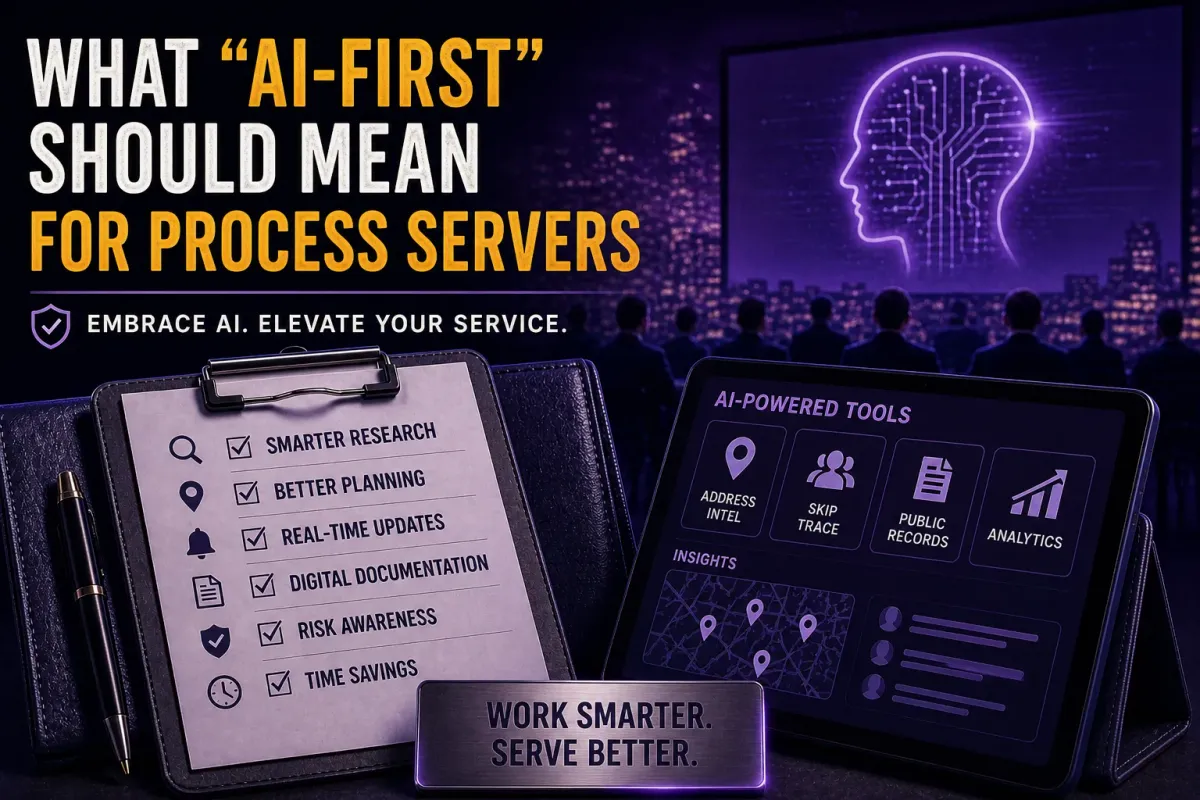
What “AI-First” Should Mean for Process Servers
Artificial intelligence is changing how legal support professionals manage information, automate repetitive work, and maintain quality control. For process serving companies, however, becoming “AI-first” should not mean adopting every new technology or removing people from critical decisions.
An AI-first approach to process serving should mean using artificial intelligence where it can produce measurable operational improvements: cleaner intake data, fewer errors, faster workflows, stronger documentation, and better compliance controls.
Process serving depends heavily on accurate information. A wrong address, duplicate party record, inconsistent case number, missing attempt note, or incomplete affidavit can delay a case and create problems for both the process server and the client.
Used responsibly, AI in process serving can help identify those problems before they become costly.
What Does AI-First Mean in Process Serving?
AI-first process serving is an operational strategy in which firms look for appropriate opportunities to use artificial intelligence and automation throughout the lifecycle of an assignment while keeping trained professionals responsible for important decisions.
The objective is not maximum automation. It is better process control.
For process servers, AI-first operations may include:
Detecting duplicate parties, addresses, or assignments
Flagging inconsistent case information before dispatch
Identifying missing affidavit fields
Reviewing attempt notes for incomplete information
Automating routine client status updates
Prioritizing assignments based on deadlines or workflow rules
Supporting route and dispatch planning
Identifying patterns across unsuccessful service attempts
Performing quality-control checks before affidavits are finalized
This approach allows artificial intelligence for process servers to function as an operational assistant rather than a substitute for professional judgment.
Why AI Matters to Process Serving Companies
Process serving is fundamentally an information-driven business.
Before a server ever approaches a residence or business, information typically passes through several stages:
Client intake → case review → address verification → dispatch → service attempts → documentation → affidavit preparation → client reporting
An error introduced early in that chain can affect everything that follows.
Consider an assignment submitted with a slightly different spelling of a defendant's name than another open job. A traditional workflow may treat those records as unrelated. An AI-assisted system could flag the similarity for staff review.
Likewise, software could identify that an address in one field does not match the address appearing elsewhere in the assignment.
These are relatively small interventions, but at scale they can prevent significant operational problems.
That is where AI-driven process serving offers the greatest value: finding inconsistencies while there is still time for a human to correct them.
7 Practical Uses of AI in Process Serving
1. Data Hygiene Before Dispatch
One of the strongest applications of AI in process serving is improving data quality before an assignment reaches the field.
AI-assisted validation systems can flag potential issues involving:
Misspelled or inconsistent names
Duplicate assignments
Incomplete addresses
Conflicting ZIP codes
Missing case numbers
Formatting inconsistencies
Duplicate documents
Required fields that were left blank
Instead of discovering these issues after an unsuccessful attempt, staff can review them during intake.
2. Duplicate Record Detection
High-volume process serving operations may receive hundreds or thousands of assignments from multiple clients.
Duplicate detection becomes increasingly difficult as volume grows.
AI and matching algorithms can compare names, addresses, case numbers, phone numbers, and other permitted data points to identify records that may refer to the same individual or assignment.
The system does not need to decide that two records are identical. It can simply flag the potential match for human review.
3. Smarter Affidavit Quality Control
Affidavits and proofs of service are among the most important documents produced by a process serving company.
AI-assisted quality-control tools can help check whether expected information is present before a document moves to final review.
Depending on applicable requirements and the firm's workflow, systems might flag:
Missing dates
Missing attempt times
Incomplete descriptions
Inconsistent addresses
Missing service details
Contradictory notes
Blank required fields
A trained professional should still review the final document, but automated checks can provide an additional layer of quality control.
4. Better Attempt-Note Review
Field notes often contain valuable information that affects future service attempts.
AI can potentially help categorize and organize those notes, making it easier for dispatchers and managers to recognize recurring patterns.
For example, a system might surface repeated references to:
Vacant properties
Gated access
Incorrect addresses
Workplace information
Building access restrictions
Occupancy indicators
Repeated unsuccessful time windows
Rather than replacing a server's assessment, AI can help teams organize information that already exists in the file.
5. Workflow and Deadline Automation
Not every useful AI implementation needs to be sophisticated.
Some of the most valuable process server automation involves straightforward workflow management.
Systems can help identify:
Assignments approaching deadlines
Jobs waiting too long for dispatch
Missing status updates
Incomplete documentation
Affidavits awaiting review
Assignments requiring client instructions
The result can be fewer administrative bottlenecks and more consistent service.
6. Client Communication
Clients increasingly expect timely visibility into their assignments.
Automation can generate routine notifications when predefined events occur, such as:
Assignment received
Assignment dispatched
Attempt completed
Service completed
Additional information required
Affidavit available
AI may also help summarize lengthy case histories for internal review, provided the technology is approved for handling the relevant information and the output is verified before use.
7. Operational Analytics
As firms accumulate service data, AI-assisted analytics may help identify patterns that are difficult to see manually.
A company might analyze its own records to evaluate:
Average time to successful service
Frequency of bad addresses
Assignment turnaround times
Documentation error rates
Reattempt patterns
Client-specific workflow bottlenecks
These insights can help managers improve operations without automating the professional decisions that belong with trained staff.
Key Benefits of AI for Process Servers
The most important AI benefits for process servers are not futuristic. They are practical business improvements.
Improved Accuracy
AI-assisted validation can identify inconsistencies before they create downstream problems.
Faster Turnaround
Automating repetitive administrative work can reduce manual data entry and allow staff to focus on assignments requiring judgment.
Stronger Documentation
Automated completeness checks can help ensure service records contain the information expected by internal policies, clients, and applicable rules.
Fewer Preventable Errors
Duplicate detection, validation rules, and exception alerts can provide additional safeguards against common administrative mistakes.
Greater Scalability
As assignment volume increases, automation can help firms maintain standardized workflows without requiring every administrative task to grow proportionally.
Better Client Experience
Consistent reporting, cleaner records, and faster status updates can strengthen relationships with attorneys, law firms, collection firms, agencies, and other clients.
AI Tools for Process Servers: What Should Firms Look For?
The best AI tools for process servers are not necessarily the tools with the longest feature lists.
Firms should prioritize technology that solves identifiable operational problems.
Useful capabilities may include:
Case management and document management
Intelligent data validation
Duplicate detection
Route optimization
Automated workflow alerts
Affidavit quality-control checks
Client status automation
Secure document processing
Searchable assignment histories
Reporting and operational analytics
Before adopting a platform, firms should also consider its security practices, access controls, audit capabilities, integrations, data retention policies, and suitability for confidential legal information.
Responsible AI Use: Privacy and Compliance Come First
Process serving records can contain sensitive information, including names, home addresses, legal allegations, financial information, phone numbers, dates of birth, and other case-related data.
That makes responsible AI use in legal services essential.
An AI-first process serving company should establish clear guardrails, including:
Use only approved systems for client and case information.
Understand how vendors store, process, and retain submitted data.
Restrict access according to employee roles.
Maintain appropriate audit trails.
Avoid entering confidential case information into unapproved public AI systems.
Require human review of important AI-generated outputs.
Follow applicable court rules, laws, contracts, and client requirements.
Establish procedures for correcting inaccurate AI-generated information.
AI output should never automatically be treated as fact simply because a computer generated it.
Human-in-the-Loop AI Is Critical
One of the most important principles for legal support companies is human-in-the-loop AI.
AI may be excellent at identifying patterns, inconsistencies, and missing fields. It can still misunderstand context or produce inaccurate conclusions.
That distinction matters enormously in process serving.
A system might flag two similar names as duplicates, but they could belong to different people. An automated review might identify an address inconsistency without understanding why the difference exists.
The appropriate workflow is often:
AI detects → human reviews → human decides → system records
This model combines the speed of automation with professional accountability.
AI Challenges Process Serving Firms Must Consider
Despite its potential, AI introduces risks that should be addressed before deployment.
Common AI challenges in process serving include:
Confidentiality and privacy concerns
Incorrect or fabricated AI outputs
Poor-quality source data
Integration difficulties
Staff training requirements
Technology costs
Vendor dependence
Inadequate audit trails
Overreliance on automation
There is also a simple principle that every firm should remember: AI cannot repair bad data merely by processing it faster.
If the information entering a system is unreliable, automated outputs may amplify rather than eliminate errors.
How to Implement an AI-First Process Serving Strategy
Process serving companies do not need to transform their entire operation at once.
A better strategy is to start with specific, measurable problems.
Step 1: Map the Existing Workflow
Document what happens from assignment intake through final reporting.
Identify where staff spends significant time on repetitive work and where errors occur most frequently.
Step 2: Identify High-Value Automation Opportunities
Look for tasks that are repetitive, rules-based, and easy to verify.
Good starting points might include duplicate detection, missing-field alerts, deadline reminders, or status notifications.
Step 3: Establish Data and Privacy Rules
Determine what information can be processed by each system and who is authorized to access it.
Step 4: Keep Humans in Critical Decisions
Define which AI outputs require staff review before any action is taken.
Step 5: Train Employees
Employees should understand both what the technology can do and where it can fail.
Step 6: Measure Results
Track metrics such as:
Intake error rates
Affidavit correction rates
Assignment turnaround time
Administrative processing time
Missing documentation
Client response times
Step 7: Expand Only When the Results Justify It
Successful AI adoption should be driven by measurable improvements, not pressure to use AI everywhere.
What AI-First Should Not Mean
AI-first should not mean:
Automatically trusting AI-generated information
Replacing experienced process servers with software
Uploading confidential case files into unapproved systems
Automating legal or factual conclusions without review
Collecting more personal information simply because technology makes it possible
Sacrificing auditability for speed
Using AI as a marketing label without measurable operational improvements
The distinction is important.
A technology-first company asks, “Where can we use AI?”
A strong AI-first process serving company asks, “Where can AI make this workflow more accurate, efficient, secure, and defensible?”
The Future of AI in Process Serving
The future of process serving technology will likely include deeper automation, better data validation, more sophisticated workflow analytics, and stronger integrations between client systems and service platforms.
However, professional judgment will remain essential.
Process serving involves real people, changing environments, jurisdiction-specific requirements, and facts that software may not fully understand. Technology can organize information and highlight potential issues, but professionals remain responsible for interpreting circumstances and following applicable rules.
The firms best positioned for the future will therefore combine three capabilities:
technology + professional judgment + documented controls
That combination is more valuable than automation alone.
Frequently Asked Questions About AI in Process Serving
Can AI replace process servers?
AI can automate administrative and quality-control tasks, but physical service, situational judgment, legal compliance, and many field decisions still require qualified professionals.
How can process servers use AI?
Process servers and their firms can use AI for data validation, duplicate detection, workflow management, document review, operational analytics, client communications, and other administrative functions where appropriate.
Is AI safe for confidential legal documents?
That depends on the system. Firms should evaluate security, privacy, retention, contractual protections, access controls, and applicable client or legal requirements before submitting confidential information to any AI platform.
Can AI help prevent service errors?
AI-assisted tools can flag missing information, inconsistencies, duplicates, and unusual records for human review. They can reduce some preventable errors, but they cannot guarantee valid service.
What is AI-first process serving?
AI-first process serving is an operational approach that uses artificial intelligence and automation strategically to improve data quality, workflow efficiency, documentation, and quality control while maintaining human oversight.
Conclusion: AI-First Means Better Systems, Not Less Human Judgment
Becoming AI-first does not require a process serving company to automate everything.
It requires the company to examine its workflows and identify where technology can produce meaningful improvements without compromising accuracy, privacy, compliance, or professional judgment.
Used responsibly, AI in process serving can help firms maintain cleaner data, detect preventable errors, accelerate routine workflows, improve documentation, and provide clients with more consistent service.
But the strongest process serving companies will not be those that simply use the most AI.
They will be the companies that build AI-assisted, human-verified, and audit-ready workflows that clients can trust.
That is what AI-first should mean for the modern process server.
Stay sharp. Stay informed. Live Mighty!
Read the full article at www.mightyprocessserver.com
This article is published by Process Server Daily, powered by MightyAutomation.ai, the leader in legal support intelligence.