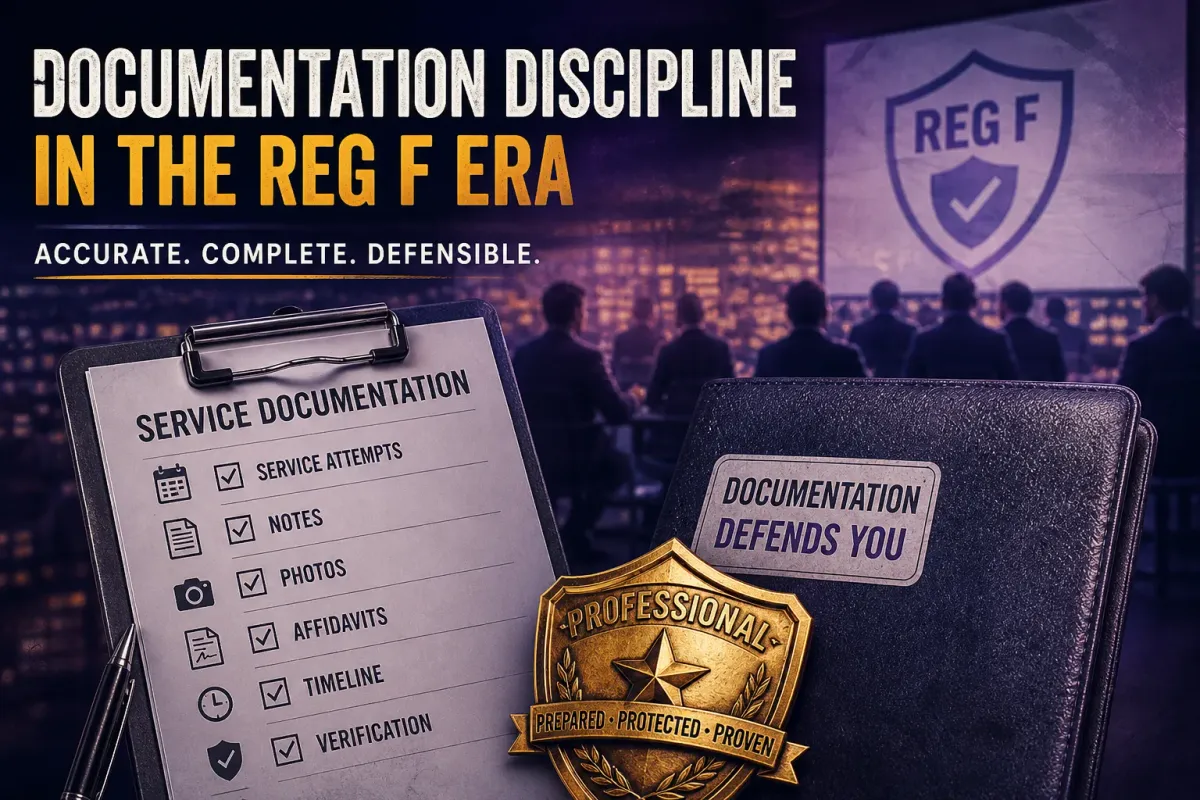
Regulation F and Process Server Documentation: Building Defensible Service Records
Debt collection compliance has changed significantly in the Regulation F era. Although process servers generally are not acting as debt collectors simply by serving legal documents, they operate within a litigation ecosystem where collection agencies, creditors, and law firms face substantial federal and state regulatory scrutiny.
That makes process server documentation increasingly important.
When collection litigation reaches the service-of-process stage, the quality of the service record can affect everything that follows. Incomplete attempt notes, inconsistent timestamps, weak affidavits, or poorly maintained records can create questions about whether service was properly completed. Strong documentation, by contrast, gives attorneys and clients a clearer record to rely on if service is later challenged.
For professional process servers, the lesson of the Regulation F era is straightforward: document every assignment as though the service record may eventually be examined by a client, court, regulator, or opposing attorney.
What Is Regulation F?
Regulation F, commonly called Reg F, is the Consumer Financial Protection Bureau's regulation implementing the Fair Debt Collection Practices Act (FDCPA). The CFPB's debt collection rules became effective on November 30, 2021.
Regulation F addresses numerous aspects of debt collection activity, including:
Consumer communications
Telephone call frequency
Electronic communications
Validation information
Limited-content messages
Consumer requests to stop certain communications
Record retention
Harassment and abusive collection practices
The regulation primarily governs debt collectors subject to the FDCPA. It does not automatically turn a process server into a debt collector, nor does it establish a universal federal documentation standard for serving legal process.
However, Regulation F is still relevant to the process-serving industry because it has contributed to a broader compliance environment in which collection firms and their attorneys increasingly value accurate, organized, and defensible records.
How Does Regulation F Affect Process Servers?
For most process servers, the connection to Regulation F is indirect.
A process server may receive an assignment from a collection law firm handling an FDCPA-regulated account. That firm may have its own compliance obligations, document-retention policies, litigation controls, and vendor-management requirements.
The process server's records can become part of that larger case file.
If service is later disputed, attorneys may need to reconstruct:
When the assignment was received
Which addresses were attempted
When each attempt occurred
What the server observed
How service was completed
Who received the documents
What evidence supports the affidavit
Whether the service record contains inconsistencies
For that reason, debt collection process serving requires documentation practices capable of supporting both procedural compliance and case defensibility.
Why Process Server Documentation Matters
Every service attempt creates evidence.
The quality of that evidence can become critical if a defendant files a motion challenging service, disputes an affidavit, or claims that the lawsuit was never properly served.
Depending on the jurisdiction and circumstances, relevant records may include:
Affidavits or proofs of service
Attempt notes
Dates and timestamps
Photographs
GPS or location records
Physical descriptions
Address verification information
Assignment histories
Client instructions
Status updates
Electronic audit trails
The objective is not to collect data simply for the sake of collecting it. The objective is to create an accurate record showing what happened, where it happened, when it happened, and how the server knows it happened.
Good documentation strengthens credibility.
Poor documentation creates questions.
The Risk of "Sewer Service" Allegations
Few allegations are more damaging to the process-serving profession than "sewer service"—the claim that legal papers were never actually served despite documentation stating otherwise.
These allegations can have serious consequences in collection litigation, particularly when disputed service contributed to a default judgment.
A challenged service record may draw attention to problems such as:
Missing attempt details
Incomplete or contradictory affidavits
Impossible or questionable timelines
Incorrect addresses
Inconsistent recipient descriptions
Missing supporting documentation
Poorly maintained electronic records
Not every jurisdiction requires photographs, GPS data, or the same level of supporting evidence. Process servers should always follow applicable court rules, statutes, licensing requirements, privacy laws, and client instructions.
Where additional documentation is legally permitted and appropriately maintained, however, corroborating evidence can make the service record easier to verify.
5 Documentation Practices That Reduce Service-of-Process Risk
1. Write Attempt Notes Like They May Become Evidence
Attempt notes should be factual, specific, and contemporaneous.
Instead of writing:
"No answer."
A stronger record might identify the relevant facts:
"Attempted service at 7:18 p.m. at the listed residential address. Knocked at the front entrance and received no response. Exterior lights were on. No individual was observed."
The goal is not to add unnecessary detail. It is to preserve meaningful observations while they are fresh.
Useful information may include:
Date and time
Exact service location
Type of property
Method of attempted service
Relevant observations
Description of the person contacted
Statements made by occupants, when relevant
Access restrictions
Unusual circumstances
Avoid speculation. Document what was actually observed or communicated.
2. Capture Photographic Corroboration When Appropriate and Permitted
Photographs can provide useful context for a service attempt.
Depending on local law, client requirements, privacy considerations, and the circumstances, useful photographs might document:
Street numbers
Building identifiers
Exterior property features
Apartment directories
Entry gates
Posted notices
Other location-identifying details
A photograph should support the service record rather than replace written documentation.
Servers should also understand applicable restrictions before photographing people, private areas, access-controlled locations, or other sensitive subjects.
3. Preserve Reliable Time and Location Data
Digital timestamps and location information can provide another layer of corroboration.
Where legally permitted and required by applicable rules or company policy, technology may help record:
Arrival times
Attempt times
GPS coordinates
Photograph timestamps
Status-update times
Affidavit preparation dates
This information can be particularly valuable when reconstructing an assignment months or years later.
The integrity of the data matters as much as its existence. Firms should consider how records are generated, whether they can be altered, how changes are logged, and how long the information is retained.
4. Use a Chain-of-Custody Mindset
Process servers handle documents that may ultimately become important components of litigation.
Each assignment should therefore have a clear history.
Depending on the firm's workflow, the record might show:
When the assignment was received
Who received it
Which documents were provided
What service instructions applied
Which server received the assignment
When attempts occurred
When client instructions changed
Who completed service
When the affidavit was prepared
Whether corrections were made
When the final record was returned
This creates an audit trail for service of process that makes it easier to understand exactly how an assignment moved through the organization.
5. Review the Record Before Finalizing the Affidavit
An affidavit should not be treated as an administrative afterthought.
Before signing or submitting a proof of service, compare it against the underlying records.
Check:
Names
Addresses
Dates
Times
Service method
Recipient descriptions
Attempt history
Document names
Jurisdiction-specific requirements
A simple quality-control review can catch inconsistencies before they become part of the court record.
Process Server Documentation Checklist
A standardized checklist can help firms create consistent files across multiple servers and jurisdictions.
Before closing an assignment, verify that the file contains, where applicable:
Correct case and party information
Complete service address
Date and time for every attempt
Clear, factual attempt notes
Recipient or contact description
Method of service
Supporting photographs when permitted or required
GPS or location records when permitted or required
Changes to client instructions
Complete assignment history
Accurate affidavit or proof of service
Quality-control review
Records stored according to applicable retention requirements
A repeatable checklist makes documentation discipline part of the workflow rather than something performed only after a problem arises.
Best Practices for Accurate Process Server Records
Document Attempts Immediately
Details become less reliable as time passes. Servers should enter notes as soon as practical after an attempt rather than reconstructing events later.
Use Standardized Documentation
Consistent templates help prevent important information from being omitted.
Standard fields can capture:
Date
Time
Location
Attempt result
Person contacted
Service method
Observations
Supporting evidence
Separate Facts From Assumptions
Documentation should distinguish between what the server observed and what the server believes.
For example, "A vehicle was parked in the driveway" is an observation.
"The defendant was hiding inside" is speculation unless supported by additional evidence.
Objective reporting makes service records more credible.
Correct Errors Transparently
Mistakes can happen. Quietly altering records can create a much larger problem.
Firms should maintain procedures for documenting corrections, identifying who made them, and preserving an appropriate audit history.
Conduct Regular Quality Audits
Periodic file reviews can identify recurring problems before they become serious.
Audit for issues such as:
Missing timestamps
Incomplete descriptions
Conflicting dates
Repeated vague notes
Missing affidavits
Incorrect addresses
Documentation gaps
These reviews can also identify opportunities for additional training.
How Technology Improves Service-of-Process Documentation
Modern process server technology can make documentation faster and more consistent, but technology should support professional judgment rather than replace it.
Mobile Documentation Applications
Mobile process-serving platforms can allow field professionals to:
Enter notes immediately
Record attempt results
Capture photographs
Update clients
Generate reports
Maintain assignment histories
Real-time entry reduces dependence on handwritten notes and memory.
GPS Verification
Where legally permitted or required, GPS data can provide additional evidence that a server was near a particular location at a particular time.
GPS records should still be considered alongside the complete service record. Location data alone does not prove that legally valid service occurred.
Secure Cloud Storage
Centralized storage can make records easier to retrieve when an assignment is challenged long after completion.
Security should be a priority because service files may contain sensitive personal and legal information.
Important considerations include:
Access controls
Authentication
Encryption
Backup procedures
Retention policies
Audit logs
Secure deletion procedures
Workflow and Case Management Systems
Process-serving software can help firms standardize documentation across their operations.
Automated workflows may flag missing fields, track deadlines, preserve assignment histories, and help supervisors conduct quality-control reviews before files are closed.
The strongest technology is technology that improves both efficiency and defensibility.
What Are the Consequences of Poor Process Server Documentation?
Weak records can create problems even when the underlying service was valid.
Potential consequences include:
Challenges to service
Motions to vacate default judgments
Delayed proceedings
Repeat service costs
Additional attorney time
Client complaints
Lost collection opportunities
Regulatory or compliance concerns for clients
Damage to the server's professional reputation
In serious cases, inaccurate documentation can raise questions about the credibility of other assignments handled by the same individual or company.
Documentation is therefore more than an administrative function. It is a form of risk management for process servers.
Regulation F, Vendor Management, and Collection Clients
One of Regulation F's broader lessons for legal support vendors is that sophisticated collection clients increasingly expect their partners to operate within structured compliance environments.
Law firms, creditors, and collection organizations may evaluate process-serving vendors based on factors such as:
Documentation quality
Data security
Record retention
Quality-control procedures
Complaint handling
Training
Technology
Audit capabilities
Compliance with jurisdiction-specific service rules
A process-serving company that can produce clear, organized, retrievable records is easier for a compliance-conscious client to manage.
That makes documentation discipline more than a defensive measure. It can also become a competitive advantage.
How MPS Supports Documentation Excellence
At MPS (Mighty Process Server), documentation quality is treated as a core component of professional process serving.
Standardized workflows, quality-control procedures, organized record management, and appropriate technology can help process servers create more consistent and defensible service files.
For collection law firms and other legal clients, reliable documentation provides greater visibility into what occurred in the field and makes it easier to evaluate a service attempt if questions arise later.
The objective is simple: create a record that is accurate, organized, professional, and capable of standing on its own.
Frequently Asked Questions About Regulation F and Process Servers
Does Regulation F Apply to Process Servers?
Regulation F primarily applies to debt collectors covered by the FDCPA. Process servers should not assume that every Regulation F requirement directly applies to their work. However, process servers working with collection firms may encounter client compliance requirements influenced by Regulation F, the FDCPA, state law, court rules, and vendor-management policies.
Does Regulation F Require Process Servers to Use GPS?
Regulation F does not create a general federal requirement that process servers use GPS to document service attempts. GPS requirements may arise from state or local law, licensing rules, court requirements, company policies, or client instructions.
Are Process Servers Required to Take Photographs?
There is no universal nationwide rule requiring photographs for every service attempt. Requirements vary by jurisdiction and assignment. Process servers should follow applicable law, court rules, privacy requirements, and client instructions.
How Long Should Process Servers Keep Service Records?
Record-retention requirements vary depending on jurisdiction, applicable regulations, contractual requirements, and company policy. Firms should establish a written retention schedule based on the requirements governing their operations rather than assuming that one retention period applies everywhere.
What Should Process Server Attempt Notes Include?
Strong attempt notes generally identify the date, time, location, result, relevant observations, persons contacted, and unusual circumstances. Notes should be factual, objective, and sufficiently detailed to help reconstruct the attempt later.
Documentation Discipline Is a Competitive Advantage
Regulation F does not create a blanket set of new service-of-process requirements for every process server. Its significance lies partly in the compliance environment surrounding modern collection litigation.
Clients increasingly need reliable vendors, and reliable vendors need reliable records.
Professional process servers can respond by creating detailed contemporaneous notes, preserving appropriate supporting evidence, maintaining clear assignment histories, reviewing affidavits carefully, and using technology that strengthens rather than complicates the audit trail.
When a service attempt is questioned months or years later, memory is rarely enough.
The record has to speak for itself.
For process servers working with attorneys, creditors, and collection firms, that is the real value of documentation discipline in the Regulation F era.
Stay sharp. Stay informed. Live Mighty!
Read the full article at www.mightyprocessserver.com
This article is published by Process Server Daily, powered by MightyAutomation.ai, the leader in legal support intelligence.