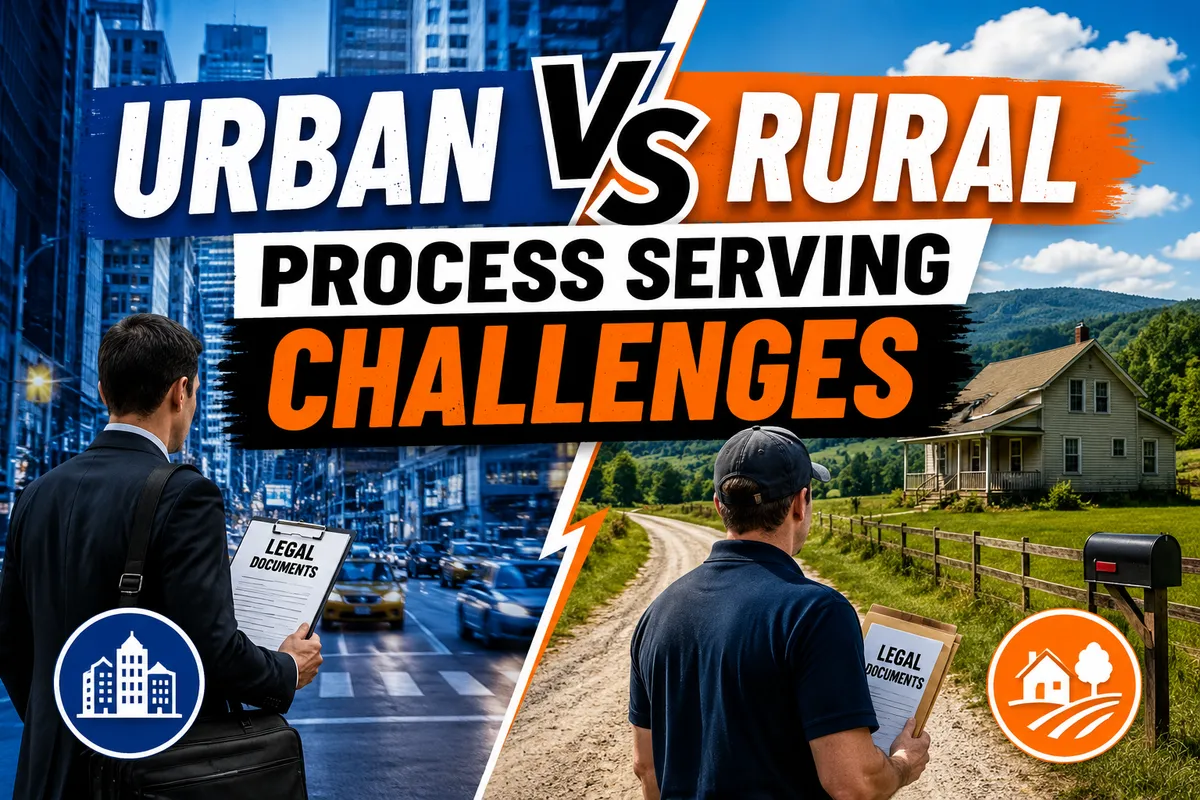
Urban vs. Rural Process Serving Challenges: What Every Process Server Should Know
Process serving can look very different depending on where an assignment takes place. Serving legal documents in a dense downtown neighborhood may involve traffic, secured buildings, parking restrictions, and apartment access. A rural assignment, meanwhile, can require long-distance travel, unreliable GPS directions, difficult roads, and limited cellular coverage.
Understanding urban vs. rural process serving challenges helps process servers plan assignments more effectively, reduce unsuccessful attempts, control travel costs, and provide more reliable service to attorneys, law firms, businesses, and other clients.
While every assignment is unique—and specific process serving laws vary by jurisdiction—the environment itself can have a major impact on how a process server prepares for and completes an attempt.
What Is the Difference Between Urban and Rural Process Serving?
The fundamental purpose of service of process does not change based on geography: legal documents must be delivered according to the rules governing the particular case and jurisdiction. What changes significantly is the logistics involved in reaching the recipient and documenting the attempt.
Urban process serving commonly takes place in environments with:
High population density
Apartment and condominium buildings
Office towers and commercial complexes
Heavy traffic and limited parking
Gated or access-controlled properties
Extensive public transportation
Frequent residential turnover
Rural process serving may involve:
Small towns and agricultural communities
Farms and ranches
Remote residential properties
Long distances between addresses
Private or unmarked roads
Limited cellular and internet coverage
Fewer nearby services
Weather-sensitive road conditions
These differences make route planning, address research, scheduling, and preparation especially important.
Common Urban Process Serving Challenges
1. Traffic Congestion and Travel Delays
Traffic is one of the most persistent urban process serving challenges. Rush hour congestion, construction, accidents, sporting events, road closures, and special events can turn a short trip into a lengthy delay.
Because a process server may have multiple assignments scheduled throughout the day, even one significant traffic delay can affect an entire route.
Useful strategies include grouping assignments geographically, using route optimization tools, checking traffic conditions before departure, and scheduling attempts outside peak congestion periods when practical.
2. Apartment Buildings and High-Rise Access
Process serving in cities frequently involves apartment buildings, condominiums, and high-rise residential complexes.
Potential obstacles include:
Locked entrances
Intercom systems
Security personnel
Concierge desks
Key-controlled elevators
Multiple towers or entrances
Incomplete apartment or unit information
Before an attempt, confirming the complete address—including unit number when applicable—can reduce wasted time.
Process servers should also understand the applicable rules governing access and service rather than assuming that a building employee or security professional must provide entry.
3. Limited and Expensive Parking
Finding legal parking can sometimes take longer than reaching the destination itself.
Urban process servers may encounter metered spaces, commercial loading zones, parking garages, permit-only areas, time restrictions, and strict parking enforcement.
Researching parking before arriving at a difficult location can save time and reduce unnecessary expenses. Servers handling multiple downtown assignments may also benefit from parking once and completing nearby attempts on foot when practical and safe.
4. Building Security and Access Restrictions
Office towers, corporate campuses, gated communities, government facilities, and luxury residential buildings may have extensive security procedures.
Process servers may need to communicate with security personnel, receptionists, property managers, or other authorized individuals while maintaining professionalism and complying with applicable laws.
Carrying appropriate identification and having accurate assignment information readily available can make these interactions more efficient.
5. Outdated or Incomplete Addresses
Urban populations can be highly mobile. A subject may have moved, changed apartments within the same complex, or provided an address that is no longer current.
Address verification before repeated attempts can prevent unnecessary travel. When permitted and appropriate, additional research or skip tracing may help identify a more current location.
Common Rural Process Serving Challenges
While city assignments can be slowed by congestion and building access, rural process serving challenges tend to revolve around distance, navigation, infrastructure, and accessibility.
1. Long Travel Distances
One of the biggest challenges of process serving in rural areas is the distance between assignments.
A server may drive many miles to reach one address and then travel a considerable distance to the next. This increases:
Fuel consumption
Vehicle wear
Travel expenses
Time per assignment
Cost of unsuccessful attempts
Efficient scheduling is therefore critical. Grouping rural assignments geographically can reduce unnecessary mileage and improve productivity.
2. Difficult-to-Locate Properties
Finding a rural property is not always as simple as entering an address into a navigation app.
Process servers may encounter:
Unmarked roads
Missing house numbers
Shared driveways
Private roads
Multiple buildings on one parcel
Rural route addresses
Inaccurate GPS coordinates
Mailing addresses that do not clearly correspond to a physical location
Reviewing maps and available satellite imagery before departure can help a server better understand the surrounding area and identify potential access routes.
3. Limited Cellular and Internet Coverage
Reliable connectivity cannot always be assumed in remote areas.
Poor cellular coverage can interfere with navigation, communication, mobile case-management systems, and real-time uploading of attempt details.
Downloading offline maps, saving assignment information locally when appropriate, and ensuring devices are fully charged can provide useful backups.
4. Weather and Road Conditions
Weather can create significantly greater logistical problems in remote areas.
Depending on the region and season, process servers may encounter:
Heavy rain
Snow or ice
Flooding
Mud
Wildfire-related closures
Fallen trees
Unpaved roads
Seasonal road restrictions
Safety should take priority over completing an attempt. Checking forecasts and road conditions before traveling to isolated areas can help avoid dangerous situations and wasted trips.
5. Isolated and Large Properties
Farms, ranches, wooded parcels, and other large properties may contain several buildings or residences far from the main road.
The physical address may identify the property without making the intended residence immediately obvious. Gates, long driveways, animals, rough terrain, and limited signage can create additional challenges.
Process servers should avoid trespassing or entering restricted areas unlawfully and should follow all applicable rules when approaching private property.
Best Strategies for Urban Process Servers
Successful urban process server strategies generally emphasize route efficiency, timing, and preparation for restricted access.
Process servers can improve city assignments by:
Grouping nearby assignments into efficient routes
Checking real-time traffic conditions
Avoiding peak traffic periods when practical
Verifying apartment and suite numbers
Researching building entrances and parking
Carrying appropriate identification
Keeping assignment details accessible
Considering lawful evening or weekend attempts when appropriate
Recording every attempt promptly and accurately
Technology can be particularly valuable when coordinating numerous assignments across a metropolitan area.
Best Strategies for Rural Process Servers
Effective rural process server strategies focus heavily on preparation because an unsuccessful trip can consume substantial time and mileage.
Before leaving for a remote assignment, consider:
Verifying the physical service address
Reviewing maps and satellite imagery
Downloading offline maps
Checking weather and road conditions
Filling the vehicle with fuel
Charging phones and other equipment
Allowing additional travel time
Grouping nearby rural assignments
Carrying reasonable emergency supplies
Informing the appropriate person of travel plans when entering isolated areas
Good preparation can reduce repeat trips and make rural service significantly more efficient.
Why Local Knowledge Matters in Process Serving
Local knowledge can be one of a process server's most valuable advantages.
An experienced local process server may understand neighborhood layouts, apartment access patterns, rural road systems, seasonal traffic, commonly used landmarks, and regional court procedures.
In rural areas especially, an address that appears straightforward on paper may be much easier to locate for someone familiar with local roads and naming conventions.
Local knowledge should always be used responsibly. Any information obtained from third parties should be handled in accordance with applicable privacy laws, ethical obligations, and service-of-process requirements.
How Technology Helps Urban and Rural Process Servers
Modern process serving technology can improve efficiency regardless of geography.
Useful tools may include:
GPS navigation
Route optimization software
Mobile process serving apps
Address verification tools
Skip tracing resources
Electronic attempt logs
Time and location documentation
Digital affidavits
Photo documentation where legally appropriate
Cloud-based case management systems
Offline navigation tools
Technology is not a substitute for professional judgment or knowledge of local rules. Instead, it helps process servers organize information, document their work, communicate with clients, and make better logistical decisions.
Address Verification Can Prevent Wasted Attempts
Address verification is particularly important for both urban and rural assignments, although for different reasons.
In cities, the challenge may be a former tenant, incorrect apartment number, or outdated workplace address. In rural communities, the address may be valid but difficult to translate into an identifiable physical location.
Before committing significant time and mileage to an assignment, verifying the information provided by the client can help reduce unsuccessful attempts.
For difficult-to-locate individuals, lawful skip tracing services may provide additional information that helps determine whether an address is current.
Process Serving Laws Still Determine How Service Must Be Completed
Geography affects logistics, but applicable law determines how service must be performed.
Process serving laws can vary by state, court, case type, and jurisdiction. Requirements may address issues such as:
Who may serve legal documents
Acceptable methods of service
Substitute service
Service deadlines
Restricted locations or circumstances
Proof or affidavit of service
Filing requirements
Documentation standards
Process servers should verify the rules applicable to each assignment rather than relying on procedures used in another jurisdiction.
For attorneys and law firms coordinating service across multiple states, working with process servers who understand local requirements can reduce avoidable complications.
Legal Document Delivery in Rural Communities
Legal document delivery in rural areas deserves particular attention because travel time can dramatically affect both turnaround times and service costs.
Before dispatching a server to a remote location, it can be helpful to confirm:
The complete physical address
Whether the address appears current
Any known directions or landmarks
Relevant information about property access
Applicable service deadlines
Whether additional nearby assignments can be combined into the same route
Providing accurate information at the beginning of an assignment can reduce unnecessary mileage and improve the likelihood of successful service.
When Should You Hire a Local Process Server?
Local process servers can be especially valuable when an assignment involves an unfamiliar city, remote community, difficult property, or jurisdiction-specific procedures.
An experienced local professional may already understand common access challenges, local geography, courthouse procedures, and realistic travel times.
Attorneys, law firms, businesses, and individuals can use a process server directory to:
Find a process server by city or state
Locate professionals serving a specific county or region
Identify local litigation support providers
Compare geographic coverage
Connect with professionals familiar with local procedures
For rural assignments in particular, hiring someone already located near the service area may reduce travel costs and improve turnaround times.
Process Server Resources for Better Field Operations
Continuing education helps professional process servers adapt to changing laws, technologies, and client expectations.
Useful process server resources include:
State statutes and court rules
Local court websites
Professional process server associations
Continuing education programs
Legal industry publications
Technology training
Process server directories
Professional networking organizations
Process servers working across multiple jurisdictions should make reviewing current local rules part of their regular workflow.
Frequently Asked Questions About Urban and Rural Process Serving
Is process serving harder in rural areas?
Not necessarily. Rural process serving presents different challenges rather than universally greater ones. Long distances, difficult navigation, limited connectivity, and remote properties can make assignments time-consuming, while urban servers face traffic, parking, secured buildings, and high residential turnover.
Why does rural process serving sometimes cost more?
Rural assignments may require substantially more travel time, fuel, and mileage. A process server may also have fewer nearby assignments to combine into the same route. Pricing varies by provider, location, urgency, and assignment requirements.
How can process servers locate difficult rural addresses?
Preparation can include verifying the physical address, reviewing digital maps and satellite imagery, downloading offline maps, and obtaining lawful location information before traveling. Available methods depend on the circumstances and applicable laws.
What are the biggest urban process serving challenges?
Common challenges include traffic congestion, limited parking, secured apartment buildings, gated properties, office security, and outdated addresses.
Can a process server enter a gated or private property?
Access rights and restrictions depend on the jurisdiction and circumstances. Process servers should understand applicable state and local laws and should never assume that their role automatically permits entry onto restricted private property.
Does GPS make rural process serving easier?
GPS is extremely useful, but it is not infallible. Rural addresses, private roads, new developments, and properties with unusual access points may be mapped incorrectly. Offline maps and additional address research can provide valuable backups.
How can law firms reduce process serving delays?
Providing complete recipient information, accurate addresses, apartment or suite numbers, relevant deadlines, and other useful assignment details can reduce delays. Selecting a process server familiar with the service area can also improve efficiency.
Urban vs. Rural Process Serving: Preparation Makes the Difference
There is no single approach that works equally well for every process serving assignment.
Urban process servers must navigate congestion, parking, high-rise buildings, security systems, and frequently changing addresses. Rural process servers face long travel distances, remote properties, navigation difficulties, limited connectivity, and potentially challenging road conditions.
In both environments, success depends on careful preparation, accurate information, strong documentation, local knowledge, appropriate technology, and compliance with applicable service of process laws.
For attorneys, law firms, businesses, and individuals who need reliable legal document delivery, choosing a process server familiar with the specific service area can make a significant difference.
Whether the assignment is located in the center of a major city or miles down a rural road, the right preparation helps make service faster, more efficient, and more dependable.
Stay sharp. Stay informed. Live Mighty!
Read the full article at www.mightyprocessserver.com
This article is published by Process Server Daily, powered by MightyAutomation.ai, the leader in legal support intelligence.