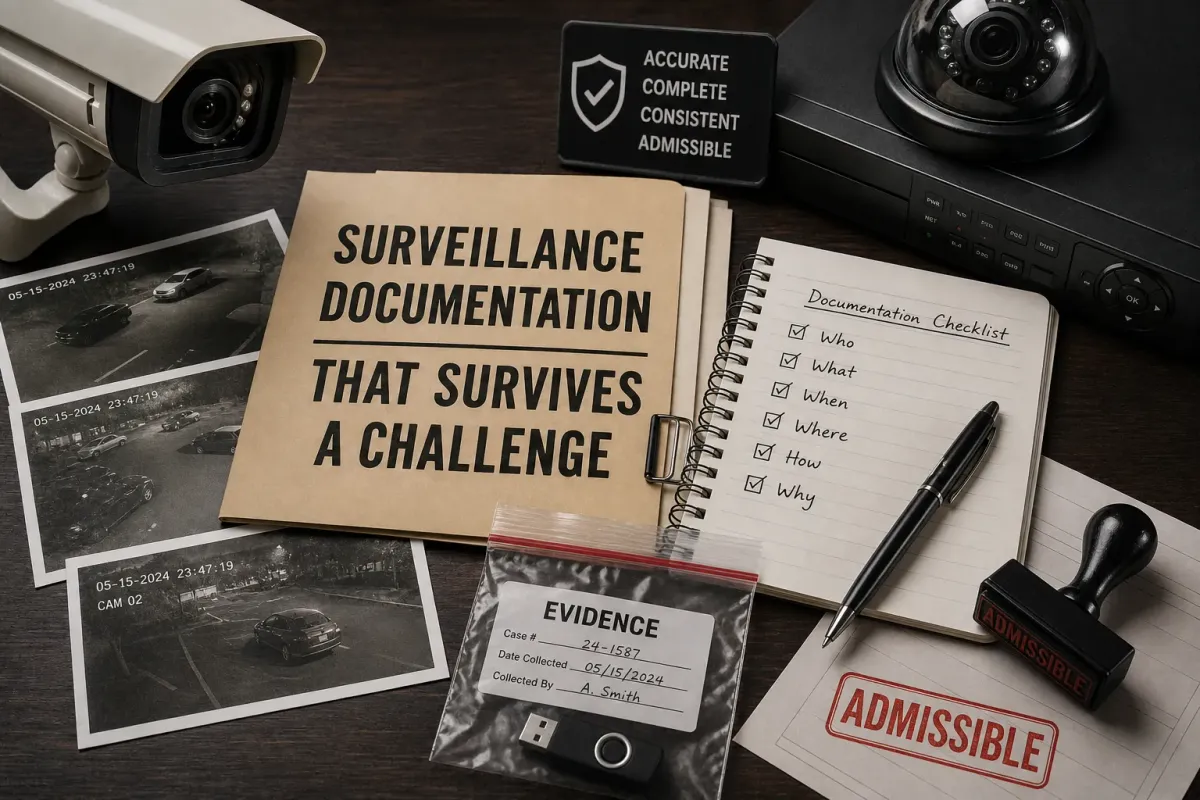
Surveillance Documentation That Survives a Challenge
When surveillance or investigative work becomes part of a legal dispute, what happened in the field is only part of the story. The quality of the documentation may determine whether observations are considered credible, whether evidence can be authenticated, and whether an investigator or process server can clearly explain the work months later.
For process servers, private investigators, attorneys, and legal support professionals, surveillance documentation should do more than summarize an assignment. It should create a clear, chronological, and defensible record of what was observed, when it occurred, how supporting evidence was created, and how those records were preserved.
That discipline becomes especially important during evasive service attempts, address verification, witness location assignments, and other matters where observations may later be questioned.
This guide explains how to build court-ready surveillance documentation, avoid common reporting mistakes, and create records that can withstand scrutiny from clients, courts, and opposing counsel.
What Is Surveillance Documentation?
Surveillance documentation is the written and digital record created during investigative or observational activities. Depending on the assignment and applicable law, that record may include:
Contemporaneous field notes
Surveillance logs
Photographs and video
Date and time records
Location information
Vehicle descriptions
Relevant observations
Evidence-handling records
Final investigative reports
Supporting affidavits or declarations
The purpose is not simply to accumulate information. Effective documentation creates a reliable record that allows another person to understand what occurred without relying solely on the investigator's memory.
For professionals involved in process server surveillance, that record can become especially important when service is disputed or a party claims that an attempt occurred differently than reported.
Why Court-Ready Surveillance Documentation Matters
A surveillance assignment may last only a few hours, but the resulting evidence could be reviewed months or even years later.
When a case is challenged, attorneys and courts may examine questions such as:
When did the observation occur?
Where was the investigator positioned?
What exactly did the investigator observe?
Were statements in the report factual or speculative?
Were photographs or videos altered?
How were original files preserved?
Who had access to the evidence?
Were applicable licensing and privacy requirements followed?
Does the written report match the underlying records?
Weak documentation can turn otherwise useful observations into a credibility problem.
Strong legal surveillance reports, by contrast, provide a consistent record that helps the professional explain and support the work performed.
1. Start With a License-First and Lawful-Scope Mindset
Documentation cannot fix an investigative method that was unlawful in the first place.
Before conducting surveillance or related investigative activities, professionals should understand the laws and regulations governing the assignment and jurisdiction. Requirements can vary significantly by state and by the type of work being performed.
Consider verifying:
Private investigator licensing requirements
Process server licensing or registration requirements
Scope-of-practice restrictions
Client authorization
Trespass laws
Audio-recording and consent laws
Restrictions involving tracking technology
Privacy requirements
Rules governing photography or recording
Cross-border or interstate licensing issues
A process server's authority to serve legal documents does not automatically authorize every form of investigative or surveillance activity.
When an assignment crosses into work that may require a private investigator license or other authorization, confirm the applicable rules before proceeding.
Important: Laws governing surveillance, recording, privacy, GPS tracking, and investigative licensing vary by jurisdiction. Organizations should obtain appropriate legal guidance when establishing surveillance policies.
2. Create Contemporaneous Field Notes
One of the most important principles of surveillance documentation is simple: record important observations as close to the event as reasonably possible.
Memory changes over time. Details that seem obvious during an assignment may become difficult to reconstruct months later.
Depending on the circumstances, contemporaneous notes may document:
Date
Start and end times
Location
Arrival and departure times
Relevant weather or visibility conditions
Description of the property
Vehicles observed
Individuals observed
Actions taken
Significant conversations
Photographs or videos captured
Changes in surveillance position
Interruptions or gaps in observation
The goal is to create a reliable factual record—not an embellished narrative.
Facts vs. Conclusions
Objective wording is particularly important.
Instead of writing:
"The subject clearly knew I was there and tried to avoid service."
A more defensible observation might be:
"At 3:14 p.m., the individual looked toward my vehicle, entered the residence, and closed the front door. No further activity was observed before I departed at 3:42 p.m."
The second version records observable behavior without claiming to know the person's intent.
That distinction can significantly strengthen process server legal documentation.
3. Build a Precise Surveillance Timeline
Chronology is one of the strongest organizing principles for investigative reports.
A reader should be able to follow an assignment from beginning to end without guessing when events occurred.
A useful surveillance timeline may look like this:
TimeObservation2:47 p.m.Arrived in the area and established an observation position3:02 p.m.Blue SUV entered the driveway3:05 p.m.Adult individual exited the driver's side3:08 p.m.Individual entered the residence through the front door3:14 p.m.Service attempt initiated3:42 p.m.Assignment concluded
Use the level of precision supported by your actual records. Do not create false precision after the fact.
A clean timeline makes surveillance evidence easier for clients, attorneys, and courts to evaluate.
4. Document Identifying Details Carefully
Descriptions should be specific enough to be useful without overstating certainty.
Relevant details may include:
Clothing
Approximate height when reasonably observable
Distinguishing physical characteristics
Vehicle make and model
Vehicle color
License plate information when lawfully observed
Direction of travel
Property features
Entry or exit points
Avoid turning estimates into facts.
If a person's age or height is estimated, identify it as an estimate. If identity cannot be confirmed, do not write as though confirmation occurred.
Good surveillance report writing distinguishes between what the investigator knows, what was observed, and what remains uncertain.
5. Preserve Original Photos and Video
Photographs and video can strengthen a report, but poor evidence-handling practices can create new questions.
Organizations should establish procedures for preserving original media whenever possible.
Those procedures may address:
Original file retention
File naming
Date and time synchronization
Secure storage
Backup procedures
Access permissions
Export procedures
Retention schedules
Documentation of copies or edits
If an image is cropped, enhanced, annotated, or otherwise modified for presentation, consider retaining the original separately according to your organization's evidence policy.
The objective is to preserve a traceable path back to the original record.
6. Maintain a Clear Chain of Custody
When digital or physical evidence could become relevant to litigation, chain of custody can be important.
A basic evidence-handling record may identify:
Who created or collected the evidence
When it was created or collected
Where it was stored
Who accessed it
Whether it was copied or transferred
Whether modifications were made
How the original was preserved
Not every assignment requires an elaborate forensic evidence system. The appropriate process depends on the nature of the matter and applicable legal requirements.
However, organizations should be able to explain how important evidence moved from collection to storage to delivery.
7. Use Consistent File-Naming and Storage Procedures
A folder filled with files named IMG_4928.jpg, IMG_4929.jpg, and VID_1882.mov may make sense on the day of an assignment. Months later, it can create unnecessary confusion.
A standardized naming convention can improve traceability.
For example:
CaseNumber_Date_Time_EvidenceType_Sequence
A hypothetical file might be:
2026-1847_2026-08-18_1514_Photo_01.jpg
Whatever system an organization adopts, consistency matters more than complexity.
The same principle applies to folder structures, report templates, evidence indexes, and retention procedures.
8. Establish Written Equipment Policies
Good surveillance documentation depends less on owning sophisticated equipment than on using equipment consistently.
A surveillance or evidence policy may address:
Approved devices
Camera settings
Date and time synchronization
Body-worn camera procedures
Storage locations
Device security
Upload procedures
Evidence transfer
Backup requirements
Retention periods
Access controls
Policies should also account for jurisdiction-specific restrictions. For example, laws governing audio recording can differ substantially from laws governing visual observation.
Equipment should support defensibility—not create avoidable compliance problems.
9. Keep Reports Consistent With Supporting Evidence
One of the easiest ways to undermine credibility is to create contradictions between different records.
Before submitting a report, compare:
Field notes
Surveillance logs
Photographs
Video timestamps
GPS or location records, when lawfully collected and used
Attempt records
Affidavits
Client status updates
Final reports
A report stating that an event occurred at 4:15 p.m. while the corresponding photograph shows a materially different time may invite questions.
Not every discrepancy indicates misconduct. Device settings, time zones, daylight-saving changes, or simple clerical errors can create inconsistencies. But unexplained discrepancies can weaken otherwise solid documentation.
10. Separate Observation From Interpretation
Professional reports should clearly distinguish facts from assumptions.
Strong documentation:
"At approximately 6:21 p.m., an adult male exited the residence, entered the driver's side of a black sedan, and drove east."
Weaker documentation:
"The defendant left the house because he realized he was being watched."
Unless the person's identity and motivation can actually be established, the second statement introduces conclusions the observer may not be able to support.
A useful rule for how to document surveillance is:
Write what you saw, heard, did, and recorded—not what you assume someone thought or intended.
Common Surveillance Documentation Mistakes
Even experienced professionals can weaken an assignment through preventable reporting errors.
Common surveillance documentation challenges include:
Writing reports long after the assignment
Missing or inconsistent timestamps
Relying on memory instead of contemporaneous notes
Using subjective or inflammatory language
Overstating identification certainty
Failing to preserve original files
Inconsistent file names
Unexplained gaps in the timeline
Missing evidence-transfer records
Reports that conflict with photographs or video
Mixing assumptions with factual observations
Inadequate security for sensitive records
A simple quality-control process can catch many of these problems before records reach the client.
Surveillance Evidence in Court: What Makes Records Defensible?
There is no single documentation practice that guarantees surveillance evidence in court will be admitted or accepted. Evidentiary rules, authentication requirements, discovery obligations, privacy laws, and licensing requirements vary by jurisdiction and case.
However, defensible records generally benefit from several characteristics:
Contemporaneous: Important details are recorded promptly.
Objective: Reports distinguish observations from opinions.
Consistent: Notes, media, logs, and reports tell the same factual story.
Traceable: Evidence can be connected to its source and assignment.
Preserved: Original records are maintained according to appropriate procedures.
Lawfully obtained: Collection methods comply with applicable legal and licensing requirements.
Secure: Access to sensitive evidence is appropriately controlled.
These principles make it easier to explain how evidence was created and why it should be considered reliable.
Applying Surveillance Documentation Standards to Process Serving
Not every process server performs formal surveillance, and process serving and private investigative work can be regulated differently.
Still, many surveillance report best practices translate directly to everyday service work.
During an evasive or difficult service assignment, useful records may include:
Exact attempt times
Accurate addresses
Property descriptions
Vehicles observed
Objective descriptions of individuals encountered
Statements made during the attempt
Photos when lawful, permitted, and appropriate
Details supporting identification
Notes explaining unsuccessful attempts
A clear chronology of events
These practices can make an affidavit or attempt report more useful if service is later challenged.
A Court-Ready Surveillance Documentation Checklist
Before closing an assignment, consider reviewing the file for the following:
Dates and times are recorded accurately.
Observations are factual rather than speculative.
Important events appear in chronological order.
Identities are not stated with greater certainty than the evidence supports.
Original photos and videos have been preserved appropriately.
File names and evidence records follow organizational standards.
Evidence transfers or access are documented when necessary.
Reports match supporting notes, photos, videos, and logs.
Required licensing and authorization have been verified.
Privacy and recording requirements have been considered.
Sensitive information is stored securely.
The final report has been reviewed for errors and inconsistencies.
How Firms Can Standardize Surveillance Reporting
For process serving companies and investigative agencies, documentation quality should not depend entirely on the habits of individual field professionals.
Organizations can improve consistency by creating:
Standard report templates
Required observation fields
Evidence naming conventions
Written equipment policies
Secure storage procedures
Chain-of-custody protocols
Quality-control reviews
Training on objective report writing
Jurisdiction-specific compliance procedures
Standardization makes documentation easier to review, easier to audit, and easier to defend.
It can also improve client experience. Attorneys and legal departments generally benefit from receiving organized records that can be understood quickly without repeatedly requesting clarification.
The Bottom Line: Document as Though the Assignment Will Be Challenged
The strongest surveillance documentation is created before anyone knows whether a dispute will occur.
Trying to reconstruct an assignment after a challenge arises is far more difficult than maintaining reliable records from the beginning.
For process servers and investigators, the core principle is straightforward:
Observe carefully. Record promptly. Preserve originals. Separate fact from assumption. Follow the law. Maintain a clear timeline.
Good surveillance documentation does more than show what happened. It demonstrates how the information was gathered and preserved, giving attorneys, clients, and courts a clearer basis for evaluating its reliability.
In legal support work, documentation is not merely administrative overhead. When an assignment is challenged, the documentation may become some of the most important evidence you have.
Stay sharp. Stay informed. Live Mighty!
Read the full article at www.mightyprocessserver.com
This article is published by Process Server Daily, powered by MightyAutomation.ai, the leader in legal support intelligence.