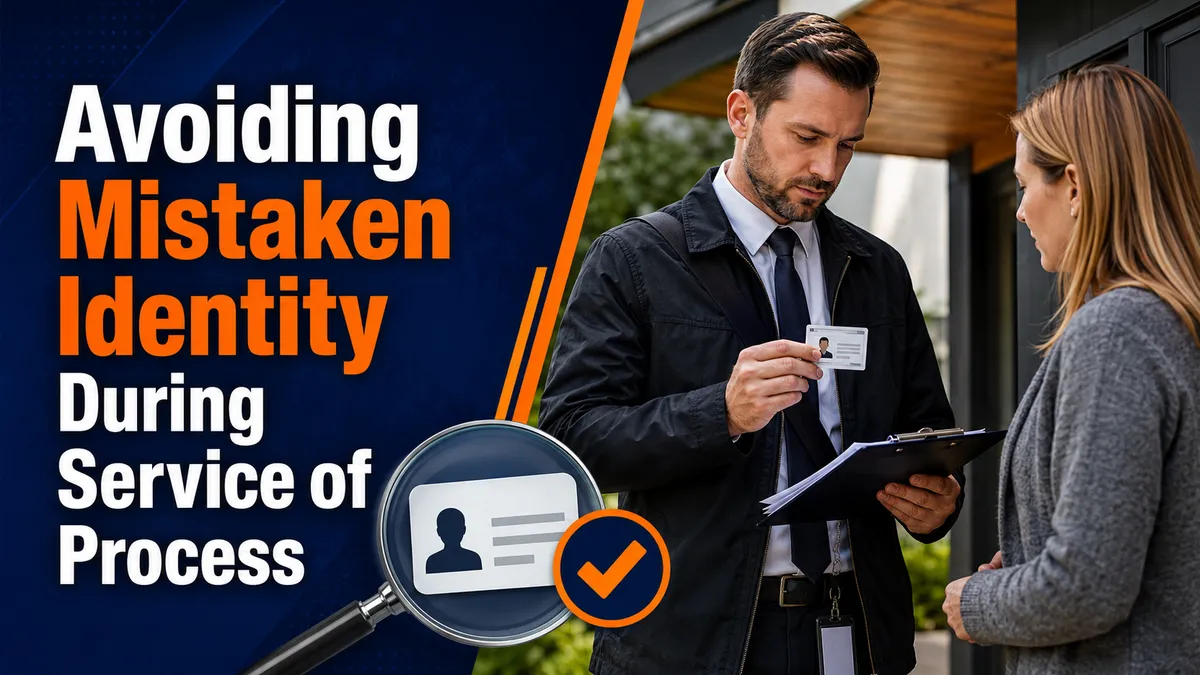
Avoiding Mistaken Identity During Service of Process
Introduction to Mistaken Identity in Process Serving
Accurate process serving is essential to protecting due process and keeping legal proceedings moving forward. However, mistaken identity process serving remains a serious challenge for process servers, attorneys, and law firms.
Mistaken identity occurs when legal documents are delivered to someone other than the intended recipient. It may result from incorrect information, shared names, outdated addresses, misleading statements, or insufficient verification. When the wrong person receives legal papers, the service may be challenged and the case may experience delays, additional expenses, or other legal complications.
Avoiding mistaken identity requires careful preparation, professional judgment, reliable process server tools, and detailed documentation.
Common Causes of Mistaken Identity
What causes mistaken identity in process serving?
Several factors can make identifying the correct recipient difficult:
Incomplete information: The work order may contain an incorrect address, misspelled name, or missing unit number.
Common names: Multiple people may share the same first and last name, especially in densely populated areas.
Family connections: Parents, children, and other relatives may have identical or similar names.
Aliases and former names: The recipient may use a nickname, maiden name, professional name, or different spelling.
Outdated records: The subject may have moved, changed employers, or transferred ownership of a business.
Insufficient verification: A server may rely only on an address or verbal response without checking other details.
Deliberate deception: Someone may deny their identity, provide misleading information, or claim that the recipient does not live at the address.
These process serving challenges demonstrate why a matching name or location should not always be considered conclusive proof of identity.
Legal Implications of Serving the Wrong Person
What are the consequences of serving the wrong individual?
The legal implications of mistaken identity depend on the jurisdiction, type of case, method of service, and circumstances surrounding the attempt.
Possible consequences include:
The service may be challenged or declared invalid.
The court may require the documents to be served again.
Hearings, responses, or case deadlines may be delayed.
A default judgment may be challenged if proper notice was not provided.
The client may incur additional service and legal expenses.
Confidential case information may be disclosed to an unrelated person.
The process server’s professional reputation may be damaged.
Improper service does not automatically result in case dismissal, but it can prevent a case from proceeding until service is corrected. Federal and state courts require legal process serving to follow specific procedural rules. The United States District Court for the Middle District of Florida, for example, explains that a complaint may be dismissed when service is not completed according to applicable law.
Process server legal issues can become more serious when an inaccurate affidavit is filed. Every return or proof of service must truthfully describe who received the papers, where the delivery occurred, and how service was completed.
Process Server Verification Before the Attempt
Accurate process serving begins before the process server visits the address. The server should review the documents, work order, client instructions, and available recipient information for possible conflicts.
Important details may include:
Complete legal name
Middle name or initial
Known aliases
Approximate age
Physical description
Current residential address
Employer or occupation
Business title
Vehicle information
Names of household members
Lawfully obtained photographs
Previous service attempt notes
If the legal documents contain a different name or spelling from the work order, the process server should contact the client before proceeding. The server should not independently change the name appearing on court-issued documents.
How to Verify the Recipient’s Identity
How can a process server verify identity effectively?
Process server verification involves evaluating several reliable facts rather than relying on one detail.
A process server may:
Politely ask the individual to confirm their name.
Request identification when appropriate.
Compare the person with a client-supplied photograph.
Confirm that the person lives or works at the address.
Match the person’s approximate age and physical description.
Review information obtained during previous attempts.
Confirm the person’s position within a business.
Observe lawful identifying information visible at the location.
A process server generally cannot force someone to produce government identification. When identification is refused, the server should consider the totality of the available information and follow the laws of the controlling jurisdiction.
The server should also avoid disclosing unnecessary information about the case to neighbors, coworkers, relatives, or building staff.
Identity Verification Process Server Checklist
Before completing service, the process server should consider the following questions:
Does the name match the legal documents?
Does the person match the available description?
Is the address current and complete?
Is there another person with the same name at the location?
Has the recipient’s connection to the address been confirmed?
Is the person authorized to accept service for a business?
Are there inconsistencies requiring clarification?
Does the selected method comply with jurisdictional requirements?
This checklist supports process serving best practices while reducing preventable process serving mistakes.
Handling Common Names and Similar Identities
Common names create a significant risk of serving the wrong person. The problem becomes more complicated when relatives share the same name or use suffixes such as Jr., Sr., II, or III.
When several individuals have similar names, the server should review:
Middle names and initials
Age differences
Suffixes
Employment information
Physical descriptions
Relationships between residents
Previous addresses
Specific language in the documents
A process server should not assume that every person with a matching name is the intended recipient. If uncertainty remains, the server should document the information and request clarification from the client.
Verifying Identity at a Business
Serving an individual at a workplace or serving a business entity requires additional care. The person contacted may be an employee, owner, officer, manager, registered agent, or receptionist.
The server should confirm both the individual’s identity and their capacity to receive legal documents.
Useful questions include:
Are you authorized to accept service for this company?
What is your position within the organization?
Does the named individual currently work here?
Is this the company’s current operating address?
Has the company recently changed ownership or management?
An employee’s willingness to accept papers does not necessarily establish legal authority. The correct recipient and authorized method of service must be determined under the applicable rules.
Process Serving Technologies That Improve Accuracy
Modern process serving technologies can help servers organize information, verify locations, and maintain detailed records. However, technology should support professional judgment rather than replace it.
Useful process server tools include:
GPS-enabled mobile applications
Digital attempt logs
Timestamped field notes
Secure document-management systems
Business-registration databases
Lawfully available public-record resources
Real-time status updates
Photograph and document-upload tools
Automated affidavit preparation
GPS data can confirm that the server visited the correct location, but it does not independently confirm the recipient’s identity. Database results may also be outdated or connected to another person with the same name.
Facial-recognition technology raises privacy, accuracy, and legal concerns and should not be treated as a routine identity-verification method. Any technology used during service should comply with applicable laws, company policies, and client instructions.
Documenting the Person Served
Thorough documentation is one of the most important process serving best practices. The attempt report should objectively explain how the recipient was identified.
Depending on jurisdictional requirements, the record may include:
Name provided by the recipient
Date and time of service
Complete service address
Approximate age
Height and weight
Hair color
Clothing description
Business title or relationship
Statements confirming identity
Method used to verify the person
Exact location where the papers were delivered
Some jurisdictions require physical descriptions in affidavits of service. New York court guidance, for example, directs servers to record the date, place, time, and description of the person served. New York State Unified Court System
Process servers should record facts rather than assumptions. Notes should be professional, precise, and free from unnecessary personal commentary.
What to Do After Discovering a Mistake
What should a process server do if the wrong person received the documents?
The process server should immediately document the error and notify the hiring attorney, law firm, or agency. Transparency gives the client an opportunity to evaluate the situation and determine the appropriate corrective action.
The server should:
Preserve the original attempt notes.
Record how the error was discovered.
Notify the client promptly.
Avoid deleting or changing the original record.
Follow instructions regarding a corrected attempt.
Complete a new service only after confirming the correct recipient.
Correct any affidavit through the proper legal procedure.
The process server should never conceal an identification mistake or file a proof of service containing information they know to be inaccurate.
How Law Firms Can Prevent Identification Errors
Law firms can support accurate service by providing complete recipient information at the beginning of the assignment.
Helpful details include:
Full legal name
Middle name or initial
Known aliases
Accurate unit or suite number
Approximate age
Current employer
Entity type
Registered-agent information
Lawfully available photograph
Known relatives with similar names
Alternative addresses
Previous identification problems
Complete information helps the server distinguish between multiple individuals and reduces unnecessary attempts.
How Mighty Process Server Can Help
Mighty Process Server provides process server resources designed to improve communication, organization, and service documentation.
The platform gives law firms and individuals access to a nationwide process server directory. Users can search for independent process servers by location, service type, and other relevant criteria.
Mighty Process Server also supports modern case-management workflows, including job tracking, status updates, document handling, GPS and photo records, and affidavit preparation. These tools can help process servers maintain accurate records while keeping clients informed throughout the assignment.
Technology cannot eliminate every identification challenge, but a centralized system can reduce communication errors and improve accountability.
Frequently Asked Questions
How common is mistaken identity in process serving?
There is no single reliable national statistic showing how often it occurs. The risk increases when assignments contain incomplete information, common names, outdated addresses, or multiple people with similar identities.
Does a process server need to see government-issued identification?
Not always. A server may request identification, but the recipient may refuse. Identity can sometimes be established through several reliable facts, subject to applicable law.
Can papers be served if the person denies their identity?
Possibly. A denial does not automatically prove that the individual is not the recipient. The server must evaluate the available evidence and follow jurisdictional requirements.
What if the server is uncertain about the recipient?
The server should pause the attempt, document the uncertainty, and contact the client for clarification. Avoiding mistaken identity is more important than completing a questionable service.
Conclusion
Avoiding mistaken identity requires preparation, careful observation, accurate documentation, and continuous training. Process servers should verify addresses, review detailed recipient information, evaluate inconsistencies, and use technology responsibly.
When a process server combines reliable information with strong professional judgment, the risk of serving the wrong person decreases. This protects the recipient, the hiring law firm, and the integrity of the legal process.
Stay sharp. Stay informed. Live Mighty!
Read the full article at www.mightyprocessserver.com
This article is published by Process Server Daily, powered by MightyAutomation.ai, the leader in legal support intelligence.