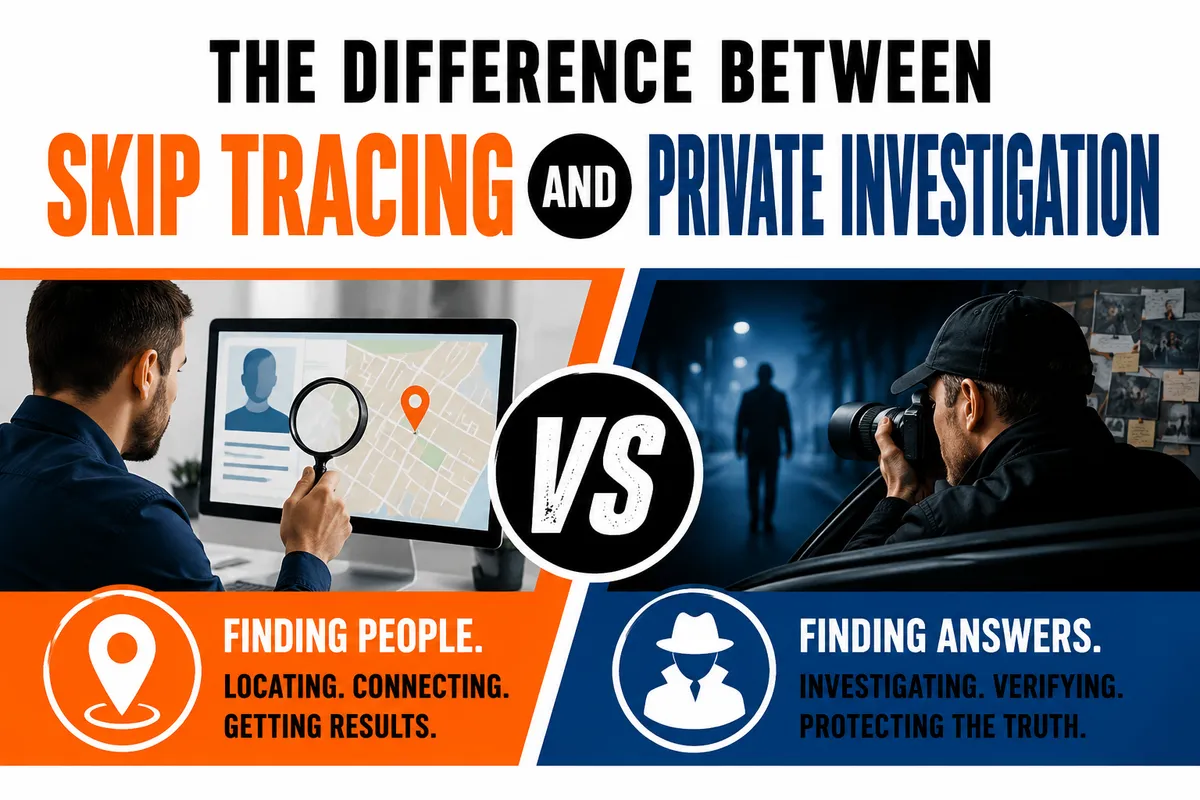
Skip Tracing vs. Private Investigation: What’s the Difference?
Skip tracing and private investigation are both used to uncover information, locate people, and support legal or investigative work. However, they are not the same service.
The primary difference between skip tracing and private investigation comes down to scope and purpose. Skip tracing is primarily focused on locating a person or verifying their current contact information. Private investigation is broader and may involve surveillance, interviews, background research, evidence gathering, and field investigations.
For attorneys, law firms, process servers, businesses, and other professionals, understanding skip tracing vs. private investigation can help determine which service is appropriate for a particular case. Choosing correctly can reduce unnecessary costs, save time, and provide the information needed to move a matter forward.
What Is Skip Tracing?
Skip tracing is the process of locating an individual whose current whereabouts or contact information is unknown or outdated. The term "skip" traditionally refers to someone who has moved or disappeared without leaving easily accessible forwarding information.
A professional skip trace typically involves gathering information from multiple lawful sources, comparing records, identifying inconsistencies, and verifying which information most likely belongs to the correct person.
Skip tracing is commonly used by:
Process servers
Attorneys and law firms
Debt collection professionals
Asset recovery companies
Real estate professionals
Investigators
Businesses attempting to locate individuals
The primary goal is usually straightforward: determine where a person can currently be found or contacted.
Depending on the assignment and applicable law, useful results may include a current or recent address, telephone number, employment information, property records, or other data that helps establish a person's whereabouts.
How Does Skip Tracing Work?
Effective skip tracing involves much more than entering a name into a search engine. Professionals often compare information across multiple sources to determine whether records belong to the same individual and whether the information is current.
Common Skip Tracing Techniques
Professional skip tracing techniques may include:
Public records searches
Property and ownership records
Court records and filings
Address history research
Phone and directory research
Social media and open-source research
Employment information where lawfully available
Professional investigative databases
Business and corporate records
Cross-referencing known associates
Verification of potential addresses
The value of professional skip tracing often lies in verification, not simply access to data. An address appearing in a database does not necessarily mean that the subject currently lives there.
Multiple records may need to be compared before a reliable location can be identified.
What Is Private Investigation?
Private investigation is a much broader category of investigative work. Rather than focusing primarily on locating an individual, a private investigator may be hired to uncover facts, document activities, interview witnesses, verify claims, or gather evidence.
Professional private investigator services can combine database research with field investigation and direct observation.
Depending on applicable laws, licensing requirements, and the circumstances of the case, services may include:
Surveillance
Background investigations
Fraud investigations
Corporate investigations
Insurance investigations
Witness location and interviews
Asset investigations
Missing-person investigations
Litigation support
Field investigations
Evidence collection and documentation
Private investigators may also prepare detailed reports, photographs, video, timelines, witness statements, and other documentation that can assist attorneys or clients.
Skip Tracing vs. Private Investigation: Key Differences
Although the two services sometimes overlap, several important differences help determine which approach is appropriate.
1. Purpose
The clearest difference between skip tracing and private investigation is the objective.
Skip tracing is generally used to answer a question such as:
Where is this person now?
The goal may be to identify a current residence, employment location, phone number, or another reliable point of contact.
Private investigation addresses broader questions, such as:
What happened?
Is a particular claim accurate?
What activities can be lawfully documented?
Where are relevant witnesses or assets?
What evidence supports or contradicts an allegation?
If locating the person is the end goal, skip tracing may be sufficient. If locating the person is only the beginning of the investigation, a private investigator may be more appropriate.
2. Scope of Work
Skip tracing typically has a narrower scope centered on research, identification, and location verification.
Private investigation can involve significantly more extensive work, including:
Surveillance
Interviews
Site visits
Background research
Evidence collection
Photography or video where lawful
Detailed investigative reporting
A private investigation may even include skip tracing as one component of a larger assignment.
3. Methods and Tools
Skip tracers frequently rely on databases, public records, open-source intelligence, and data cross-referencing.
Common skip tracing methods include:
Address history research
Database searches
Property record searches
Court record research
Social media research
Phone and contact verification
Identity cross-referencing
Common private investigation methods may include:
Physical surveillance
Witness interviews
Field investigations
Background investigations
Records research
Evidence documentation
Site visits
Undercover work where lawful and appropriate
The exact methods available depend on the jurisdiction, purpose of the investigation, and applicable privacy and licensing laws.
4. Licensing and Legal Requirements
Licensing is another important consideration when comparing skip tracing vs. private investigation.
Private investigators are subject to licensing requirements in many jurisdictions. Those requirements may regulate who can perform investigative services, what activities are permitted, and how investigations must be conducted.
Skip tracing requirements can be more complicated. Some forms of lawful public-record research or location research may not require a private investigator license, while other activities may fall within regulated investigative work depending on the jurisdiction and services being offered.
For that reason, businesses should not assume that calling a service "skip tracing" automatically exempts it from licensing or other legal requirements.
Professionals should verify the rules applicable to the jurisdiction and assignment.
5. Cost and Time
Skip tracing is often less expensive than a full private investigation because the assignment is typically more focused and research-driven.
A relatively straightforward skip trace may require database searches, public-record research, and verification of several possible addresses.
Private investigations can become more costly because they may require:
Investigator hours
Travel
Surveillance
Multiple field visits
Specialized equipment
Interviews
Detailed evidence documentation
Comprehensive reports
The appropriate service should therefore be based on the information actually needed rather than simply choosing the most extensive investigative option.
When Should You Use Skip Tracing?
Skip tracing is generally the better choice when the primary objective is to find or verify the location of a person.
Common Uses for Skip Tracing
Skip tracing may be appropriate for:
Serving legal documents
Locating defendants
Finding witnesses
Locating former tenants
Identifying current addresses
Finding property owners
Supporting lawful recovery efforts
Verifying contact information
For legal professionals, skip tracing for process servers can be particularly valuable when the address provided by a client is outdated, incomplete, or inaccurate.
Skip Tracing for Process Servers
A process server cannot complete service efficiently if the subject cannot be found. This makes process server skip tracing an important tool when a defendant, witness, or other party has moved or the available address information is unreliable.
A professional skip trace can help identify potential:
Residential addresses
Employment locations
Recent address history
Phone numbers
Property ownership records
Other lawful location indicators
However, a database result should not automatically be treated as proof that a person resides at a particular address. Reliable skip tracing involves comparing multiple data points and assessing how recent and credible each source is.
Accurate location information can reduce wasted service attempts, improve efficiency, and help attorneys and process servers determine the appropriate next step.
When Should You Hire a Private Investigator?
A private investigator may be the better choice when simply locating someone will not accomplish the objective.
Examples include cases involving:
Suspected fraud
Corporate misconduct
Insurance claims
Complex background investigations
Witness interviews
Litigation support
Surveillance
Evidence gathering
Difficult missing-person investigations
Verification of disputed facts
For example, an attorney who needs the current address of a witness may only require skip tracing. If the attorney also needs to locate the witness, conduct an interview, verify facts, and document additional evidence, a licensed private investigator may be more appropriate.
Can a Private Investigator Perform Skip Tracing?
Yes. Skip tracing is commonly one of the research methods used by private investigators.
A private investigator may begin an assignment by locating a subject and then continue with additional investigative activities permitted by law and within the scope of the assignment.
This is one reason the services are sometimes confused.
A useful way to think about the relationship is:
Skip tracing is a specialized location-research function, while private investigation can include skip tracing as part of a much broader investigation.
Can a Process Server Perform Skip Tracing?
Process servers frequently use skip tracing tools to locate defendants and other parties who need to be served. Whether particular investigative activities require additional licensing depends on the jurisdiction and the nature of the work being performed.
Process serving firms should therefore maintain clear procedures regarding:
Permitted data sources
Privacy requirements
Database access
Documentation standards
Client authorization
Applicable state and local licensing rules
The goal should be to obtain accurate location information while remaining within legal and ethical boundaries.
Legal and Ethical Considerations
Both skip tracing and private investigation must be conducted lawfully.
Depending on the information being accessed and how it will be used, professionals may need to consider:
Federal and state privacy laws
Consumer protection requirements
Fair Credit Reporting Act (FCRA) requirements where applicable
Permissible-purpose restrictions on certain databases
State private investigator licensing laws
Laws governing surveillance and recording
Data security requirements
Professional and ethical standards
Access to information does not automatically mean that information can legally be obtained or used for every purpose.
Likewise, investigative professionals should avoid deceptive, intrusive, or unlawful tactics and maintain accurate records of their work.
Which Service Do You Need?
Choosing between skip tracing and private investigation starts with defining the objective.
Choose skip tracing when:
You primarily need to locate someone.
You need updated contact or address information.
A process server needs a better address for service.
Database and public-record research may answer the question.
Consider a private investigator when:
You need surveillance or field investigation.
You need witnesses interviewed.
You need evidence gathered or documented.
You are investigating fraud or misconduct.
The case requires a broader investigative strategy.
In some cases, the most efficient approach is to begin with skip tracing. If location research does not resolve the matter—or if additional evidence is required—the assignment can expand into a more comprehensive investigation where legally appropriate.
Frequently Asked Questions About Skip Tracing and Private Investigation
Is skip tracing the same as private investigation?
No. Skip tracing primarily focuses on locating an individual or verifying contact information. Private investigation covers a broader range of investigative activities, potentially including surveillance, interviews, fieldwork, and evidence collection.
What information can a skip tracer find?
Depending on the available lawful sources, a skip tracer may identify current or previous addresses, phone numbers, property records, employment indicators, court records, and other information useful for locating an individual.
Do skip tracers need a license?
Licensing requirements vary by jurisdiction and by the activities being performed. Some location research may not require a private investigator license, while other investigative activities may be regulated. Professionals should verify applicable state and local requirements.
Is skip tracing useful for process servers?
Yes. Skip tracing for process servers can help identify more current or reliable addresses when the information provided for service is outdated or inaccurate.
When is a private investigator better than a skip tracer?
A private investigator is generally more appropriate when the assignment requires surveillance, interviews, field investigation, evidence collection, or investigation of allegations rather than simply locating an individual.
Can a private investigator also conduct a skip trace?
Yes. Private investigators commonly use skip tracing as one tool within a broader investigation.
Conclusion
The difference between skip tracing and private investigation is primarily one of purpose and scope.
Skip tracing focuses on locating people and verifying contact information through research, records, databases, and other lawful sources. Private investigation can go considerably further, incorporating surveillance, interviews, fieldwork, evidence gathering, and comprehensive investigative reporting.
For attorneys, law firms, process servers, and businesses, selecting the appropriate service can save both time and money. If the objective is simply to determine where someone can be found, professional skip tracing may be the most efficient solution. If the case requires evidence, surveillance, interviews, or a broader investigation, a qualified private investigator may be necessary.
Understanding the distinction helps legal professionals choose the right investigative resource while maintaining accuracy, efficiency, and compliance.
At MPS (Mighty Process Server), we understand the critical role that both skip tracing and investigative services play in legal success. By selecting the right service for the situation, legal professionals can improve efficiency, reduce delays, and achieve better outcomes for their clients.
Stay sharp. Stay informed. Live Mighty!
Read the full article at www.mightyprocessserver.com
This article is published by Process Server Daily, powered by MightyAutomation.ai, the leader in legal support intelligence.