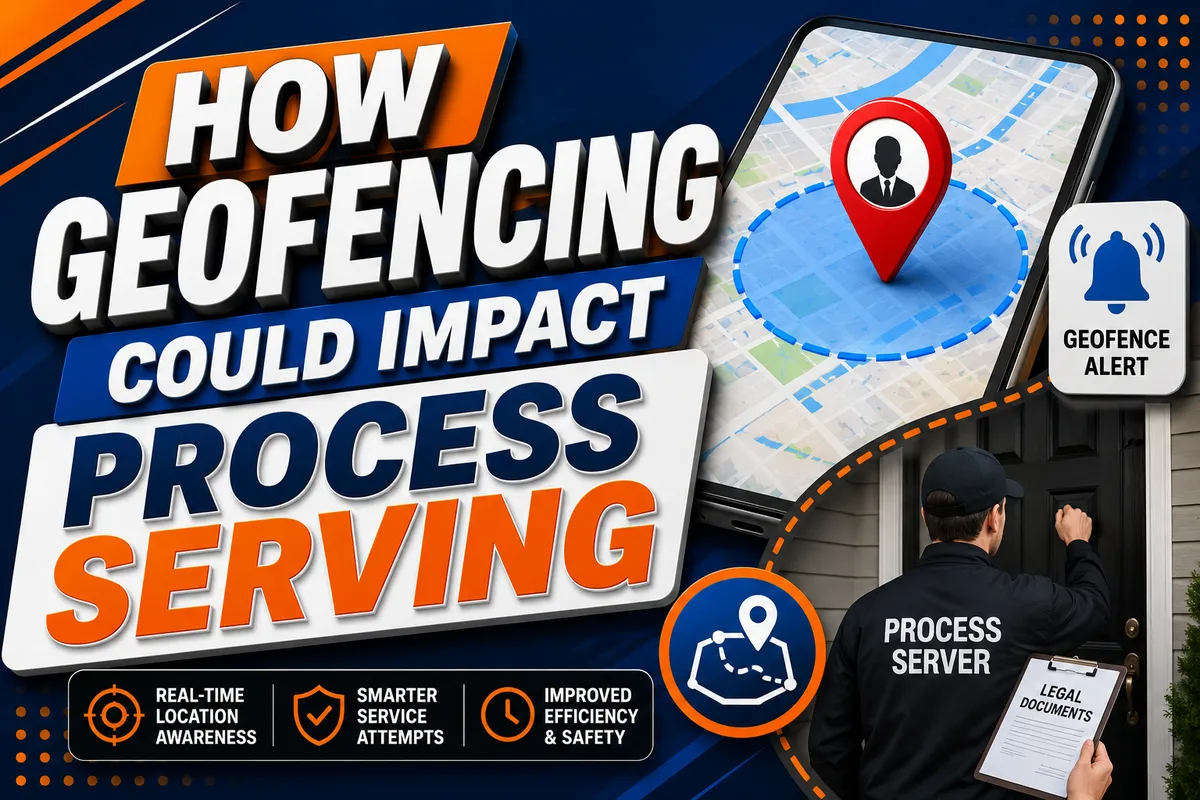
How Geofencing Could Impact Process Serving: Benefits, Risks, and the Future
Technology continues to reshape the legal support industry, and process serving is no exception. Mobile apps, GPS verification, digital affidavits, automated status updates, and route optimization have already changed how many process servers manage fieldwork. Geofencing in process serving could be another important step in that evolution.
Geofencing uses location technology to create a virtual boundary around a physical location. For process serving companies, that boundary can help document when a server arrives at or leaves a service address, trigger workflow reminders, update job statuses, and provide clients with greater visibility into field activity.
However, geofencing should not be confused with proof that valid service occurred. Location data can support a service record, but process servers must still comply with applicable statutes, court rules, privacy requirements, and documentation standards.
Below, we explore how geofencing could impact process serving, its potential benefits and limitations, and how agencies can evaluate this technology responsibly.
What Is Geofencing?
Geofencing is a location-based technology that establishes a virtual perimeter around a defined geographic area. Depending on the system, geofencing may use technologies such as:
GPS
Cellular location data
Wi-Fi positioning
Bluetooth or other proximity technologies
When an authorized mobile device enters or exits the designated area, software can trigger a predefined action.
In location-based process serving, for example, a process serving platform could establish a geofence around an address where legal documents need to be served. When the assigned server arrives within the designated area, the mobile app might record the time and location or prompt the server to begin documenting the attempt.
Potential automated actions include:
Recording arrival and departure times
Capturing available GPS coordinates
Prompting the server to record attempt details
Updating the assignment status
Reminding the server to take required photographs
Notifying dispatchers that an attempt is underway
Sending authorized status updates to a client portal
The goal is not to replace the process server's observations. Instead, geofencing can help make field workflows more consistent and reduce repetitive administrative work.
How Does Geofencing Work in Process Serving?
A geofencing-enabled process serving workflow might look like this:
A service address is entered into the system. The agency receives an assignment and adds the address to its process serving software.
A virtual boundary is established. The software creates a geographic perimeter around the service location.
The process server travels to the address. An authorized mobile application uses available location services while the server performs the assignment.
The server enters the geofence. The application recognizes that the device is within the designated area and can trigger a timestamp, notification, or workflow prompt.
The service attempt is documented. The process server records the outcome, observations, photographs when appropriate, and other required information.
The server leaves the area. Depending on the platform, departure may also be logged automatically.
The case record is updated. Relevant information can be transmitted to the agency's case management system or client portal.
When implemented correctly, this process can create a more organized record of field activity without requiring the server to manually enter every administrative detail.
7 Potential Benefits of Geofencing for Process Servers
The potential benefits of geofencing for process servers go beyond simply knowing where a mobile device is located.
1. More Consistent Location Documentation
Process servers frequently handle multiple assignments in a single day. Geofencing can help establish a consistent record showing when an authorized device entered or exited an area associated with an assignment.
When combined with timestamps, attempt notes, photographs, and other records, location data can provide additional context about field activity.
2. Fewer Manual Check-Ins
Without automation, process servers may need to manually notify dispatchers when they arrive at an address, complete an attempt, or move to another assignment.
Geofencing can potentially automate portions of this process.
For example, entering a designated service area might automatically change an assignment from "en route" to "on site," while leaving could prompt the server to complete the attempt report.
Reducing manual status updates allows servers to spend more time completing assignments and less time performing administrative tasks.
3. Faster Client Status Updates
Attorneys and law firms increasingly expect timely information about active service assignments.
When geofencing is integrated with process serving software, certain status changes could flow automatically into a client portal or internal dashboard.
Instead of calling or emailing an agency to ask whether an attempt occurred, authorized clients may be able to see that field activity has taken place and wait for the completed attempt report.
4. Stronger Operational Accountability
Process serving agencies need reliable systems for managing field assignments, particularly when coordinating multiple servers across large geographic areas.
Geofencing can provide additional operational data that helps managers identify:
Whether assignments were visited
Approximate arrival and departure times
Jobs awaiting documentation
Geographic concentrations of assignments
Potential workflow bottlenecks
This information can improve dispatching and quality-control processes.
5. More Efficient Routing and Dispatch
Geofencing becomes particularly useful when combined with route optimization for process servers.
A modern platform may be able to consider:
Current assignment locations
Server availability
Travel distance
Traffic conditions
Attempt priorities
Court or client deadlines
Geographic service zones
The objective is to reduce unnecessary travel while increasing the number of productive attempts a server can complete.
6. Automated Workflow Reminders
A geofence does not need to serve only as a tracking mechanism. It can also function as a workflow trigger.
For example, entering a service area might remind a process server to:
Review identifying information
Confirm special instructions
Record the attempt outcome
Capture permitted photographs
Complete required notes
Upload supporting documentation
These reminders can improve consistency, especially for agencies managing large numbers of assignments.
7. Better Data for Business Decisions
Over time, aggregated operational data may help process serving businesses understand how their field operations are performing.
Agencies could potentially analyze metrics such as:
Average travel time between assignments
Time spent at service locations
Attempts completed per route
Geographic areas with frequent unsuccessful attempts
Average time from assignment to first attempt
Overall service cycle time
These insights can support better staffing, pricing, territory management, and scheduling decisions.
Geofencing vs. GPS Tracking: What's the Difference?
Although the terms are sometimes used interchangeably, geofencing and GPS tracking are not exactly the same thing.
GPS tracking generally refers to determining or recording the location of a device.
Geofencing uses location information to determine whether that device has entered, remained within, or exited a predefined geographic boundary.
In practical terms, GPS may tell a process serving application where a device is located, while a geofence can use that information to trigger a specific workflow.
A process serving platform might use both technologies together to provide location verification and automated job management.
Can Geofencing Provide Proof of Service?
Geofencing can provide supporting location data, but it should not be treated as proof that legal service was properly completed by itself.
A device being near an address does not establish:
Who was actually present
Whether the correct individual was identified
Whether documents were delivered
How the documents were delivered
Whether substituted or alternative service requirements were satisfied
Whether jurisdiction-specific service rules were followed
Those facts generally depend on the process server's actions, observations, records, affidavit or declaration, and the applicable rules governing service.
For that reason, geofencing is best viewed as an additional documentation and workflow tool, not a substitute for legally required proof of service.
How Geofencing Could Improve Process Serving Documentation
Reliable documentation is critical to professional process serving.
A well-designed technology platform can combine geofencing information with other records associated with an attempt, including:
Date and time
GPS information
Service address
Attempt notes
Photographs when permitted
Description of the person served
Method of service
Digital signatures when applicable
Affidavits or declarations of service
Subsequent attempt information
Combining these records can create a more complete chronological history of an assignment.
That can be particularly valuable when a client needs to review what occurred during an attempt or when service is later challenged.
Geofencing and Route Optimization
One of the strongest potential applications of geofencing technology for process servers is its integration with routing and dispatch systems.
Consider an agency managing dozens of assignments across a metropolitan area. Rather than manually determining the order in which every address should be attempted, software could help organize assignments based on geography and operational priorities.
Geofencing could then help the system recognize when each location has been visited.
Combined with mapping technology, a process serving platform could potentially:
Group assignments by geographic area
Suggest efficient routes
Identify nearby assignments
Reduce unnecessary backtracking
Adjust routes as priorities change
Track completion throughout the day
Alert dispatchers to overdue assignments
For high-volume process serving agencies, even small reductions in travel time can translate into meaningful operational savings.
Privacy and Legal Considerations for Geofencing
The benefits of location technology must be balanced against privacy, employment, and data-security considerations.
Requirements can vary significantly by jurisdiction and by how a company uses the technology. Process serving businesses considering geofencing should evaluate applicable laws and obtain qualified legal advice when necessary.
Important considerations may include:
Employee and Contractor Notice
Servers should understand when location information is collected, what information is collected, how it is used, and how long it is retained.
Work-Related Tracking
Where appropriate, location collection should be limited to legitimate business purposes and configured to avoid unnecessary tracking outside authorized work activities.
Data Security
Location histories can contain sensitive information. Agencies should use appropriate technical and organizational safeguards to prevent unauthorized access.
Access Controls
Not every employee or client needs access to detailed location records. Permissions should be limited according to legitimate operational needs.
Data Retention
Organizations should establish clear policies defining how long location information is retained and when it is deleted.
Applicable State and Local Laws
Privacy, electronic monitoring, employment, and data-protection requirements can differ between jurisdictions. A practice that is acceptable in one state may require different notices, consent, or procedures in another.
Challenges and Limitations of Geofencing
Despite its potential, geofencing is not perfect.
Location Accuracy
GPS and other location technologies can have accuracy limitations. Buildings, urban environments, device settings, connectivity, and other technical factors may affect location readings.
For this reason, a geofence event should not automatically be interpreted as definitive evidence that a particular action occurred at an exact physical point.
Battery and Device Requirements
Location services can consume battery power, and functionality may depend on device permissions and operating-system settings.
False Triggers
If a geofence is too large, a server could enter it while merely driving nearby. If it is too small, location inaccuracies could prevent the system from recognizing a legitimate visit.
Geofence configuration therefore requires careful testing.
Software Reliability
Mobile applications can crash, lose connectivity, or fail to synchronize immediately. Agencies need procedures for documenting attempts when technology is temporarily unavailable.
Training Requirements
Technology only improves a workflow when people use it correctly. Process servers and office staff need clear training regarding both the software and the agency's documentation policies.
Data Overload
Collecting more information is not automatically beneficial. Agencies should focus on collecting information that has a legitimate operational, compliance, or client-service purpose.
Best Practices for Implementing Geofencing in a Process Serving Business
Agencies considering geofencing implementation should focus on both technology and policy.
Useful steps include:
Define the business purpose. Determine whether geofencing will support documentation, dispatch, workflow automation, client communication, or another specific objective.
Choose appropriate process serving software. Look for technology that integrates location functionality with existing job management, reporting, invoicing, and client communication systems.
Create clear tracking policies. Document when location information is collected and how it may be used.
Train process servers and staff. Explain both the technical workflow and the limitations of location data.
Use geofencing as supporting documentation. Do not allow automated location records to replace required attempt notes, affidavits, or jurisdiction-specific service documentation.
Secure collected data. Apply appropriate access controls, authentication, encryption, and retention practices.
Test geofence accuracy. Evaluate boundary sizes and location performance under real-world conditions before relying heavily on automation.
Review legal requirements periodically. Privacy and data-protection rules continue to evolve, making regular compliance reviews important.
How Geofencing Could Benefit Law Firms and Legal Departments
The advantages of geofencing are not limited to process serving companies.
Attorneys, litigation teams, corporate legal departments, property managers, and other clients may benefit from greater visibility into service activity.
With the appropriate permissions and integrations, a client dashboard might show:
Assignment received
Server assigned
Attempt scheduled
Field activity recorded
Attempt completed
Attempt report available
Service completed
Affidavit or proof of service available
This type of transparency can reduce routine status inquiries and help legal teams monitor cases with approaching deadlines.
The Future of Geofencing and Process Serving Technology
The future of process serving technology will likely involve increasingly connected systems rather than isolated tools.
Geofencing could eventually work alongside technologies such as:
AI-assisted dispatching
Automated assignment based on proximity
Predictive route optimization
Real-time traffic information
Digital affidavits
Automated compliance checks
OCR document processing
Client dashboards
Electronic invoicing
API integrations
Mobile field applications
Analytics and performance reporting
For example, an intelligent dispatch system could identify an available server near a high-priority assignment, recommend the job, optimize the route, recognize arrival through a geofence, prompt the appropriate documentation workflow, and update the client's dashboard after the attempt.
The value comes not from geofencing alone but from connecting location technology with the broader process serving workflow.
Geofencing and the Digital Transformation of Process Serving
The process serving industry is becoming increasingly data-driven.
Clients want faster turnaround times, better communication, reliable documentation, and convenient access to case information. Meanwhile, agencies need tools that allow them to handle larger workloads without dramatically increasing administrative costs.
Technologies supporting this transformation include:
GPS verification
Geofencing
Mobile process serving apps
Automated client notifications
Online ordering
Digital affidavits
Route optimization
Cloud-based case management
API integrations
Analytics dashboards
Agencies do not need to adopt every new technology immediately. The more important objective is building a reliable digital workflow in which technology supports professional judgment rather than attempting to replace it.
How Mighty Process Server Supports Modern Process Serving
At MightyProcessServer.com, we believe technology should make process serving easier to manage, more transparent, and more efficient.
Modern process serving software can bring job management, field documentation, client communication, digital records, workflow automation, and operational reporting into a more connected system.
As technologies such as geofencing continue to develop, process serving businesses have an opportunity to reduce administrative work, strengthen documentation, and provide attorneys and law firms with greater visibility throughout the service process.
For agencies evaluating their technology stack, the goal should not simply be adopting the newest feature. The priority should be choosing tools that solve real operational problems while supporting security, compliance, accuracy, and professional service.
Frequently Asked Questions About Geofencing in Process Serving
What is geofencing in process serving?
Geofencing in process serving uses a virtual geographic boundary around a service location to trigger actions when an authorized mobile device enters or exits the area. Those actions might include recording a timestamp, prompting an attempt report, or updating an assignment status.
Can geofencing verify that a process server visited an address?
Geofencing can provide location information indicating that an authorized device entered a designated geographic area. However, location data has technical limitations and does not independently establish everything that occurred during a service attempt.
Is geofencing the same as GPS tracking?
No. GPS tracking determines or records device location. Geofencing uses location information to identify when a device enters or exits a predefined geographic boundary and can trigger automated actions.
Does geofencing prove legal service occurred?
No. Geofencing may support documentation of field activity, but valid service depends on applicable laws and court rules as well as what actually occurred during the attempt. Required affidavits, declarations, notes, or other documentation remain important.
How can geofencing improve process serving efficiency?
Geofencing can reduce manual check-ins, automate status changes, trigger documentation reminders, support route management, and provide field activity information to office staff and authorized clients.
Are there privacy concerns with geofencing?
Yes. Location information can be sensitive. Process serving companies should consider applicable privacy and employment laws, provide appropriate notice, establish clear policies, restrict access, secure collected data, and determine reasonable retention periods.
Can geofencing integrate with process serving software?
Yes. Depending on the platform, geofencing can potentially integrate with mobile field applications, case management systems, client portals, dispatch tools, reporting systems, and other process serving technology.
Conclusion
Geofencing could have a significant impact on process serving by connecting field activity with automated digital workflows.
When appropriately implemented, geofencing can help process serving agencies improve location documentation, reduce manual administrative work, streamline dispatching, provide faster client updates, and gain better visibility into field operations.
Its limitations are equally important. A geofence event does not prove that valid service occurred, and location information must be collected, stored, and used responsibly. Professional observations, accurate attempt notes, affidavits, applicable court rules, and jurisdiction-specific service requirements remain essential.
As process serving becomes increasingly digital, successful agencies will be those that use technology to strengthen—not replace—the professional judgment and reliable documentation at the heart of effective service of process.
For process servers and agencies preparing for the next generation of legal field services, geofencing technology represents an opportunity to build a more efficient, accountable, transparent, and client-focused operation.
Stay sharp. Stay informed. Live Mighty!
Read the full article at www.mightyprocessserver.com
This article is published by Process Server Daily, powered by MightyAutomation.ai, the leader in legal support intelligence.