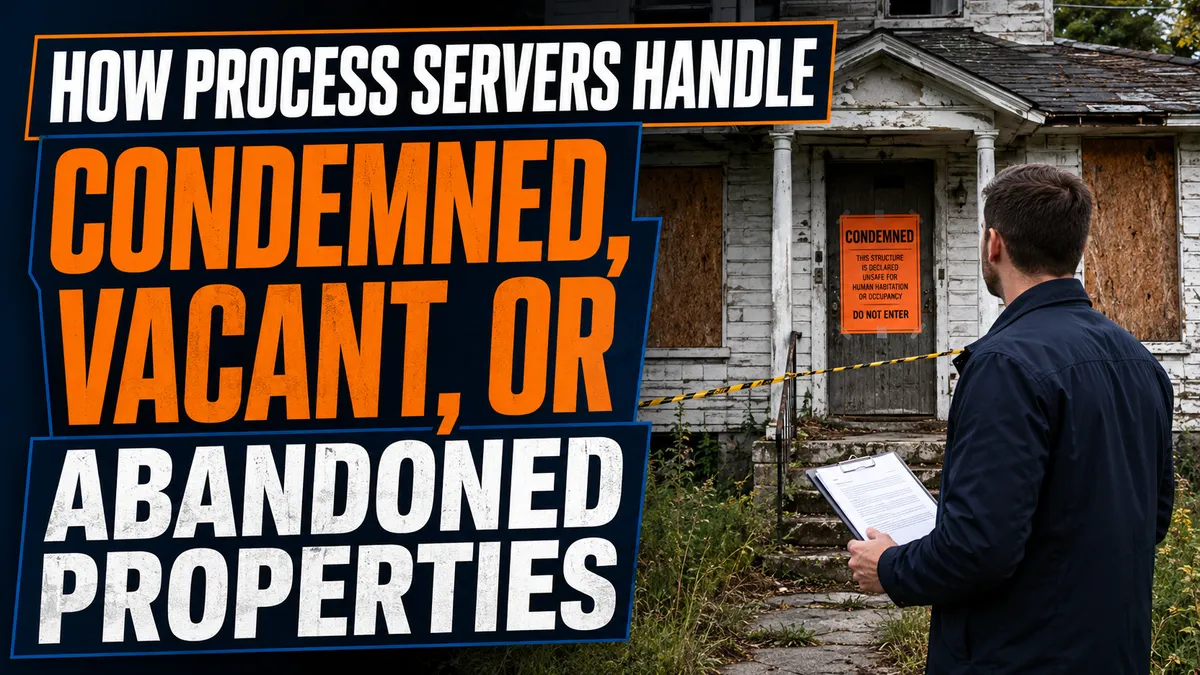
How Process Servers Handle Condemned, Vacant, or Abandoned Properties
Introduction to Process Serving at Challenging Properties
Process serving is a critical part of the legal system because it ensures that individuals and businesses receive proper notice of legal actions involving them. Delivering documents at a normal residence can already require careful planning, but the assignment becomes more complicated when the address is condemned, vacant, or abandoned.
A process server condemned property assignment may involve structural hazards, government restrictions, uncertain occupancy, outdated address information, or people living at the location without clear authorization. Process servers must balance persistence with legal compliance, accurate reporting, and personal safety.
The appearance of a property does not prove whether someone lives there. Process servers must document observable facts, investigate the address, and avoid unsupported conclusions.
Understanding Condemned, Vacant, and Abandoned Properties
Although these terms are sometimes used interchangeably, they have different meanings.
Condemned Property
A condemned property has generally been declared unsafe or unfit for occupancy by a government authority. Reasons may include structural instability, fire damage, sanitation problems, exposed utilities, or serious building-code violations.
The legal effect of a condemnation notice depends on local law. The process server should record the language appearing on the official notice rather than personally declaring that the property is condemned.
Vacant Property
A vacant property is currently unoccupied. It may still be maintained, owned, insured, and prepared for sale or future occupancy. A vacant home is not necessarily abandoned.
Abandoned Property
An abandoned property generally appears neglected and no longer actively maintained. However, legal abandonment cannot always be established through visual observation. An owner, tenant, relative, unauthorized occupant, or maintenance worker may still visit the location.
Understanding these differences is important for legal process serving vacant properties because each situation may require a different research and field strategy.
How Do Process Servers Handle Condemned Properties?
Before approaching a condemned building, a process server should evaluate the visible conditions and determine whether access is permitted. Official notices, barriers, fencing, or active demolition work may indicate that the location is unsafe or restricted.
The server may research:
Code-enforcement records
Building department notices
Fire department reports
Property ownership records
Court filings
Demolition permits
Recent sales or foreclosure activity
Information supplied by the client
A legal service condemned building attempt does not give the process server permission to ignore posted restrictions or enter a hazardous structure. OSHA warns that damaged and demolition environments can contain serious hazards caused by unstable structures and unknown conditions. Occupational Safety and Health Administration
If someone is lawfully encountered outside the building or in another safe, accessible area, personal service may still be possible if the individual is correctly identified and the governing rules are satisfied.
Challenges of Serving Legal Papers at a Vacant Home
Serving legal papers vacant home assignments often begins with determining whether the residence is actually unoccupied.
Possible signs of vacancy include:
Accumulated mail or newspapers
Overgrown vegetation
Boarded windows
Disconnected utility meters
Empty rooms visible from a lawful public area
A real estate lockbox
Uncollected packages
Repeated absence of vehicles
Foreclosure or sale notices
Construction or renovation activity
These conditions do not independently prove vacancy. A resident could be traveling, hospitalized, temporarily displaced, or living in only part of the property.
The process server may need to make attempts on different dates and at different times. Comparing observations across several visits can produce a clearer picture of the property’s status.
Legal Considerations at Abandoned Properties
Abandoned property process serving creates several legal concerns. The server must determine whether the address remains connected to the person being served and whether any proposed delivery method is legally authorized.
Important process serving legal considerations include:
Whether the recipient still resides at the address
Whether the building can be approached safely
Whether entry is prohibited
Whether substituted service is permitted
Whether previous personal-service attempts are required
Whether posting is authorized
Whether follow-up mailing is required
Whether a court order is necessary
Whether unauthorized occupants are present
A person found inside an abandoned-looking structure is not automatically the named recipient. The server must verify identity before completing service person found inside an abandoned-looking structure is not automatically.
Can Documents Be Posted at the Property?
An abandoned building legal notice delivery should not be completed merely because the location is the defendant’s last known address. Posting may be authorized in certain cases or jurisdictions, but it may require prior attempts, mailing, court approval, or other procedural steps.
The process server should confirm:
The exact documents being served
The law governing the case
The number and timing of required attempts
The approved posting location
Whether mailing must follow
How the posting must be photographed or documented
When service becomes legally effective
Federal Rule of Civil Procedure 4 identifies methods for serving individuals and certain organizations while also recognizing some methods authorized by applicable state law. State and local requirements can differ considerably. United States Courts
Leaving documents on a vacant door without legal authorization could result in defective service result in defective.
Research and Planning Before the Attempt
Successful process serving strategies begin before the server reaches the property. The address should be compared with current records to determine whether it remains connected to the subject.
Useful research may include:
Property tax records
Ownership and deed information
Eviction or foreclosure filings
Utility indicators available through lawful sources
Building permits
Code-enforcement databases
Business registrations
Professional licenses
Recent court records
Skip-tracing reports
Previous service-attempt notes
Property ownership does not prove occupancy. An individual may own a vacant building while living elsewhere, or a tenant may occupy a property owned by another person.
Research results should be ranked according to recency and reliability.
Speaking With Neighbors and Property Contacts
Neighbors, landlords, property managers, real estate agents, contractors, and maintenance personnel may help confirm whether the subject still uses the address.
Appropriate questions may include:
Is the property currently occupied?
Does the named person still live here?
When was the person last seen?
Has the property recently changed ownership?
Is anyone maintaining or renovating the building?
Is there a known forwarding address?
The server should avoid revealing unnecessary details about the lawsuit. Information obtained from another person must also be attributed correctly in the field notes.
For example:
“A neighbor stated that the subject moved approximately two months ago.”
This is more accurate than:
“The subject moved two months ago.”
The first statement identifies the source and avoids presenting unverified information as fact.
Process Server Safety Tips
Safety is essential when serving papers abandoned property locations. Damaged buildings may contain unstable floors, exposed wiring, broken glass, mold, animals, hazardous waste, or unauthorized occupants.
Important process server safety tips include:
Assess the property from a safe location before approaching
Observe warning signs and posted restrictions
Avoid entering unstable or damaged structures
Never climb fences or force open doors
Keep a charged communication device available
Tell dispatch or a colleague where the attempt is occurring
Park where a clear exit remains available
Avoid poorly lit areas when hazards cannot be evaluated
Leave immediately if conditions become threatening
Consider a coordinated or two-person approach when lawful, permitted, and justified by the risk
High-visibility clothing may be appropriate near traffic or active construction, but a process server should never wear clothing that falsely suggests government, utility, or law enforcement authority.
Dealing With Unauthorized Occupants
An abandoned-looking property may contain squatters, trespassers, former tenants, or other unauthorized occupants. A process server should not attempt to determine their legal right to be there.
If someone answers the door, the server should focus on identifying the named recipient. The occupant’s presence may confirm that the building is not physically vacant, but it does not prove that the defendant lives there.
The server should avoid confrontation and should not enter the building without lawful permission. If the occupant becomes threatening, the server should leave and document what occurred.
Documenting the Attempt
Detailed documentation is one of the most important parts of vacant property service of process. The field report should include:
Date and exact time
Complete address
Condition of the building
Posted government notices
Barriers or access restrictions
Visible signs of occupancy or vacancy
Vehicles observed
Names or descriptions of people contacted
Statements made by neighbors or property personnel
Safety hazards
Reason service was not completed
Permitted photographs and GPS information
The server should write only what was observed or reliably reported.
Instead of writing, “The house is abandoned,” a stronger report would state:
“The front windows were boarded, vegetation covered the walkway, and a city notice marked ‘Unsafe Structure’ was posted on the entrance. No occupants or vehicles were observed.”
This factual approach gives the client information that can be reviewed and used in future legal decisions.
Common Process Server Legal Challenges
Common process server legal challenges at these properties include:
Determining whether the address remains valid
Distinguishing temporary vacancy from permanent relocation
Confirming who occupies the property
Complying with no-entry restrictions
Establishing whether substituted service is allowed
Documenting sufficient attempts
Avoiding service on the wrong person
Responding to unsafe conditions
Handling conflicting information from records and neighbors
Process servers should consult the client or supervising legal professional when the correct method is unclear.
What Happens if Service Cannot Be Completed?
If the subject cannot be located, the server should promptly report the findings. The client may then choose to:
Order a skip trace
Attempt another residential address
Try a verified workplace
Locate a registered agent
Complete additional diligent attempts
Request alternative service
Seek authorization for publication
Return the assignment as unsuccessful
A failed attempt still has value when it produces accurate information and eliminates an outdated address.
Successful Process Serving Strategies
Successful process serving strategies at difficult properties rely on five basic principles:
Research the address before visiting.
Observe and document conditions without making assumptions.
Follow all access restrictions and safety precautions.
Verify identity before completing service.
Use posting, mailing, publication, or another alternative only when legally authorized.
Persistence matters, but every attempt must remain lawful, professional, and safe.
How Mighty Process Server Can Help
MightyProcessServer.com connects attorneys, law firms, businesses, government agencies, and individuals with professional process servers nationwide. The process server directory helps clients find experienced local professionals who understand difficult addresses, skip tracing, field verification, and jurisdiction-specific service requirements.
Local knowledge can be especially valuable when a neighborhood contains properties affected by foreclosure, redevelopment, natural disasters, or building-code enforcement.
Conclusion
Serving documents at condemned, vacant, or abandoned properties requires research, careful observation, legal knowledge, and sound judgment. A damaged or neglected appearance does not automatically prove that the recipient moved, and a last known address does not automatically authorize documents to be posted there.
By following condemned property service laws, documenting objective facts, respecting property restrictions, and prioritizing safety, process servers can manage these difficult assignments more effectively. Even when service is unsuccessful, a detailed field report can help the client identify the next lawful step.
Stay sharp. Stay informed. Live Mighty!
Read the full article at www.mightyprocessserver.com
This article is published by Process Server Daily, powered by MightyAutomation.ai, the leader in legal support intelligence.