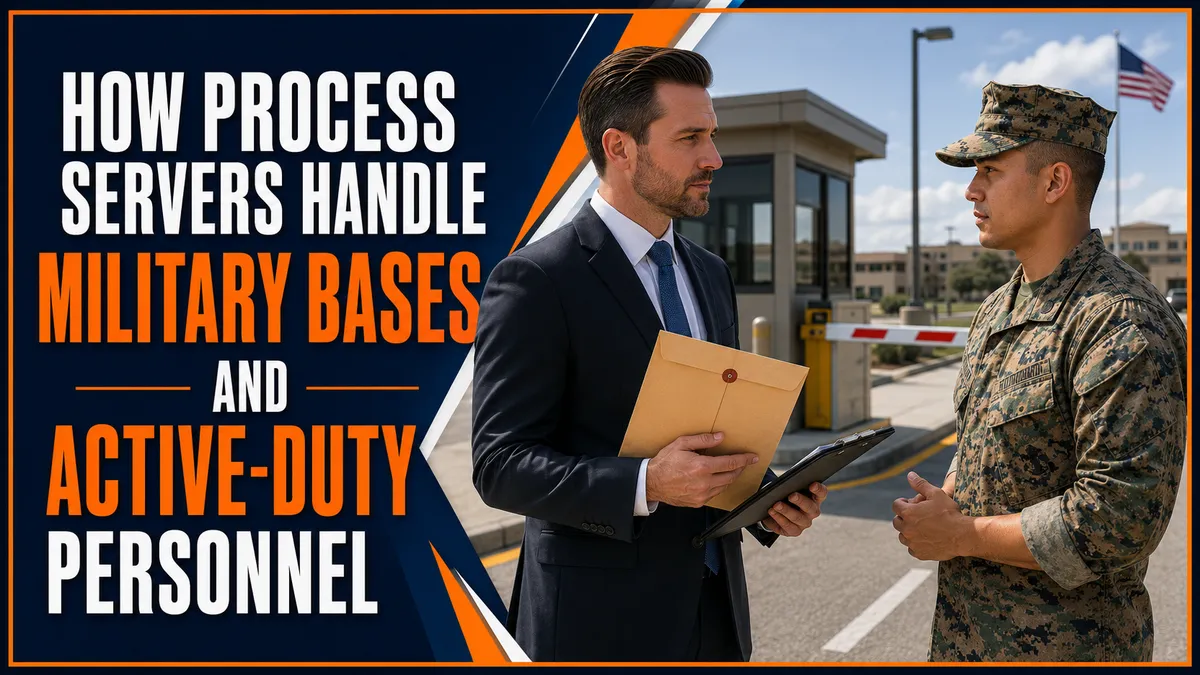
How Process Servers Handle Military Bases and Active-Duty Personnel
Understanding Process Serving on Military Bases
Process servers help protect due process by delivering summonses, complaints, subpoenas, petitions, court orders, and other legal notices to the appropriate parties. When an assignment involves a military installation, the process can become more complicated.
A military base is controlled federal property with security rules designed to protect personnel, equipment, facilities, and military operations. A process server military base assignment therefore requires advance preparation, coordination with installation authorities, and compliance with both service laws and security procedures.
Active-duty status does not generally prevent someone from being served. However, serving papers to active-duty military personnel may involve installation access controls, deployments, changing duty assignments, and federal protections that can affect the underlying court case.
Can Process Servers Serve Legal Papers on Military Installations?
Yes, serving legal papers on military base property may be possible. However, a civilian process server does not automatically have the right to enter a military installation simply because they possess court documents.
Installation commanders have authority to control access to their facilities. The process server may need approval from the visitor center, security office, legal office, provost marshal, military police, or the recipient’s command before entering.
The military base process serving protocol can vary by branch and installation. One base may arrange for the servicemember to meet the server at a visitor center, while another may require the server to coordinate with a legal office or designated command representative.
Process servers should confirm the local procedure before traveling to the installation.
Understanding the Military Base Access Process
A military base access process server assignment usually begins with contacting the installation. The server should explain that they have legal documents for an individual believed to be assigned to or residing on the base.
Depending on the installation, the server may be asked to provide:
Government-issued identification
Process server license or registration
Court name and case number
Copies of the documents
Recipient’s full name and rank
Recipient’s unit or command
Vehicle registration
Proof of vehicle insurance
Expected arrival date and time
Contact information for the requesting attorney
The installation may also conduct a background check, inspect the vehicle, issue a temporary visitor credential, or require an authorized escort.
Process server military access is granted at the installation’s discretion. Arriving without checking local requirements can result in delays or denial at the gate.
Steps for Serving Legal Papers on a Military Base
Military base serving legal documents generally involves several important steps.
1. Review the Assignment
Confirm the subject’s full legal name, branch, rank, installation, unit, residential address, and known duty location. Determine whether the assignment requires personal service or allows another method.
2. Contact the Installation
Call the visitor center, legal assistance office, staff judge advocate, provost marshal, or security office. Ask for the installation’s procedures for civilian service of process.
3. Submit the Required Information
Provide identification and case information requested by the base. Some installations may require advance written notice or additional documentation.
4. Coordinate a Meeting
When entry is permitted, base authorities may arrange for the servicemember to meet the server at an approved location. This could be a visitor center, legal office, security building, or another private area away from sensitive operations.
5. Follow Security Instructions
The process server must remain in authorized areas, comply with escort requirements, and follow all instructions from security personnel.
6. Document the Attempt
Record all contacts, access decisions, instructions, delays, and results. If service cannot be completed, provide the client with a detailed report.
Can a Commanding Officer Accept Legal Documents?
A commanding officer is not automatically authorized to accept personal legal documents for a servicemember. A commander may assist with locating the member or arranging a meeting, but that does not necessarily make the commander a legally qualified substitute recipient.
Naval regulations, for example, permit commanding officers to help facilitate service under certain circumstances, but they do not require commanders to act as process servers. When appropriate, a command may designate a private location where the civilian server and servicemember can meet. 32 CFR § 720.20
Before leaving legal documents military personnel must receive with anyone other than the named recipient, the process server should verify:
Whether substituted service is permitted
Whether the person has authority to accept
Whether previous personal attempts are required
Whether mailing must follow the delivery
Whether the court has issued special instructions
A person’s military rank does not automatically create authority to accept legal documents for someone else.
Legal Considerations for Active-Duty Process Serving
Legal considerations military process serving assignments involve both the rules governing delivery and laws protecting servicemembers during civil proceedings.
The Soldiers’ and Sailors’ Civil Relief Act mentioned in older materials was replaced and modernized as the Servicemembers Civil Relief Act, commonly known as the SCRA.
The SCRA does not ordinarily prohibit active-duty process serving. Instead, it provides protections when military duties materially affect a servicemember’s ability to participate in certain civil proceedings.
Before entering a default judgment, a court may require an affidavit stating whether the defendant is in military service or whether the plaintiff could not determine the defendant’s status. When a defendant is serving in the military, the court may need to appoint an attorney and grant a stay under qualifying circumstances. U.S. Department of Justice
Process servers do not normally decide whether a servicemember qualifies for a stay. Their responsibility is to complete service correctly and report known military information accurately to the client.
Serving Military Personnel Who Live Off Base
Serving military personnel legal papers at an off-base residence may follow the same state rules used for other civilian residences. The server may attempt personal delivery or another authorized method.
However, military households can experience frequent relocations and extended absences. When someone else answers the door, the server should determine:
Whether the servicemember still resides there
Whether the member is deployed or temporarily assigned elsewhere
Whether the residence remains the member’s usual home
Whether the person answering is qualified to accept service
Whether follow-up mailing is required
A military mailing address should not automatically be treated as a current residence. The server should document exactly what was learned without revealing unnecessary details about the lawsuit.
How Deployment Affects Service
Deployment is one of the most significant military process server challenges. The recipient may be overseas, aboard a vessel, participating in training, or assigned to a location that cannot be disclosed.
Family members and military staff may be unable to provide deployment details. The process server should not pressure them or attempt to obtain protected operational information.
If the member is unavailable because of deployment, possible next steps may include:
Reporting the deployment information to the client
Requesting additional time from the court
Coordinating through the installation legal office
Waiting for the member’s return
Attempting another legally authorized address
Requesting permission for alternative service
Following international service procedures when applicable
International agreements, host-country laws, federal rules, military regulations, and court orders may affect service outside the United States. The attorney should determine the correct legal procedure.
Major Military Process Server Challenges
Process serving military installations can involve:
Denied or delayed base access
Extensive visitor screening
Missing unit information
Classified or restricted duty locations
Training exercises
Deployments
Temporary duty assignments
Transfers to another installation
Overseas postings
Unpredictable schedules
Privately managed military housing
Confusion about command authority
Short court deadlines
A process server should never attempt to overcome these obstacles by bypassing security, following vehicles through a gate, entering restricted buildings, or misrepresenting their identity.
Unauthorized entry can lead to removal, detention, future exclusion, or possible legal consequences.
Military Process Server Best Practices
Following military process server best practices can improve efficiency and reduce unnecessary delays.
Plan in Advance
Contact the installation before the first attempt. Ask what identification, documents, and appointment procedures are required.
Verify the Recipient
Confirm the person’s complete name, rank, branch, and unit whenever possible. Military installations may include many people with similar names.
Respect Military Duties
Avoid demanding access to operational areas or interrupting critical responsibilities. Work with the command to arrange service at an appropriate time and location.
Communicate Clearly
Explain the purpose of the visit without revealing unnecessary details about the case. Maintain professional communication with gate personnel, military police, and legal staff.
Protect Sensitive Information
Do not include deployment routes, classified locations, security details, or unnecessary personal information in the service report.
Document Everything
Record each contact, instruction, access decision, and service result accurately. Detailed notes help the client understand why an attempt succeeded or failed.
Following Process Server Military Regulations
The process server military regulations relevant to an assignment may include installation-specific access rules, Department of Defense policies, branch regulations, state service laws, federal court rules, and international requirements.
For example, Air Force installation commanders have authority to grant or deny access and remove unauthorized individuals when reasonably necessary to protect personnel, property, and order. 32 CFR § 809a.2
Process servers should not rely on procedures used at another base. Approval to enter one installation does not necessarily provide permission to enter a different installation.
Documenting a Military Service Attempt
A complete military service report should include:
Date and exact time
Installation and gate visited
Identification presented
Security procedures completed
Offices and personnel contacted
Name or description of each contact
Whether the member’s assignment was confirmed
Whether access was granted or denied
Reason given for the decision
Meeting arrangements offered
Information about deployment or transfer
Final result
Recommended next step
The report should distinguish between confirmed information and third-party statements. For example, write, “The unit representative stated that the subject transferred in June,” rather than presenting the transfer as personally verified.
Process Server Military Resources
Useful process server military resources may include:
Installation visitor centers
Staff judge advocate offices
Military legal assistance offices
Provost marshal offices
Security forces or military police
Department of Defense guidance
State court rules
Federal court rules
The Defense Manpower Data Center
Professional process-serving associations
The National Association of Professional Process Servers and state process server associations may also provide education and networking opportunities. However, installation authorities and the governing court remain the primary sources for assignment-specific procedures.
Serving an Individual Versus the Federal Government
Serving papers to active-duty military personnel in a personal case is different from serving a military department, the Department of Defense, or a servicemember in an official capacity.
Official service may require delivery to designated government representatives and compliance with federal rules. Department of Defense regulations identify officials responsible for accepting certain legal process directed to military departments. 32 CFR § 257.5
The client should clearly identify whether the defendant is being served personally, officially, or in both capacities.
How Mighty Process Server Can Help
MightyProcessServer.com connects law firms, government agencies, businesses, and individuals with professional process servers nationwide. Its process server directory can help clients locate experienced servers near military installations and surrounding communities.
Local professionals may already understand nearby visitor procedures, military housing arrangements, and jurisdiction-specific requirements for serving legal papers.
Conclusion
Serving active-duty personnel requires more than arriving at a military gate with court documents. Process servers must research the assignment, contact the appropriate installation office, obtain required authorization, respect security rules, and coordinate service without disrupting military duties.
Military status does not automatically prevent service, but it can affect access, scheduling, court procedures, and the protections available to the servicemember. Careful planning, accurate documentation, and professional cooperation are essential for completing military assignments lawfully and efficiently.
Stay sharp. Stay informed. Live Mighty!
Read the full article at www.mightyprocessserver.com
This article is published by Process Server Daily, powered by MightyAutomation.ai, the leader in legal support intelligence.