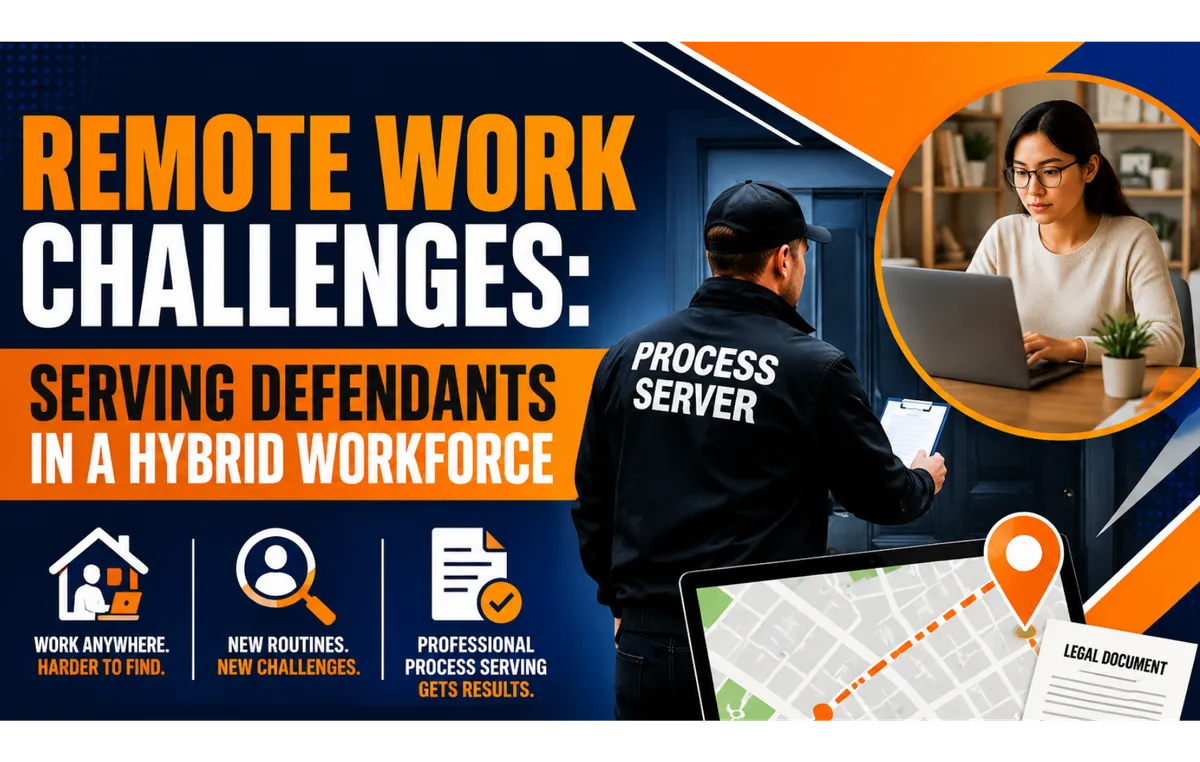
Remote Work Challenges: How to Serve Defendants in a Hybrid Workforce
Remote and hybrid work have transformed where, when, and how people work. Employees who once reported to the same office five days a week may now split their time between home and the workplace, use coworking spaces, travel frequently, or work entirely remotely.
For attorneys, law firms, and process servers, this shift has created a practical challenge: how do you serve a defendant when their workplace is no longer a predictable location?
Successful process serving in a hybrid workforce requires more than repeated visits to an office address. It may involve address verification, skip tracing, strategic scheduling, multiple lawful service locations, technology-assisted documentation, and close communication between the process server and legal team.
This guide explores the biggest remote work challenges in process serving, strategies for locating defendants, technology that can improve service attempts, and best practices law firms can use to reduce delays.
How Remote and Hybrid Work Have Changed Service of Process
Traditionally, a defendant's workplace could be one of the most useful locations for attempting service. Employees often worked predictable schedules at a fixed business address, giving process servers a reasonable opportunity to locate them.
Hybrid work has disrupted that predictability.
A defendant may now:
Work from home several days per week
Visit the office only on designated days
Alternate between multiple company locations
Work from coworking or shared office spaces
Travel regularly for business
Follow a flexible or unpredictable schedule
Work entirely remotely
Be associated with an employer that has downsized or closed its physical office
Consequently, serving defendants in a hybrid workforce often requires more research and flexibility before the first attempt is even made.
Simply having an employer's address may no longer mean the defendant can reliably be found there.
Common Remote Work Challenges for Process Servers
The growth of remote employment has introduced several obstacles that can make traditional service strategies less effective.
1. Inconsistent Office Attendance
One of the biggest challenges is determining when a defendant will actually be at work.
An employee might visit the office only once or twice per week, and those days may change. A process server relying exclusively on workplace attempts could make several unsuccessful visits without ever encountering the defendant.
When permitted and appropriate, varying attempt times and evaluating other possible service locations can improve efficiency.
2. Outdated Employment Information
An address appearing in an old case file, database, or business directory may no longer reflect where an employee actually works.
Companies may:
Relocate
Consolidate offices
Close branch locations
Adopt fully remote operations
Move employees between locations
Replace permanent offices with coworking arrangements
Verifying employment and address information before making repeated attempts can save valuable time.
3. Flexible Work Schedules
Remote employees may not follow conventional 9-to-5 schedules.
Someone may work early mornings, evenings, or a schedule that changes throughout the week. That makes predicting when a defendant will be available at either a workplace or residence more difficult.
Strategic scheduling becomes especially important when dealing with hybrid employees.
4. Increased Workplace Security
Even when a defendant is physically present, modern office security can create another obstacle.
Corporate campuses, high-rise buildings, gated properties, and shared offices may require:
Visitor registration
Identification
Appointments
Security screening
Employee authorization
Access cards or escorts
Professional process servers must understand what they can lawfully do while respecting property restrictions and applicable service rules.
5. Greater Reliance on Residential Service
When workplace service becomes less practical, a verified residential address may become more important.
However, residential service brings its own considerations. Process servers must follow applicable laws governing personal, substituted, or other authorized methods of service while maintaining professionalism and respecting privacy.
How Process Servers Can Locate Remote Defendants
Modern hybrid workforce process serving increasingly combines traditional fieldwork with investigative research.
The goal is not simply to make more attempts. It is to make better-informed attempts.
Verify Addresses Before Service Begins
Address verification can help determine whether the information supplied by the client is still current.
Before relying heavily on one address, a process server may evaluate lawful information sources to determine whether the defendant appears connected to the location.
This can reduce wasted attempts at outdated residences or abandoned workplaces.
Use Skip Tracing When Appropriate
Skip tracing for process serving can be particularly valuable when a defendant's current residence or workplace is uncertain.
Depending on applicable laws and the resources legally available, skip tracing may involve reviewing:
Public records
Address histories
Business records
Property information
Court records
Professional information
Other lawful databases and open-source information
The objective is to develop reliable leads that can be independently evaluated before attempting service.
Consider Multiple Lawful Service Locations
A workplace should not automatically be treated as the only viable location.
Depending on the jurisdiction, circumstances, and authorized method of service, possible locations may include a defendant's:
Residence
Workplace
Business location
Other verified locations where lawful service can be attempted
Using several credible leads can be more effective than repeatedly visiting a single address that produces no results.
Vary Service Attempt Times
Timing can make a significant difference.
For defendants working remotely, attempts during appropriate mornings, evenings, or weekends may increase the likelihood of finding someone at home. Workplace attempts can likewise be adjusted when credible information suggests particular office days.
Any strategy should remain consistent with local laws, professional standards, and assignment requirements.
Using OSINT and Lawful Research in Remote Process Serving
Open-source intelligence, or OSINT, can complement traditional skip tracing when used lawfully and responsibly.
Publicly available information may help identify:
Current employers
Business affiliations
Recent relocations
Public professional profiles
Business addresses
Connections between known locations
However, online information should not automatically be assumed to be accurate.
A professional process server should treat digital information as investigative leads rather than unquestioned facts. Whenever practical, important details should be corroborated before relying on them for field attempts.
Technology for Process Servers in a Hybrid Workforce
Technology has become increasingly important as service assignments grow more complex.
Modern process server technology can improve both field operations and client visibility.
GPS-Verified Service Attempts
GPS data can help document where an attempt occurred and provide additional support for field notes and reporting.
When used appropriately, location and timestamp information creates a stronger record of the server's activity.
Mobile Case Management
Mobile applications allow servers to access assignment information, record attempts, upload documentation, and communicate status updates while working in the field.
This can reduce delays between an attempt and the client's receipt of an update.
Digital Affidavits and Proofs of Service
Digital workflows can reduce manual paperwork and accelerate preparation of affidavits, declarations, or proofs of service.
Accuracy remains essential. Technology should improve documentation rather than replace careful review.
Secure Cloud-Based Reporting
Secure client portals and cloud-based case management systems can give attorneys access to:
Attempt histories
Status updates
Notes
Documents
GPS information
Photographs when appropriate
Completed proofs of service
Real-time visibility is particularly valuable when attorneys are managing urgent deadlines or large numbers of assignments.
Route Optimization
Route planning software can help process servers coordinate attempts across multiple addresses and reduce unnecessary travel.
This becomes increasingly useful when a server must evaluate residential, employment, and other potential service locations within the same assignment.
Legal Considerations When Serving Remote Workers
Remote work may change where a defendant can be found, but it does not eliminate the legal requirements governing service of process.
Service requirements vary by jurisdiction and may depend on factors such as:
Type of legal action
Documents being served
Identity of the recipient
Method of service
Location of service
Court rules
Applicable statutes
Prior service attempts
Process servers and legal professionals should verify the rules that apply to each assignment rather than assuming that a method permitted in one jurisdiction will be valid in another.
Can You Serve Legal Documents Electronically?
Electronic communication has become routine in remote workplaces, but an email, text message, social media message, or other digital communication does not automatically constitute valid service.
Electronic service of process should be used only when authorized by applicable law, court rule, agreement, or court order.
Where alternative service requires judicial approval, detailed documentation of previous attempts and investigative efforts may become especially important.
Why Accurate Defendant Information Matters
The quality of information provided at the beginning of an assignment can directly affect the efficiency of service.
Law firms and clients should provide as much accurate and legally appropriate information as possible, including:
Current residential address
Known employer and workplace address
Possible work schedule
Recent photograph
Vehicle information when relevant
Previous service history
Known alternate addresses
Other useful identifying information
Providing complete information allows the process server to develop a more targeted strategy instead of spending valuable time investigating details the client already possesses.
Best Practices for Law Firms Handling Hybrid-Work Defendants
Law firms can also adjust their workflows to account for today's less predictable workplace environment.
Start the Service Process Early
Waiting until a deadline approaches leaves little room for address problems, remote schedules, gated properties, or unsuccessful attempts.
Assigning service early provides time to investigate alternative locations and strategies if the initial information proves inaccurate.
Verify Information Before Assignment
Review addresses, employer information, photographs, and other available details before sending the assignment.
Even a quick internal review can identify obvious inconsistencies.
Share Previous Attempt Information
If another process server has already attempted service, provide those reports.
Prior attempt notes may reveal useful information about occupancy, security restrictions, schedules, vehicles, or outdated addresses.
Maintain Communication With the Process Server
When new information becomes available, communicate it quickly.
Likewise, process servers should provide timely updates so attorneys can determine whether additional research or alternative legal remedies should be considered.
Document Every Attempt Thoroughly
Detailed records may become important when demonstrating diligence or requesting another method of service.
Quality reporting should identify what happened, when it happened, where the attempt occurred, and other relevant observations.
Due Diligence in Hybrid Workforce Process Serving
Hybrid work makes thorough documentation even more important.
Depending on applicable requirements and circumstances, a strong attempt record may include:
Date and time of each attempt
Exact address or location
Relevant observations
Information obtained during the attempt
GPS verification when used
Photographs when lawful and appropriate
Description of access restrictions
Accurate affidavits or declarations
The purpose is not merely to create more data. It is to establish a clear, credible record of the reasonable efforts made to complete service.
Choosing a Process Server for Remote and Hybrid Workforce Cases
When you need to find a process server for a difficult-to-locate defendant, consider more than price alone.
A qualified provider should demonstrate:
Experience locating hard-to-find individuals
Knowledge of applicable service requirements
Access to lawful skip-tracing resources
Strategic scheduling capabilities
Detailed attempt documentation
GPS verification where appropriate
Secure digital reporting
Clear client communication
Familiarity with local courts and procedures
For law firms handling time-sensitive litigation, these capabilities can help reduce delays and improve visibility throughout the service process.
Frequently Asked Questions About Serving Remote Workers
Can a process server serve someone at their home if they work remotely?
Potentially, yes. Whether and how residential service may be completed depends on the applicable jurisdiction, type of case, and authorized method of service. Process servers should follow the specific rules governing the assignment.
What happens if the defendant no longer works at the listed company?
The process server should accurately document the information discovered during the attempt. The legal team may then provide another address, authorize additional investigation, or consider other legally available service options.
How can a process server find someone who works remotely?
Lawful skip tracing, public records research, address verification, OSINT, prior service information, and other investigative methods may help develop current residential or employment leads.
Does email count as valid service of process?
Not automatically. Electronic service must be authorized under the applicable law, court rule, agreement, or court order. Legal professionals should confirm the requirements before relying on electronic delivery.
Are multiple service attempts always required?
Not necessarily. Requirements vary based on jurisdiction, method of service, case type, and circumstances. When diligence must be demonstrated, however, detailed records of reasonable attempts can be important.
Does GPS verification prove that service was legally valid?
GPS data can support documentation showing where an attempt or service occurred, but location data alone does not establish legal compliance. The server must still satisfy all applicable service requirements.
The Future of Process Serving in a Remote-First World
Hybrid and remote employment are likely to remain important features of the modern workforce.
As working patterns evolve, process serving will increasingly depend on the combination of experienced fieldwork and technology.
Developments such as:
Workflow automation
Secure client portals
Advanced address verification
Mobile reporting
GPS documentation
Data-assisted route planning
Digital case management
Lawful investigative technology
may continue improving how assignments are researched, attempted, documented, and reported.
Technology, however, does not replace professional judgment. Successful process serving still depends on understanding applicable laws, evaluating reliable information, documenting attempts accurately, and adapting strategy to the circumstances of each case.
Conclusion: Adapting Process Serving to Remote Work
Remote and hybrid work have made workplace service less predictable, but they have not made effective service impossible.
The key is adapting the strategy.
Professional process servers can respond to remote work challenges in process serving by verifying information before attempting service, using lawful skip-tracing techniques, evaluating multiple service locations, varying attempt schedules, leveraging modern technology, and maintaining detailed documentation.
For attorneys and law firms, providing accurate information and assigning service early can further reduce delays.
As the workforce continues to evolve, successful process serving will increasingly depend on combining traditional field experience with modern investigative tools, secure technology, and strong communication.
Need help serving a defendant who works remotely or follows a hybrid schedule? MPS provides professional process serving, skip tracing, GPS-supported reporting, and detailed service documentation to help law firms and legal professionals move cases forward efficiently.
Disclaimer: This article is for general informational purposes only and does not constitute legal advice. Service-of-process requirements vary by jurisdiction and case type. Consult applicable statutes, court rules, and qualified legal counsel regarding specific matters.
Stay sharp. Stay informed. Live Mighty!
Read the full article at www.mightyprocessserver.com
This article is published by Process Server Daily, powered by MightyAutomation.ai, the leader in legal support intelligence.