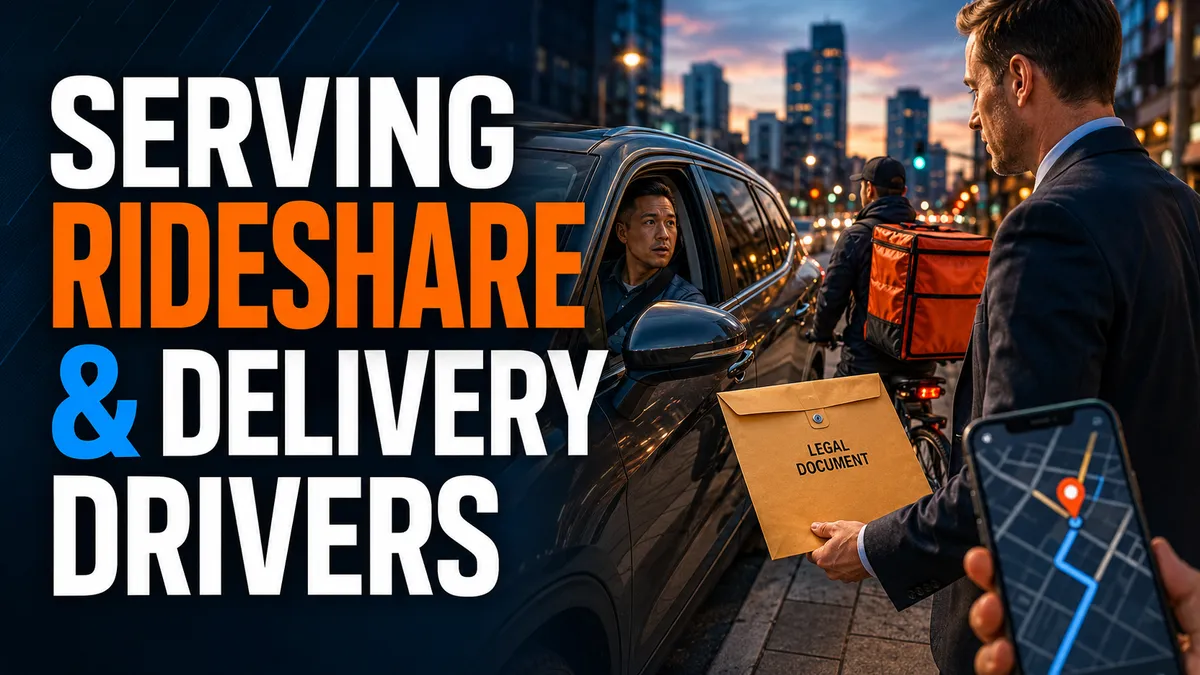
Serving Documents to Rideshare and Delivery Drivers
Listen up, Mighty Nation. The gig economy changed how millions of people work. Rideshare drivers move people around on Uber and Lyft. Delivery drivers run food, groceries and everything else through DoorDash, Uber Eats and Instacart. Great for them. Flexible hours, be your own boss.
Not so great for us when one of them ends up named in a lawsuit. A guy who works out of his car all day doesn't sit at a desk waiting for you. He's in a different neighborhood every hour, maybe a different county by lunch. Serving a rideshare driver takes good research, smart timing, a solid ID, and you keeping your head on straight around moving cars, all while you follow the service rules where you are.
Why Gig Workers Are Tough to Pin Down
A regular employee shows up at an office, a store, a warehouse. You know where they'll be at 9 AM. A rideshare or delivery driver works out of the vehicle and bounces between neighborhoods, cities and counties all day long.
And a lot of them run more than one app. Somebody might take Uber rides in the morning, run DoorDash at lunch and drive Lyft at night. Their schedule, their platform and their area can change every single day.
Here's what you're usually up against:
No fixed business location
Hours that are all over the place
An old residential address in the file
A car shared with family or other drivers
Not much public employment info
Driver profiles that use a nickname or a short name
Company privacy policies that keep driver info locked down
None of that changes the legal standard. You still have to find the right person and serve them the way the rules of the case say.
Fun fact: plenty of us have been on the other side of that windshield. Amanda Curran (EP 08) told me she built her process serving business while driving Uber and Lyft, with both apps on at the same time. Every time she stopped, she'd look up the nearest attorney's office, walk in and hand them her card. She said one of her best clients is somebody she met in her Uber. Stephen Snyder (EP 07) up in Canada has driven Uber too, to stay diversified when serving gets slow. So when you go looking for a driver, remember it's a working person on a hustle, same as you.
Can You Serve a Driver Through the Rideshare Company?
Usually not. Uber, Lyft or DoorDash isn't automatically authorized to accept papers for one of its drivers. A lot of these drivers are independent contractors, not employees. Dropping papers at a corporate office, a local support center, a restaurant or a warehouse may not be valid service on the driver at all.
If the platform itself is a named party, that's a different job. Those papers may need to go to its registered agent or another authorized corporate rep. Don't mix the two up.
Before you try anything through a company, read the summons, the court rules, your client's instructions and the statutes that apply. Still not sure what the right method is? Get direction from the client or the supervising attorney. That's their call, not yours.
Start With Solid Address Research
The home address is usually your best shot at a gig worker. Before you burn gas, check the address in the file against everything else you can legally pull.
That can mean recent public records, property records, prior service reports, lawful database searches, vehicle info from the client and professional skip tracing. Public social media can give you leads, but don't treat it as proof of where somebody lives or works.
Dan Brouillette (EP 25) out of Texas runs license plates the second he gets on site, before he even goes to the door. That way when somebody says "they don't live here," he already knows the car parked out front is registered to them. He'll also tell you that data runs behind, and not every state allows plate lookups, so know your state's rules and verify.
Write down how you tied the address to the person. If the info looks old or contradicts itself, do more research. That saves you wasted trips and keeps you from serving the wrong person.
Hitting the Residence
The house is where you've got the best chance of catching a driver. These folks keep weird hours, so time your attempts around their routine and the service hours your local law allows.
A car that matches the client's description helps tie them to the property. Rideshare decals, insulated delivery bags or other gear back that up. But none of that by itself proves who you're looking at.
If you talk to an occupant, a property manager or a neighbor, keep your mouth shut about the lawsuit. Ask only what you need to find and identify your person.
If your state allows substitute service, follow every rule on who can take it, where, the mailing requirements and the proof of service. Miss one and you're back out there.
Serving a Driver on the Clock
Depending on local law, you may be able to serve a driver personally in a public place. But safety comes first: the driver's, the passengers', the customers' and everybody else on the road.
Never serve somebody while the vehicle is moving. Don't block the car in. Don't chase it. Don't go onto restricted property, don't interfere with a delivery, and don't create a traffic hazard. If they've got a passenger in the back, wait. A better moment will come, and you skip the embarrassment and the blowup.
Walking up to a parked car? Keep some distance, keep your hands where they can see them, identify your person clearly and tell them why you're there like a professional.
Serving a DoorDash driver at a restaurant or a customer's house brings its own privacy and access problems. Restaurant staff and customers generally can't accept papers for an independent driver unless a specific law or court order says they can.
Don't Game the App
You'll see people online say "just order a ride" or "just order a pizza" to get the driver to come to you. Don't. It raises ethical, legal, privacy and safety problems. You can't even pick which driver gets your request, and placing and canceling orders over and over can break the platform's rules.
Somebody in the Facebook group did tell a story about staking out a bar, picking up an Uber ride, and the person who got in his car was the one he was trying to serve. That's dumb luck, folks. It's a great story, not a plan. Don't set that up on purpose.
No fake identities. No made-up emergencies. No borrowed or unauthorized accounts. No shady location tracking. Never try to get into a company's protected data or lean on platform employees to give up a driver's private info.
If you're thinking about some unusual investigative move, check it against your local law and professional standards first. Serve these papers the lawful way so the service holds up.
Make Sure You've Got the Right Person
ID matters a ton on Uber, Lyft and delivery jobs, because that car can be shared, borrowed, rented or registered to somebody else entirely.
Things that help you confirm it:
The subject's full legal name
A photo from the client
A good physical description
Confirmed vehicle info
What the person tells you
Info from an occupant who actually knows them
Several public records tying them to the location
When the info conflicts, no single clue settles it. If the person says "that's not me" and you can't confirm otherwise, write it all down and go do more research. That's the safe move.
When They Won't Take the Papers
Sometimes you identify the driver and they flat out refuse to take the documents. Depending on where you are, refusing may not defeat otherwise valid personal service.
Some places let you clearly announce service and leave the papers near the person when they won't take them. Other places have different rules. Know which one you're in before you try it.
Your report should say how you confirmed who they were, what you said, how they reacted and exactly where you left the papers. Never throw papers at anybody, never stick them on a moving car, and never turn it into a physical confrontation.
Document Every Attempt
Sandra Kimbrough (EP 33) in Baytown, Texas said it best. Some of those Harris County judges are very picky, so document everything that happened. Write down the license plates. Write down who you spoke to. Get a name if you can, because names make what you're saying credible when the judge asks "well, who told you this?"
And like I told her, a picture of the house with the car and the plate is gold. Run it, find out it's theirs, and now any time you see that car around town, you can pretty much attach it to that person. On a driver who lives in his car, that's huge.
A good attempt report covers:
Date and exact time
Full address or public location
GPS info when allowed
What the property looks like
Vehicles and plate numbers that matter
Who you talked to and what they said
How you checked the person's identity or address
Photos when they're lawful and appropriate
Safety concerns or anything weird
What you recommend next
Keep what you saw separate from what you're guessing. Don't write "the driver moved." Write "the current occupant said the subject moved about four months ago and didn't leave a forwarding address."
That right there is why Mighty Process Server logs every attempt for you. Every attempt gets a GPS pin and a timestamp. Snap the photo, log the attempt, move on. When somebody says you were never there, your phone already answered them. And once you finally catch your driver, you can build the affidavit right in the MPS mobile app before you even start the truck, then send it and get it signed for notarization through Mighty Notary. Your proof is done before the next stop.
Evasive Drivers and Alternative Service
If a driver keeps ducking you, switch up your attempt times, sit on the place with a lawful stakeout, run a deeper skip trace, or send the job back to the client for direction.
Depending on the jurisdiction and the case, the court may authorize substitute service, mailing, electronic delivery, posting, publication or another alternative. A lot of those require proof that you made reasonable efforts at personal service first. That's what your attempt log is for.
And you don't get to decide on your own that an alternative method is good. Document every attempt and every sign of evasion so the attorney or the court can decide what happens next.
For the Attorneys and Firms Sending These Jobs
If you're the paralegal or attorney hiring a server for a gig worker, give us everything you've got up front: full legal name, a photo, the vehicle, plate if you have it, and any app or work schedule info your client knows. Every detail you hand over saves an attempt and saves you money.
And if you're shopping for a server, look for one who quotes you right on the order form. With the instant quote in Mighty Process Server, the paralegal gets a number without picking up the phone. Driver lives two counties over? Servers in Mighty Nation can throw it on the bid board so somebody who's actually there can take it.
Bottom Line
Serving rideshare and delivery drivers takes prep, patience and good judgment. Verify the address before you roll, use lawful research, stay away from unsafe roadside stuff, protect confidential info and document every attempt.
The goal isn't to chase a driver through an app or mess with their customers. The goal is to find the right person and get them served safely, respectfully and in a way that holds up in court.
Take the old field methods, adapt them to people who work on wheels, and you'll handle these gig jobs while protecting everybody's rights along the way.
Be safe out there.
Stay sharp. Stay informed. Live Mighty!
Read the full article at www.mightyprocessserver.com
This article is published by Process Server Daily, powered by MightyAutomation.ai, the leader in legal support intelligence.