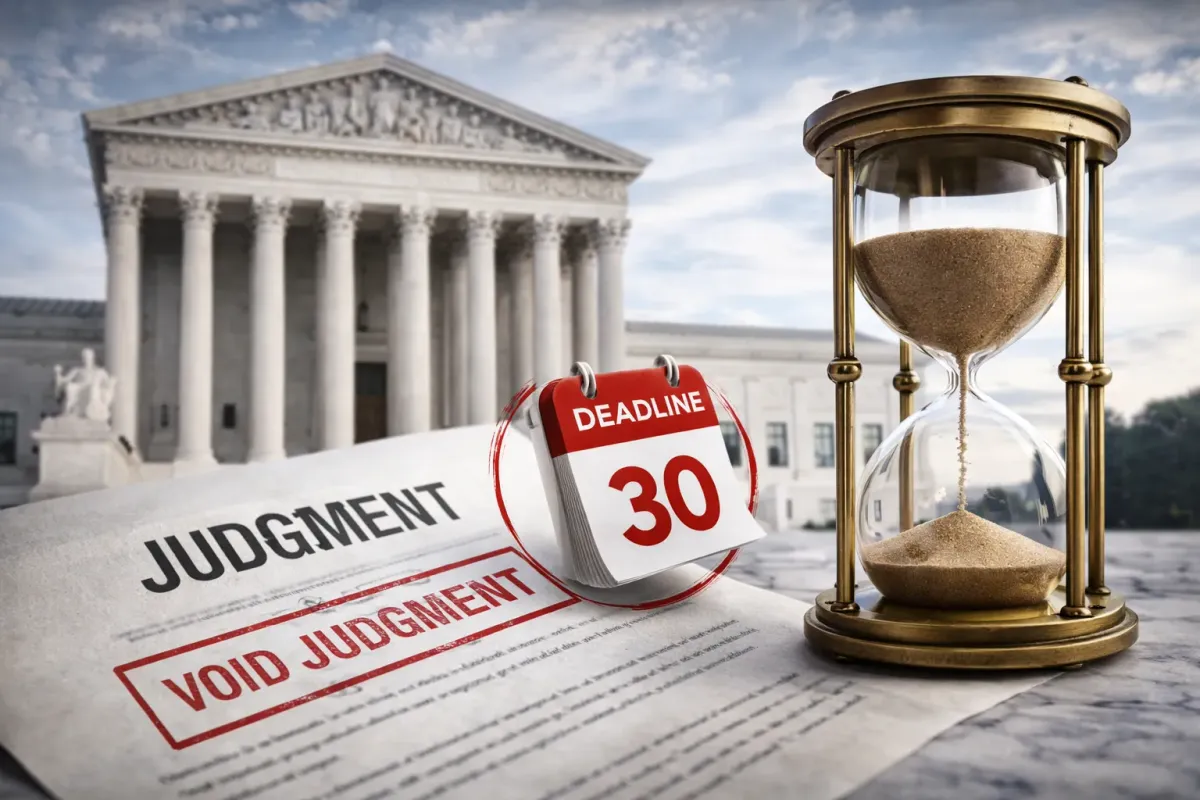
Supreme Court Rules Void Judgment Challenges Have a Time Limit: What It Means for Process Servers
Article version in Mike's voice for Process Server Daily. Not legal advice.
On January 20, 2026, the U.S. Supreme Court decided Coney Island Auto Parts Unlimited, Inc. v. Burton. The short version: if you want a federal court to throw out a judgment because it's "void," you still have to ask within a reasonable time.
If you serve papers, that matters. A void judgment fight almost always starts with one question. Was the defendant served right? And the answer lives in your proof of service.
I used to do 30 or 40 serves a day when I built my process serving company in Redding, up in Northern California. I'm not an attorney, and I don't play one on TV. The firm decides the method. This is what the Court actually said, and what I take from it.
The short version
The case is No. 24-808. The Court decided it on January 20, 2026, after arguments on November 4, 2025.
Justice Alito wrote the opinion. The Court affirmed.
Nobody dissented. Eight justices joined the opinion. Justice Sotomayor agreed with the result and wrote separately.
The holding: the "reasonable time" limit in Federal Rule of Civil Procedure 60(c)(1) applies to a motion claiming a judgment is void under Rule 60(b)(4).
If you saw "8-1" somewhere, that's wrong.
What happened in the case
Vista-Pro Automotive, LLC, went into bankruptcy in 2014. As part of that, it started a lawsuit against Coney Island Auto Parts Unlimited to collect $50,000 in unpaid invoices.
Vista-Pro tried to serve Coney Island by mail. Coney Island says Vista-Pro didn't follow the mail service rule for bankruptcy cases, Federal Rule of Bankruptcy Procedure 7004(b)(3). Coney Island never answered, and the bankruptcy court entered a default judgment in 2015.
Over the next six years, the bankruptcy trustee tried to collect. In April 2016 the trustee sent a demand letter to Coney Island's CEO. The lower courts found that letter gave the company notice of the judgment and the collection effort.
In 2021, a marshal seized money from Coney Island's bank account. Then Coney Island asked the court to vacate the judgment, saying bad service made it void.
The bankruptcy court said no, because the motion wasn't made within a reasonable time. The district court and the Sixth Circuit agreed. The Supreme Court did too.
What the Court actually held
Rule 60(b)(4) lets a court relieve a party from a judgment that is void. Rule 60(c)(1) says a motion under Rule 60(b) "must be made within a reasonable time."
A motion claiming a judgment is void is a motion under Rule 60(b), so the reasonable time limit applies.
Coney Island argued that a void judgment is a "legal nullity," so time can't fix it. The Court said even if time can't cure voidness, that's true of most legal errors, and rules put time limits on those all the time. Rule 60 also sets a one year limit for some reasons, like mistake and fraud, and says nothing about an unlimited window for void judgments.
What the Court did not decide
This is where headlines get loose, so I'll be careful.
The Court did not say Coney Island's service was defective. In a footnote it expressed no view on that.
It did not say the delay was unreasonable either. Coney Island didn't argue it met the reasonable time requirement, so the Court didn't expound on whether its timing was reasonable.
It did not set a number of days or years. "Reasonable time" is not a fixed deadline.
And it did not decide the limits on other routes to relief, like an independent action under Rule 60(d). It expressed no view there.
"A reasonable time" is not a countdown
One part of the opinion matters a lot to people in my line of work.
Coney Island argued that service is different. If you were never properly served, you might not find out about the case until years later. The Court answered that the reasonable time standard handles exactly that. In the context of a default judgment, the Court said, it might be reasonable for a defendant not to seek relief before learning about the plaintiff's attempt to enforce it.
So this isn't "serve badly and you're safe after a year." A defendant who truly didn't know can still have a good argument. A defendant in Coney Island's spot, with a 2016 demand letter and no motion until after the 2021 seizure, has a problem, especially when it didn't even argue its timing was reasonable.
The concurrence and the circuit split
Justice Sotomayor agreed with the result. She wrote separately because she thought the majority said too much about due process, an argument Coney Island never made. It was about how far to go, not about the outcome.
The Court took the case to resolve a split among the federal appeals courts. The opinion says several courts of appeals had held there's no time limit for void judgment motions. A Thompson Coburn write-up counts eleven circuits on that side, with the Sixth Circuit alone on the other. I'm not going to tell you the exact count myself. The Sixth Circuit's reading is the one that won.
This is a federal rule
Rule 60 is a federal rule. It applies in federal court, and the Court noted that it also reaches bankruptcy cases through the bankruptcy rules.
Your state court has its own rules, and they can be very different. California is a good example. The Senate Judiciary Committee's analysis of AB 2042 says the SPARE Act, AB 747, allows a motion to vacate a default judgment that is void for lack of proper service at any time after entry of the judgment. That's a different rule from the federal one in this case. Where your serves end up determines which clock applies. That's a question for the attorney, not for me.
What this means for a process server
Here's where I land. The ruling doesn't make service less important. It makes your paperwork more important, for a different reason.
When a defendant files a motion saying "I was never served," a judge looks at the proof of service. That might be soon after the judgment. It might be years later, since a defendant who didn't learn about the case may still be within a reasonable time. Either way, you have the paper, not your memory.
When I was serving eviction notices, I took a date and time stamped photograph of every single posting. Why? Because the notice is the most contested thing in eviction court. "I never got notice." I heard it all the time. When the judge saw my proof of service with the date and time stamped photo, that was usually the end of it.
I'd do it the same way on any serve where the paper might get challenged later. That's my habit, not a rule from the case.
Show up when they call you
A motion like this can put you on the witness stand. I learned that the hard way.
In Redding, a guy I served at a gas station threw the packet back at me and it cut my head. The city police cited me for trespass. I didn't show up to the court date. Years later, a Shasta County bench warrant turned up when a permit application came back.
Learn from my mistake. If you get a court date, you show up. If a lawyer calls and says they need your testimony on a serve from three years ago, you want to be the server with the clean file.
Why this lands hardest in collections
This case was about collecting unpaid invoices, and collections is where default judgments pile up.
I remember when I picked up a collection account. I went in to grab some serves and they handed me a stack of 40 serves and a $12,000 check. Prepaid. I said, "This is a company."
At that volume, one sloppy proof can sit in a file for years. Then a judgment gets enforced, a defendant says they were never served, and your name is on the paper.
Real attempts leave a real file
I call one of my methods the stalking method. I know the word isn't great. Before I left the office, I wanted to know: Do they work? What time do they work? What kind of car do they drive? And do you have a picture of them?
With those answers, most serves went on the first try, and the file showed a server who did the work.
What I'd tell a server
Write it down while it's fresh. Date, time, address, who you spoke to, and what they looked like.
Take date and time stamped photos of the door or the spot where you served.
Keep your own copy of the proof of service and your notes.
If the firm's attorney calls years later, call back and show up.
What I'd tell attorneys and paralegals
An attorney once told me a server has "one job, serve the paper, and that's it. Sign the proof of service, maybe, right? And communicate status." That's still the job.
If you hold a default judgment, a clean proof of service is part of what protects it. Ask your server how they document each serve and how long they keep their file. Don't wait for a motion.
If you're on the other side, the Court did not take away your right to challenge a void judgment. It said you have to move within a reasonable time. Talk to an attorney about when your clock started.
Need a server?
You can sign up for a free Mighty Process Server account and get up to 25 free jobs every month. You never have to upgrade to a paid plan.
Be safe out there.
FAQ
Did the Supreme Court rule 8-1 in Coney Island Auto Parts v. Burton?
No. There was no dissent. Eight justices joined Justice Alito's opinion, and Justice Sotomayor concurred in the judgment.
When did the Court decide it?
January 20, 2026.
What did the Court hold?
That the reasonable time limit in Federal Rule of Civil Procedure 60(c)(1) applies to a motion claiming a judgment is void under Rule 60(b)(4).
Is there a set deadline now?
No. The rule says "a reasonable time." The Court did not set a number of days or years.
Does this mean the service in the case was valid?
The Court said it expressed no view on whether the alleged defect in service would make the judgment void.
Can a defendant who never knew about the case still challenge a default judgment?
The Court said it might be reasonable for a defendant not to seek relief before learning about the plaintiff's attempt to enforce the judgment. Whether a particular delay is reasonable depends on the case. Ask an attorney.
Does this apply in state court?
Rule 60 is a federal rule. State courts have their own rules, and California, for example, treats this differently under AB 747. Ask an attorney in your state.
Sources
Coney Island Auto Parts Unlimited, Inc. v. Burton, No. 24-808 (U.S. Jan. 20, 2026), opinion of the Court, Alito, J. Supreme Court of the United States: https://www.supremecourt.gov/opinions/25pdf/24-808_lkgn.pdf
Coney Island Auto Parts Unlimited, Inc. v. Burton, syllabus, opinion and concurrence. Cornell Law School LII: https://www.law.cornell.edu/supremecourt/text/24-808
Kelsey Dallas, "Court holds there is a time limit on challenging void judgments," SCOTUSblog, Jan. 20, 2026: https://www.scotusblog.com/2026/01/court-holds-there-is-a-time-limit-on-challenging-void-judgments/
Jeffrey Zawadzki and Emaan Choudhry, "Supreme Court Clarifies Time Limits for Challenging 'Void' Judgments Under Rule 60(b)(4)," Thompson Coburn LLP, Jan. 22, 2026: https://www.thompsoncoburn.com/insights/supreme-court-clarifies-time-limits-for-challenging-void-judgments-under-rule-60b4/
Federal Rule of Civil Procedure 60. Cornell Law School LII: https://www.law.cornell.edu/rules/frcp/rule_60
Senate Judiciary Committee analysis of AB 2042, hearing June 23, 2026: https://sjud.senate.ca.gov/system/files/2026-06/ab-2042-kalra-sjud-analysis.pdf
Stay sharp. Stay informed. Live Mighty!
Read the full article at www.mightyprocessserver.com
This article is published by Process Server Daily, powered by MightyAutomation.ai, the leader in legal support intelligence.