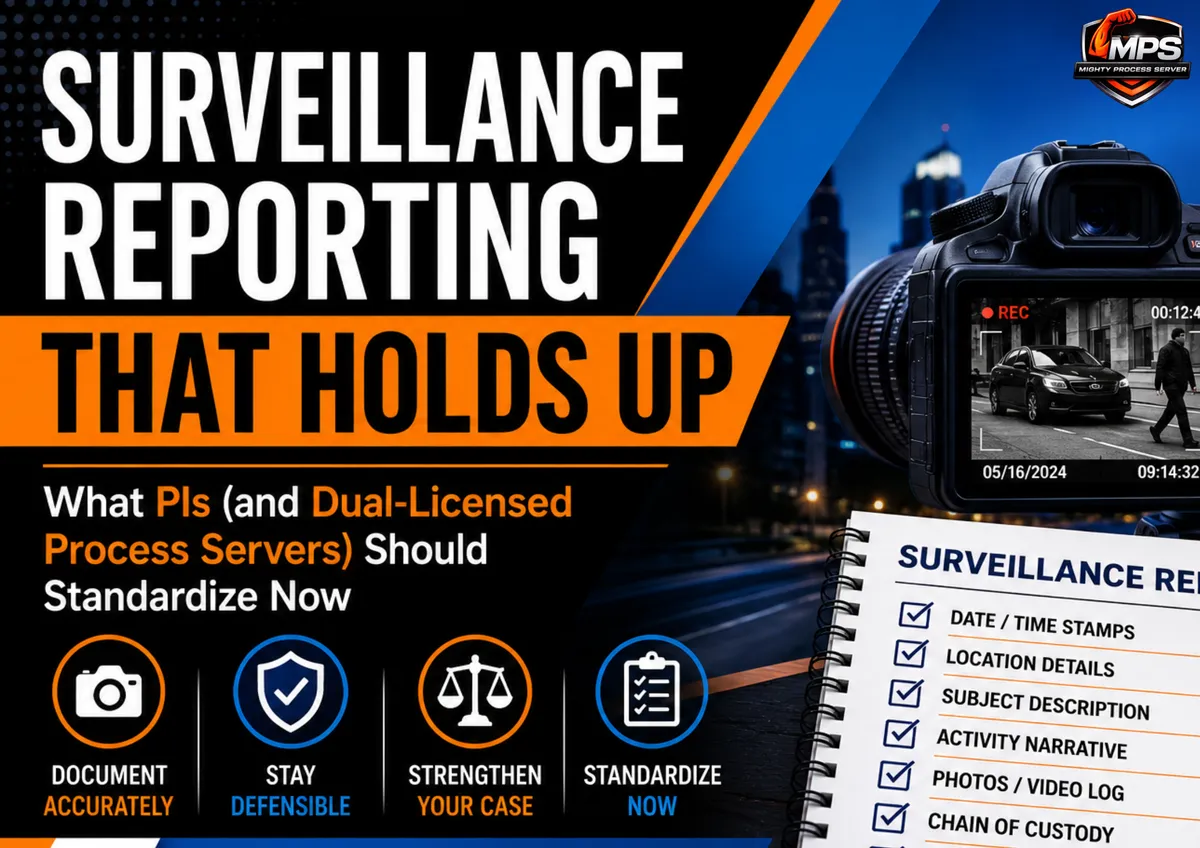
Surveillance Reporting That Holds Up: What PIs and Dual-Licensed Process Servers Should Standardize Now
Surveillance is only as valuable as the documentation that supports it.
For private investigators (PIs) and dual-licensed process servers, conducting effective fieldwork is just one part of the assignment. Attorneys, insurance companies, corporations, and other clients also need a clear, accurate, and defensible record of what happened.
That makes surveillance reporting a critical professional skill.
A strong surveillance report establishes a reliable timeline, documents observable facts, connects photographs or video to specific events, and gives the client a record that can be reviewed without repeatedly asking the investigator for clarification.
For firms offering both investigative and process serving services, standardized reporting can also improve quality control, reduce errors, strengthen client relationships, and create a more defensible record when field activity is questioned.
What Is a Surveillance Report?
A surveillance report is a written record of observations, activities, locations, times, and supporting evidence collected during a surveillance assignment.
Depending on the assignment and applicable laws, a private investigator surveillance report may document:
Dates and times of surveillance
Investigator arrival and departure
Surveillance locations
Subject descriptions
Vehicles observed
Subject movements and activities
Relevant interactions
Photographs and video
Changes in surveillance position
Environmental or visibility conditions
Interruptions or gaps in observation
Other significant field activity
The objective is not simply to record what the investigator believes happened. Effective surveillance documentation distinguishes between observable facts and interpretation.
That distinction can become especially important when attorneys, claims professionals, corporate clients, or opposing parties later review the report.
Why Surveillance Reporting Standards Matter
Surveillance can produce valuable information, but poorly documented surveillance can create unnecessary questions.
Incomplete timestamps, unclear descriptions, inconsistent terminology, missing media, or subjective conclusions can make otherwise useful fieldwork harder for a client to evaluate.
Strong private investigator reporting standards help create consistency from one investigator and assignment to another.
Standardization can help firms:
Reduce missing information
Improve surveillance report accuracy
Simplify supervisor review
Organize supporting evidence
Respond more efficiently to client questions
Maintain consistent documentation across investigators
Create clearer records of field activity
For agencies handling a high volume of assignments, consistency becomes even more important. Clients should not receive dramatically different reporting quality depending on which investigator handled a case.
7 Elements Every Surveillance Report Should Standardize
Although reporting requirements can vary by client, assignment, jurisdiction, and firm policy, several elements deserve particular attention.
1. Accurate Time-Stamped Activity Logs
A reliable timeline is one of the foundations of a professional surveillance report.
Instead of relying on broad statements such as "surveillance continued throughout the morning," reports should document significant activity using specific times whenever practical.
A surveillance log might document when:
The investigator arrived
Surveillance was established
A subject or vehicle was first observed
The subject departed a location
The investigator followed or repositioned
Significant activity occurred
Visual contact was interrupted
Surveillance resumed
The assignment concluded
Accurate timestamps allow the reader to reconstruct the sequence of events and compare written observations with photographs, video, GPS records, or other permitted supporting documentation.
2. Clear Location Documentation
Reports should make it clear where observations occurred.
Depending on the circumstances, this may include addresses, intersections, businesses, public locations, or other relevant geographic descriptions.
Investigators should avoid creating ambiguity about whether an activity occurred at the subject's residence, another property, a business, or while traveling between locations.
Consistent location documentation also makes longer surveillance assignments easier to review.
3. Objective Subject and Activity Descriptions
A strong surveillance report describes what was actually observed.
For example, an investigator might document that a subject was observed carrying an object, entering a vehicle, walking across a parking lot, or speaking with another individual.
The investigator should be cautious about assigning motives, medical conclusions, emotional states, identities, or other interpretations that cannot be established from direct observation or reliable information.
Neutral language strengthens surveillance reporting because it separates evidence from assumption.
A useful internal rule is simple:
Document what you observed—not what you think the observation means.
4. Photographic and Video Evidence Management
Photographs and video can significantly strengthen a surveillance report, but firms should also standardize how that media is handled.
Files should be organized so that relevant media can be connected to the corresponding activity described in the written report.
A firm's procedures may address:
File naming conventions
Date and time information
Original-file preservation
Storage locations
Access controls
Backup procedures
Media references within reports
Retention policies
Procedures for providing copies to clients
Good surveillance data management reduces the risk of losing evidence or creating confusion months after an investigation is completed.
5. Media Chain of Custody
When surveillance photographs or videos may become evidence, maintaining appropriate records concerning the handling of those files can be particularly important.
Firms should consider procedures documenting how media moves from capture through storage, review, transfer, and delivery.
Depending on the assignment, this may include documenting:
Who captured the media
When it was captured
Where original files are stored
Who accessed or transferred files
Whether copies were created
Whether files were edited, compressed, or converted
When evidence was delivered to the client
The appropriate chain-of-custody procedure depends on the evidence, client requirements, applicable law, and potential use of the material.
6. Surveillance Gaps and Visibility Conditions
Reports should not create the impression that an investigator continuously observed something when that was not the case.
If visual contact was lost, visibility became obstructed, or surveillance was interrupted, the report should accurately reflect that circumstance.
Examples can include:
Heavy traffic
Weather conditions
Darkness or poor lighting
Physical obstructions
Distance from the subject
Loss of visual contact
Investigator repositioning
Documenting limitations can actually strengthen the credibility of a report because it demonstrates that the investigator is distinguishing confirmed observations from periods when activity could not be verified.
7. Consistent Report Formatting
Every investigator within a firm should ideally follow a consistent reporting structure.
A standardized surveillance report template can include sections for:
Case or assignment information
Investigator information
Surveillance date
Location
Start and end times
Subject description
Vehicle information
Chronological activity log
Media references
Relevant field notes
Assignment conclusion
Templates should support accuracy rather than encourage investigators to fill reports with repetitive or unnecessary language.
Surveillance Report Checklist for Quality Control
Before delivering a report, investigators and supervisors should perform a final quality-control review.
A surveillance report checklist might confirm that:
Dates and timestamps are accurate and consistent
Locations are clearly identified
Subject and vehicle descriptions are complete where relevant
Activity is presented chronologically
Statements are based on documented observations
Subjective or speculative language has been removed
Surveillance gaps are appropriately disclosed
Photographs and videos correspond with the report
Supporting files are correctly labeled
Original media has been preserved according to firm procedures
Spelling, grammar, names, and case information have been reviewed
Required client-specific information is included
A short review process can prevent minor documentation mistakes from becoming larger problems later.
Technology Is Changing Surveillance Reporting
Modern private investigator technology can make surveillance documentation faster and more consistent.
Depending on applicable laws and assignment requirements, investigators may use tools such as:
Mobile case-management applications
Digital field notes
High-resolution cameras
Secure cloud evidence storage
Automated timestamps
GPS-enabled documentation tools
Case management platforms
Secure client portals
Modern surveillance reporting software can also help investigators create chronological activity logs, attach supporting media, standardize terminology, and maintain case records.
Technology, however, does not eliminate the need for professional judgment.
An automated timestamp cannot determine whether a statement is speculative. A reporting platform cannot guarantee that surveillance was conducted lawfully. And sophisticated software cannot compensate for inaccurate field notes.
Technology should strengthen reporting discipline—not replace it.
Legal Compliance in Surveillance Should Come First
Surveillance laws can vary significantly by jurisdiction and by the specific investigative activity being conducted.
Rules involving privacy, trespass, audio recording, video recording, GPS or electronic tracking, data collection, licensing, and evidence handling may differ between states and circumstances.
Private investigators and process servers performing investigative work should understand the laws applicable to each assignment and jurisdiction.
Firms should also maintain procedures for reviewing changes to relevant statutes, licensing requirements, court decisions, and client requirements.
When uncertainty exists about whether a particular surveillance technique is lawful, professionals should obtain appropriate legal guidance before using it.
A well-written surveillance report cannot cure an unlawfully conducted investigation.
What Dual-Licensed Process Servers Should Consider
The overlap between private investigation and process serving deserves special attention.
A dual-licensed professional may sometimes conduct investigative activity to locate a subject, verify information, document activity, or support a lawful service attempt.
However, process serving and private investigation are not automatically interchangeable activities.
Licensing requirements, permissible investigative methods, documentation requirements, and privacy restrictions can vary by jurisdiction.
Dual-licensed professionals should clearly understand:
Which professional role they are performing
What authority applies to that activity
What the client authorized
Which documentation standards should be followed
How investigative information should be stored and reported
Clear separation of roles can help reduce confusion while providing clients with more useful documentation.
How Better Reporting Helps Process Servers
Even process servers who do not conduct traditional surveillance can benefit from investigative-grade documentation practices.
Contested service often places significant attention on details such as:
When an attempt occurred
Where the server was positioned
How the location was identified
Who was encountered
What the individual looked like
What was said or observed
How long the server remained
What evidence supports the attempt
Detailed contemporaneous notes can make it easier to prepare accurate proofs, declarations, affidavits, or testimony later.
The broader lesson is the same for both professions:
If an important field event happens, document it accurately while the details are fresh.
Common Surveillance Reporting Mistakes to Avoid
Standardization should also address practices that weaken reports.
Common problems include:
Writing reports long after surveillance occurred
Using vague time ranges
Failing to document gaps in observation
Mixing assumptions with confirmed facts
Using unnecessarily dramatic language
Misidentifying people or vehicles
Failing to connect media with written observations
Renaming or modifying original evidence without documentation
Inconsistent formatting between investigators
Omitting information because it appeared insignificant at the time
Some details that appear unimportant during surveillance may become highly relevant later. Contemporaneous documentation helps preserve those details.
Building a Surveillance Reporting SOP
Firms seeking more consistent results should consider developing a written surveillance reporting standard operating procedure (SOP).
The SOP can establish expectations for:
Field note collection
Timekeeping and timestamps
Subject and vehicle descriptions
Report terminology
Media capture and labeling
Original evidence preservation
File storage and security
Supervisor review
Client delivery
Record retention
Training every investigator on the same procedure can improve consistency across the organization.
Firms should also periodically review their procedures as technology, client expectations, and legal requirements change.
Better Surveillance Reports Can Become a Competitive Advantage
Private investigation firms often compete on experience, responsiveness, geographic coverage, and price.
Reporting quality provides another way to differentiate.
Attorneys and other professional clients benefit from reports that are easy to understand, internally consistent, well-organized, and supported by clearly identified evidence.
That can translate into fewer follow-up questions and greater confidence in the firm's work.
For dual-licensed process servers, strong documentation can also distinguish the business from providers that treat field notes and reporting as an afterthought.
The assignment does not end when surveillance stops or papers are served.
The final report is part of the product.
Frequently Asked Questions About Surveillance Reporting
What should be included in a surveillance report?
A surveillance report generally includes the date, time, location, subject description, chronological observations, relevant vehicle information, photographs or video references, surveillance interruptions, and other material field observations. Exact requirements depend on the assignment, client, jurisdiction, and firm procedures.
Why are timestamps important in surveillance reports?
Timestamps create a chronological record of the investigation. They help clients understand when observations occurred and can help connect written observations with supporting photographs, video, and other documentation.
Should surveillance reports contain opinions?
Reports generally benefit from separating observable facts from assumptions or opinions. Investigators should use objective, precise language and clearly identify the basis for any conclusions that legitimately belong in the report.
What is a surveillance report template?
A surveillance report template is a standardized format used to document investigative activity. It helps investigators consistently capture essential information such as times, locations, subject activity, vehicle information, and supporting media.
How should surveillance video be stored?
Firms should use secure storage procedures that preserve relevant original files, control access, maintain appropriate backups, and comply with applicable client requirements, retention policies, and laws.
Can process servers conduct surveillance?
The answer depends on the activity and jurisdiction. Some investigative activities may require a private investigator license or be subject to other legal restrictions. Process servers should verify applicable state and local requirements before performing investigative work outside the ordinary scope of process serving.
Final Takeaway: Standardize the Report Before You Need to Defend It
The future of professional surveillance is not simply about better cameras, more sophisticated PI surveillance tools, or advanced case-management software.
It is about producing documentation that accurately reflects what happened in the field.
Private investigators and dual-licensed process servers should prioritize consistent timestamps, objective language, organized evidence, documented surveillance gaps, secure media management, quality-control reviews, and jurisdiction-specific legal compliance.
A strong surveillance reporting system protects the integrity of the investigation while making the final product more valuable to attorneys and other clients.
The best time to establish those standards is before a report, service attempt, photograph, or video becomes the subject of scrutiny.
Article provided by Mighty Process Server (MPS).
Stay sharp. Stay informed. Live Mighty!
Read the full article at www.mightyprocessserver.com
This article is published by Process Server Daily, powered by MightyAutomation.ai, the leader in legal support intelligence.