Proof of Service Compliance: Why Strong Documentation Protects Collection Litigation
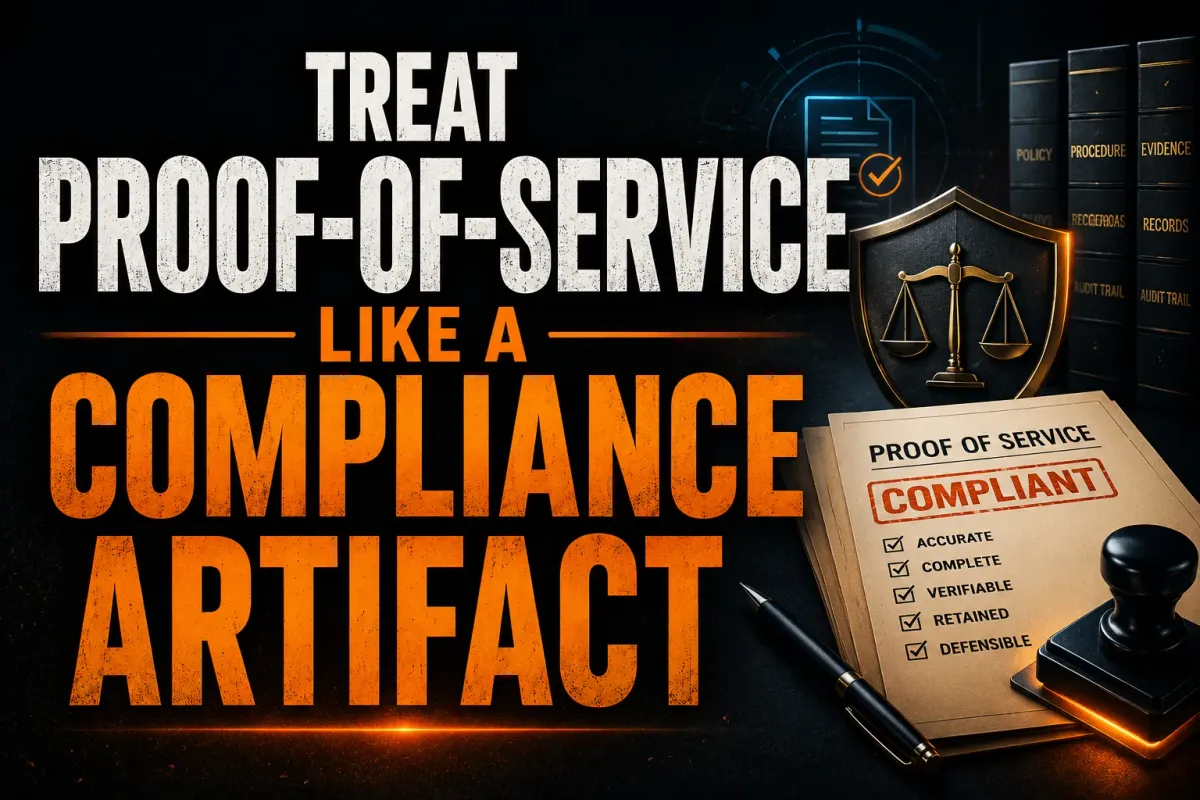
In debt collection litigation, proof of service should be treated as more than a routine court filing. It is a critical compliance record that can help establish whether service was properly completed, support a default judgment, and provide evidence when service is later challenged.
Collection law firms, creditors, process serving companies, and legal support providers operate in an environment where service practices can face scrutiny from courts, consumers, regulators, and state enforcement agencies. That makes accurate process serving documentation increasingly important.
When a defendant challenges a default judgment by claiming improper service, attention often turns immediately to the service record. Questions may include: Was the correct address used? How was that address obtained? How many attempts were made? What happened during each attempt? Does the affidavit match the server's field notes? Is there supporting evidence?
A strong proof of service compliance program helps answer those questions with documentation rather than assumptions.
What Is Proof of Service?
Proof of service is the formal record showing that legal documents were served in accordance with applicable procedural requirements.
Depending on the jurisdiction, case type, and method of service, a proof or affidavit of service may document information such as:
Date and time of service
Address or location of service
Method of service
Documents served
Name or description of the person receiving the documents
Process server information
Details required for substituted or alternative service
Supporting information concerning prior service attempts
The exact requirements vary by jurisdiction, so process servers and law firms should always follow the applicable statutes, court rules, standing orders, and local requirements.
Accurate legal proof of service helps demonstrate that the parties received the notice required for a legal proceeding to move forward.
Why Proof of Service Should Be Treated as a Compliance Artifact
For collection litigation, an affidavit should not exist in isolation.
Think of the filed proof of service as the final output of a larger documentation trail. Behind it should be records capable of showing how, when, where, and under what circumstances service occurred.
A well-managed service record can help:
Establish a clear history of service activity
Support process server compliance procedures
Provide evidence when service is challenged
Identify inconsistencies before an affidavit is filed
Strengthen internal compliance reviews
Support responses to consumer complaints
Reduce the time required to investigate disputed service
Improve accountability across high-volume operations
This becomes particularly important in debt collection litigation, where a properly supported service record may be central to defending a default judgment against a later challenge.
The Risk of “Sewer Service” Allegations
One of the most serious issues associated with collection litigation is alleged sewer service.
The term generally refers to situations in which legal documents are not properly served but records are created indicating that service occurred. Allegations involving inaccurate affidavits, questionable service attempts, or unreliable documentation can undermine confidence in the litigation process and potentially create substantial legal and reputational consequences.
For legitimate process serving companies, the best defense is a strong documentation system.
Instead of relying solely on the final affidavit, firms should maintain a defensible record of the entire service lifecycle whenever permitted and appropriate.
That may include:
Assignment records
Address sources
Attempt histories
Field notes
Timestamps
GPS data
Photographs where lawful and appropriate
Skip trace results
Status changes
Affidavit revisions
Filing records
The objective is simple: the documentation should tell a consistent story from assignment through completion.
5 Proof of Service Controls Collection Firms Should Standardize
Organizations handling large volumes of collection matters should establish repeatable process server compliance controls rather than allowing documentation practices to vary significantly from one assignment or server to another.
1. Establish Address Verification and Governance
Every address sent for service should have a documented source whenever practicable.
Depending on the matter and applicable law, address information may come from:
Client records
Credit applications
Prior litigation records
Public records
Verified databases
Skip trace investigations
Previous service information
Field verification
Maintaining the source and history of address information can help explain why a particular location was selected for service.
This is especially valuable when a defendant later argues that they did not live at the address when service allegedly occurred.
Rather than asking only, “What address did we serve?” compliance teams should be able to ask:
Where did this address come from, when was it obtained, and what information supported using it?
2. Create Consistent Diligence Standards
When personal service cannot be completed immediately, detailed attempt records become increasingly important.
Organizations should establish service-attempt protocols consistent with applicable jurisdictional requirements and client instructions.
Documentation may include:
Date of each attempt
Exact time of each attempt
Location
Observations at the property
Relevant conversations
Vehicle or occupancy observations where appropriate
Access restrictions
Contact attempts
Outcome of each attempt
Where multiple attempts are required or appropriate, varying the days and times of attempts may help create a more complete record of reasonable diligence.
Most importantly, the process server's notes should accurately reflect what actually happened in the field.
3. Capture Supporting Digital Evidence
Modern process serving technology makes it possible to create a much more detailed service record than a traditional handwritten log.
Depending on applicable law, company policy, and the circumstances of the assignment, digital proof of service may include:
GPS coordinates
Geolocation verification
Automatic timestamps
Photographs
Attempt history
Route information
Electronic field notes
Document activity logs
Server status records
These records can provide additional context when an affidavit is questioned months—or even years—after service.
Technology should not replace accurate process server observations. Instead, it should help corroborate and preserve them.
4. Implement Affidavit Quality Assurance
A proof of service should be reviewed for accuracy before it reaches the court.
Quality-control procedures are particularly important for matters involving:
Substituted service
Posting
Multiple defendants
Businesses or registered agents
Gated or secured properties
Alternative service
Complex diligence requirements
Jurisdiction-specific declarations
A proof of service quality assurance checklist can help identify issues such as:
Incorrect names
Wrong addresses
Inconsistent dates or times
Missing attempt information
Conflicting field notes
Incorrect service methods
Incomplete descriptions
Missing signatures or declarations
Catching a discrepancy before filing is far easier than explaining it after a judgment has been challenged.
5. Build a Service Challenge Response Package
Do not wait until service is challenged to determine what records exist.
Collection firms and process serving agencies should consider maintaining a standardized service challenge response package for each matter, subject to applicable retention and privacy requirements.
Depending on the case, that package could include:
Filed proof or affidavit of service
Complete service attempt history
Process server notes
GPS or geolocation records
Photographs
Address verification records
Skip trace information
Relevant assignment instructions
Supporting system activity records
If a motion challenging service is filed, authorized personnel can then retrieve the relevant documentation efficiently.
Proof of Service Best Practices for Process Servers
Individual process servers also play a major role in creating defensible records.
Some important proof of service best practices include:
Record service attempts as soon as possible after they occur.
Use precise dates and times rather than estimates.
Document factual observations rather than assumptions.
Follow jurisdiction-specific service requirements.
Review names and addresses carefully.
Preserve supporting evidence according to company policy and applicable law.
Make sure field notes and affidavits are consistent.
Report unusual circumstances rather than omitting them.
Never alter facts to make an unsuccessful attempt appear successful.
Correct identified errors through appropriate procedures rather than ignoring discrepancies.
Good documentation protects more than the client. It can also protect the process server when the accuracy of a service event is questioned.
Digital Proof of Service Is Changing Compliance
Modern process server software has transformed how service attempts can be documented and reviewed.
Instead of relying on disconnected paper records, digital systems can centralize information throughout the assignment lifecycle.
Common capabilities may include:
Real-time service status updates
GPS-enabled attempt records
Electronic field notes
Photo documentation
Automated timestamps
Digital affidavit generation
Secure document storage
Assignment histories
Compliance reporting
Centralized record retrieval
For high-volume collection litigation, these capabilities can make proof of service management more consistent and scalable.
However, technology alone does not create compliance.
A sophisticated platform combined with weak operating procedures can still produce unreliable records. Firms need both the right technology and clearly defined documentation standards.
What Collection Law Firms Should Require From Process Serving Vendors
Collection law firms should evaluate process serving vendors based on more than price and completion speed.
Useful questions to ask include:
How are service attempts documented?
Are timestamps automatically recorded?
Is GPS verification available?
What quality-control procedures are used?
How are affidavits reviewed before filing?
How are service records retained?
Can historical attempt information be retrieved quickly?
How are disputed service events investigated?
What controls prevent unauthorized changes to records?
How does the company handle process server training and compliance?
A process serving provider should be able to explain not only how it serves documents, but also how it proves what happened afterward.
How Long Should Proof of Service Records Be Retained?
There is no universal retention period appropriate for every process serving operation.
Retention requirements can depend on state law, court rules, contractual requirements, the nature of the case, company policies, privacy obligations, and potential litigation holds.
Collection firms and process serving companies should establish a written proof of service record retention policy with appropriate legal and compliance guidance.
The policy should address both the filed affidavit and supporting records such as photographs, GPS information, notes, and address-verification data.
Keeping everything forever is not automatically the safest strategy. Organizations must balance evidentiary needs against privacy, security, contractual, and data-retention requirements.
Standardization Is a Competitive Advantage
For collection law firms, agencies, and process serving companies trying to scale, consistency can become a major competitive advantage.
Whether an organization uses Mighty Process Server, ServeManager, PST, Crosstrax, or another process serving platform, the fundamental question remains the same:
Can your system produce a consistent, accurate, retrievable, and defensible service record every time?
A strong compliance program should connect:
Address verification → service attempts → evidence capture → affidavit preparation → quality assurance → filing → record retention → challenge response.
When those stages operate as one documented workflow, proof of service becomes more than a form filed with the court. It becomes evidence of how the organization operates.
Frequently Asked Questions About Proof of Service Compliance
What is proof of service?
Proof of service is a formal document or declaration recording that legal documents were served according to applicable procedural requirements. It commonly identifies when and where service occurred, the method used, and other information required by the relevant jurisdiction.
Why is proof of service important in debt collection cases?
Proper service helps establish that a defendant received legally required notice of a lawsuit. If service is defective or cannot be established, subsequent proceedings—including a default judgment—may face challenges.
What information should a process server document?
Requirements vary by jurisdiction, but records may include the date, time, location, method of service, recipient information, descriptions, attempt history, and other facts relevant to the service. Digital systems may also preserve timestamps, GPS information, photographs, and field notes where permitted.
Can GPS be used as proof of service?
GPS information can provide supporting evidence that a process server was at a particular location, but it does not necessarily establish every legal element required for valid service. The applicable court rules and service laws still control.
What is digital proof of service?
Digital proof of service refers to electronic records used to document service activity. These may include electronic affidavits, timestamps, GPS records, photographs, attempt histories, field notes, and related system records.
What happens if proof of service is challenged?
The court may examine the affidavit and other available evidence to determine whether service complied with applicable law. Complete supporting records can help attorneys and process servers reconstruct the service event and respond to allegations of improper service.
Turn Proof of Service Into a Defensible Compliance Record
The strongest proof of service is not simply a completed affidavit. It is the product of a reliable documentation process that begins before the first attempt and continues through filing and record retention.
For collection law firms and process serving companies, stronger controls around address verification, diligence, digital evidence, affidavit review, and record preservation can improve operational consistency and make disputed service easier to investigate.
As legal operations become increasingly digital and data-driven, process serving organizations should ask a straightforward question:
If this service is challenged two years from now, can we quickly demonstrate exactly what happened?
Organizations that can answer that question with complete, consistent, and defensible records will be better prepared for the compliance expectations surrounding modern collection litigation.
This article is for general informational purposes and does not constitute legal advice. Service requirements and documentation rules vary by jurisdiction. Consult applicable statutes, court rules, client requirements, and qualified legal counsel when establishing service and record-retention procedures.
About Mighty Process Server
Mighty Process Server (MPS) helps legal professionals, law firms, collection agencies, and process servers improve operational efficiency and legal compliance through advanced technology solutions, a nationwide process server directory, and powerful process server tools. By supporting process server best practices and comprehensive legal document compliance, MPS enables organizations to create reliable, defensible, and audit-ready service records that meet the demands of today's legal environment.
Stay sharp. Stay informed. Live Mighty!
Read the full article at www.mightyprocessserver.com
This article is published by Process Server Daily, powered by MightyAutomation.ai, the leader in legal support intelligence.