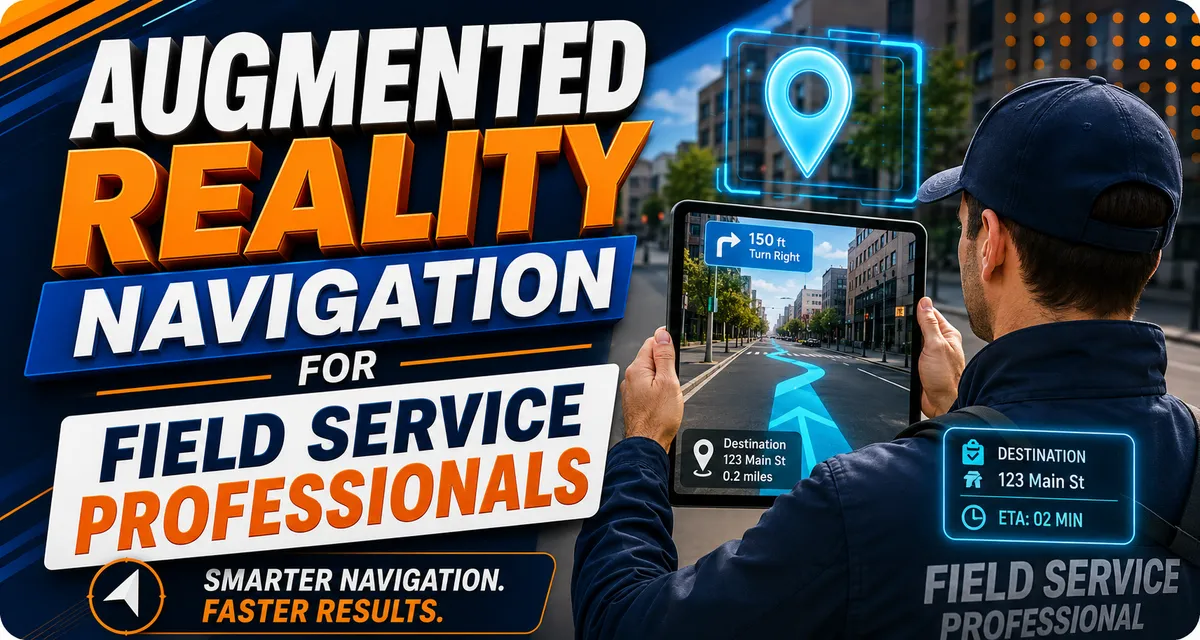
Augmented Reality Navigation for Field Service Professionals: The Future of Process Serving
Augmented reality (AR) is moving beyond gaming and entertainment and into practical business applications. For mobile workers, augmented reality navigation could change how professionals find locations, access job information, document field activity, and communicate with their teams.
For field service professionals, including process servers, investigators, couriers, inspectors, and other mobile workers, AR navigation offers an intriguing advantage: digital information can be layered over a live view of the physical environment. Instead of constantly switching between maps, job details, notes, and other applications, workers could receive relevant information while navigating a property or completing an assignment.
For the process serving industry specifically, AR technology in process serving could eventually complement GPS verification, route optimization, geofencing, mobile case management, and other technologies already reshaping field operations.
This article explores how augmented reality navigation works, its potential benefits for process servers, current limitations, and what AR could mean for the future of legal field services.
What Is Augmented Reality Navigation?
Augmented reality navigation combines digital mapping with a live view of the user's surroundings. Using a smartphone, tablet, wearable device, or smart glasses, AR software can place visual information over streets, buildings, entrances, and other real-world objects.
Instead of looking at a traditional two-dimensional map and determining which direction to walk or drive, a user might see digital arrows, street names, building markers, or destination indicators positioned directly within the camera view.
AR navigation may rely on several technologies working together, including:
GPS and location services
Digital maps
Smartphone cameras
Motion and orientation sensors
Computer vision
Artificial intelligence
Cloud-based mapping data
Unlike virtual reality, which immerses a user in a completely digital environment, augmented reality adds digital information to the physical world the user already sees.
For mobile professionals who regularly travel to unfamiliar addresses, that distinction makes AR particularly relevant.
How Could Augmented Reality Navigation Work for Process Servers?
Process servers spend a significant portion of their working day locating residences, businesses, offices, apartment units, and other service addresses. Traditional GPS applications can guide a server to the general destination, but finding the correct entrance, building, unit, or parking area may still require additional effort.
Augmented reality for process servers could provide another layer of visual guidance.
For example, as a process server approaches a large apartment complex, an AR-enabled application could potentially display visual markers identifying the correct building, pedestrian route, entrance, or other relevant location information.
Depending on the capabilities of the platform, future AR systems could also integrate assignment information such as:
Service address
Case or job number
Authorized service instructions
Previous attempt notes
Property information
Navigation guidance
Safety reminders
Next scheduled assignment
The result could be a more connected process server navigation experience in which location data and workflow information are available through a single interface.
Benefits of Augmented Reality for Process Servers
The potential advantages of augmented reality extend beyond simply replacing a traditional map.
Easier Navigation in Complex Locations
Some addresses are considerably more difficult to locate than others. Large apartment complexes, office parks, campuses, multi-building properties, and commercial developments can turn a seemingly simple service attempt into a time-consuming search.
AR-powered navigation tools for process servers could help display relevant information such as building numbers, entrances, walking routes, parking locations, destination markers, and other location details.
Better visual guidance could reduce the amount of time spent circling a property or searching for the correct entrance.
Greater Location Accuracy
Accuracy is critical in service of process. A process server needs to confirm that an attempt is being made at the correct location while following applicable laws and service requirements.
AR navigation could supplement existing GPS and mapping tools by making the relationship between digital location data and the physical environment easier to understand.
However, AR should not be treated as proof that a person resides at an address or that service was legally completed. Location technology can support field operations, but proper identification, documentation, and compliance procedures remain essential.
Improved Field Productivity
Every unnecessary minute spent searching for a building or navigating a complex property reduces the number of assignments a process server can efficiently handle.
More effective navigation could help process serving companies:
Reduce time between assignments
Minimize unnecessary driving
Complete more attempts during a route
Improve turnaround times
Reduce fuel and labor costs
Respond more quickly to client requests
For high-volume operations, even modest improvements in navigation efficiency can become significant when multiplied across hundreds or thousands of assignments.
More Context at the Point of Service
One of the most interesting possibilities for AR field service tools is the ability to provide relevant information precisely when and where a worker needs it.
Instead of opening several applications to review an assignment, a process server could potentially access approved job information while approaching the destination.
This could reduce application switching and create a more streamlined mobile workflow.
How AR Could Improve Field Service Efficiency
Improving field service efficiency requires more than simply reaching a destination faster. Mobile professionals must also access instructions, document activity, communicate with office staff, and move efficiently between assignments.
Augmented reality could eventually bring these functions together.
An integrated AR interface might display navigation directions alongside service instructions, property details, appointment information, client notes, safety alerts, and route information.
For process serving companies managing a large mobile workforce, connecting AR with existing process serving software could potentially create a continuous workflow from dispatch to field attempt to reporting.
The goal would not be to add another technology that employees must manage. The value would come from reducing friction between the technologies they already use.
Potential AR Applications in Legal Field Services
While navigation is one of the most obvious applications, augmented reality could eventually support other areas of legal field work.
Property and Entrance Identification
AR could help mobile workers orient themselves within large or unfamiliar properties by displaying location markers or previously verified navigation information.
This may be especially useful for apartment communities, office campuses, hospitals, universities, and multi-building commercial properties.
Route Guidance
When integrated with route optimization technology, AR navigation could provide visual guidance from one assignment to the next.
Traditional route optimization determines an efficient sequence of stops. AR could potentially improve the final portion of the journey by helping the field professional navigate from the street or parking area to the appropriate destination.
Contextual Job Information
AR applications could present authorized case or assignment information without requiring workers to navigate repeatedly through multiple application screens.
The practical benefit would be faster access to information while maintaining a streamlined workflow.
Remote Team Collaboration
Connected AR platforms could also support communication between office staff and field personnel.
For example, a dispatcher or supervisor might provide updated instructions while a process server is in the field. In more advanced implementations, remote assistance tools could help workers interpret complex locations or address operational issues.
Augmented Reality and Process Serving Software
The greatest long-term opportunity may come from integrating AR with existing process serving technology rather than treating it as a standalone tool.
Modern process serving platforms can already manage assignments, GPS data, attempt records, affidavits, client communication, billing, and reporting. AR could become another interface through which authorized information is delivered to field personnel.
A future integrated workflow might look like this:
A new service assignment enters the process serving platform.
Route optimization determines an efficient schedule.
GPS navigation guides the process server toward the destination.
AR provides visual guidance near the property.
Geofencing confirms arrival within a designated location.
The mobile application provides authorized service instructions.
The server records the outcome of the attempt.
Case information synchronizes with the central platform.
The client receives an updated status through the appropriate reporting system.
In this model, augmented reality becomes part of a broader mobile field service ecosystem.
Can AR Improve Documentation and Proof of Service?
AR could support better documentation, but organizations should distinguish between operational data and legally sufficient proof of service.
Location information, timestamps, photographs where legally appropriate, and application records may help document a process server's activity. However, the legal requirements for proof of service vary by jurisdiction and case type.
AR-generated information should therefore complement—not replace—required affidavits, declarations, identification procedures, and other legally mandated documentation.
Process serving companies considering AR should also establish clear policies governing what information is captured, how long it is retained, who can access it, and how it is used.
Safety Considerations for AR Navigation
AR navigation has potential safety benefits, but it also introduces risks that field service organizations should address.
Traditional navigation can distract workers when they repeatedly look down at a smartphone. AR can make directions easier to interpret by placing guidance over the surrounding environment.
However, viewing a phone camera while walking or driving can itself become a distraction. Process servers should never use handheld AR applications in ways that interfere with safe driving, awareness of traffic, or attention to their surroundings.
Organizations implementing AR should establish clear safety policies and encourage hands-free or stationary use when appropriate.
Technology should improve situational awareness—not compete with it.
Privacy and Data Security Considerations
Because augmented reality applications may use cameras, GPS data, mapping information, and cloud services, privacy and data security deserve careful consideration.
This is particularly important in legal field services, where assignment information may contain confidential or sensitive data.
Organizations evaluating AR technology should consider:
What information the application collects
Whether images or video are stored
How GPS information is retained
Whether third parties receive location data
How case information is encrypted
Which employees can access stored information
Whether data-retention policies meet legal and contractual requirements
Process serving companies should evaluate applicable privacy laws, court rules, client requirements, and local recording restrictions before deploying technology that captures or stores information from the field.
Challenges of Implementing AR Technology
Despite its potential, widespread adoption of augmented reality in field services faces several practical challenges.
Hardware Costs
Basic AR experiences can operate through smartphones, but more advanced systems may require smart glasses, specialized cameras, or other wearable devices.
Organizations must determine whether the productivity gains justify the investment.
Software Integration
AR applications become considerably more valuable when connected to existing dispatch, case management, mapping, and reporting systems.
Poor integration could create additional work instead of reducing it.
Employee Training
Even intuitive technology requires training. Field personnel need to understand how to operate AR tools safely, interpret displayed information, protect client data, and troubleshoot common problems.
Connectivity Limitations
Some AR functions depend on mobile data, cloud processing, or current mapping information. Rural areas, large buildings, underground locations, and other environments with poor connectivity may limit functionality.
Battery Consumption
Cameras, GPS, mobile data, and continuous screen usage can consume significant battery power. Field professionals working long routes may require charging solutions or devices optimized for extended operation.
Mapping Accuracy
AR is only as useful as the underlying data and positioning technology. Outdated maps, inaccurate building information, GPS drift, and incomplete property data can produce incorrect guidance.
Human judgment therefore remains essential.
Emerging AR Field Service Tools
As AR technology develops, field service applications are likely to become more sophisticated.
Future AR field service tools may include:
Smart glasses with hands-free navigation
Voice-controlled field assistance
Indoor positioning and navigation
AI-powered destination recognition
Building and entrance identification
Real-time safety or hazard notifications
Interactive property maps
Context-aware work instructions
Automated translation
Remote visual assistance
Artificial intelligence could further expand these capabilities by interpreting surroundings and presenting relevant information based on the worker's location and assignment.
AR, AI, and the Future of Process Serving Technology
The future of process serving technology will likely involve multiple technologies working together rather than one innovation transforming the industry by itself.
Augmented reality could complement:
Artificial intelligence
Geofencing
GPS verification
Route optimization
Mobile case management
Cloud-based process serving software
Digital affidavits
Automated client notifications
Predictive scheduling
Workflow automation
Improved mobile connectivity and edge computing may also make real-time AR applications faster and more practical.
For process serving companies, the key question is not simply whether AR is impressive. It is whether the technology can reduce operational friction, improve field accuracy, protect sensitive information, and provide measurable value to clients.
Is Augmented Reality the Future of Field Service?
Augmented reality is unlikely to replace experienced field professionals or eliminate the need for human judgment. Instead, its greatest potential lies in giving mobile workers better information at the moment they need it.
For process servers, AR could eventually make it easier to navigate complex properties, access assignment details, coordinate with dispatch teams, and move efficiently between service attempts.
Adoption will depend on affordability, accuracy, software integration, privacy safeguards, and whether AR tools provide meaningful improvements over existing mobile applications.
Organizations do not necessarily need to invest immediately in expensive wearable hardware. Monitoring AR developments and ensuring existing systems can integrate with emerging mobile technologies may be the more practical approach.
Frequently Asked Questions About Augmented Reality Navigation
What is augmented reality navigation?
Augmented reality navigation uses GPS, cameras, sensors, mapping data, and computer vision to place digital directions or location information over a live view of the physical environment.
How could augmented reality help process servers?
AR could help process servers locate buildings and entrances, navigate complex properties, access assignment information, follow optimized routes, and communicate more efficiently with office staff.
Is augmented reality currently used in process serving?
AR is not yet a standard process serving technology. Its current significance is primarily as an emerging field service technology with potential applications for process serving and other mobile legal services.
Can AR replace GPS navigation?
Not necessarily. AR typically works alongside GPS and digital mapping. GPS helps determine the user's location and route, while AR can provide additional visual guidance within the physical environment.
Can augmented reality improve proof of service?
AR-generated location and activity data could potentially support documentation, but it does not automatically satisfy legal proof-of-service requirements. Process servers must continue to comply with applicable statutes, court rules, and documentation requirements.
What are the biggest challenges of AR in field service?
Common challenges include hardware costs, battery consumption, connectivity, mapping accuracy, employee training, software integration, privacy, and data security.
Are smart glasses necessary for AR navigation?
No. Many augmented reality applications can operate on smartphones or tablets. Smart glasses may eventually provide more convenient hands-free functionality for certain field service applications.
How Mighty Process Server Supports Technology Driven Operations
At MightyProcessServer.com, we believe technology should empower process servers to work smarter while delivering exceptional service to attorneys, law firms, and clients.
Modern platforms already provide powerful capabilities such as job management, GPS supported documentation, digital affidavits, online ordering, automation, client communication, and real time reporting. As augmented reality navigation becomes more widely adopted, it has the potential to integrate seamlessly into these platforms, giving process servers even more powerful tools to improve productivity, accuracy, and customer satisfaction.
Conclusion
Augmented reality navigation for field service professionals represents an emerging opportunity to make mobile work more connected, efficient, and information-driven.
For process servers, AR could eventually provide visual navigation through complex properties, immediate access to assignment information, improved coordination with office teams, and tighter integration with modern process serving software.
However, successful adoption will depend on more than the technology itself. Process serving companies must consider safety, privacy, data security, software integration, accuracy, training, and jurisdiction-specific legal requirements.
As augmented reality, artificial intelligence, geofencing, GPS verification, route optimization, and mobile automation continue to evolve, process servers will have access to increasingly sophisticated tools for managing field operations.
The companies that benefit most will be those that use these technologies strategically—not simply because they are new, but because they make service faster, documentation stronger, operations more transparent, and the client experience better.
Stay sharp. Stay informed. Live Mighty!
Read the full article at www.mightyprocessserver.com
This article is published by Process Server Daily, powered by MightyAutomation.ai, the leader in legal support intelligence.