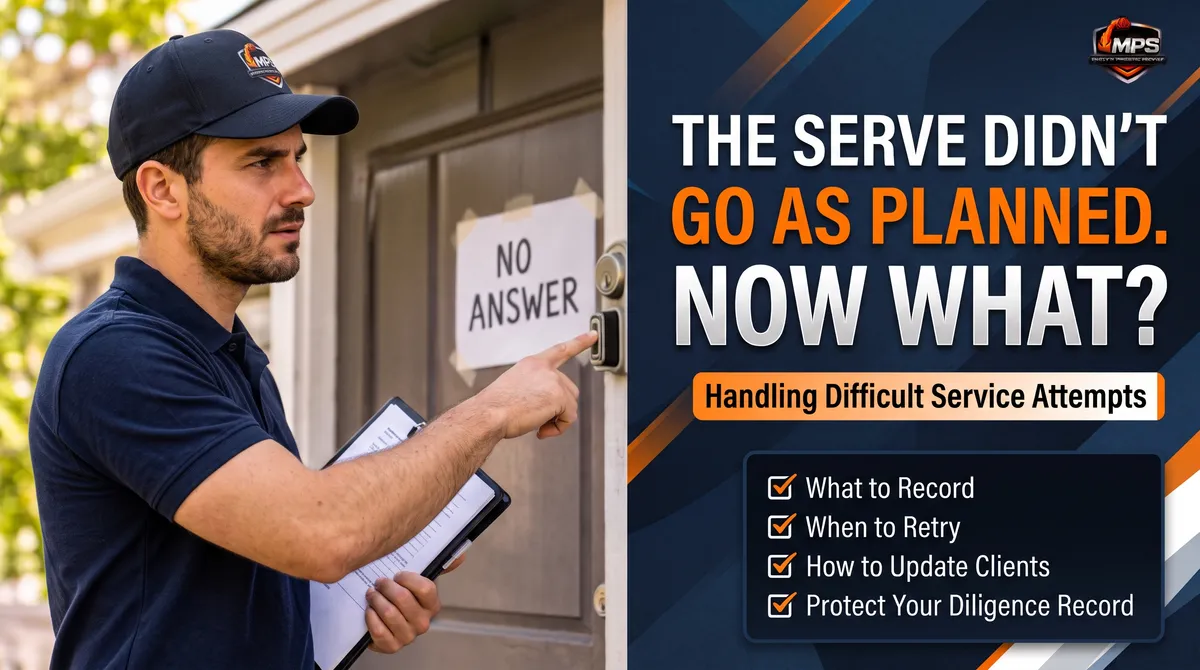
The Serve Didn’t Go as Planned. Now What? Handling Difficult Service Attempts
By Mike Reid for Process Server Daily. This is practical commentary from the field, not legal advice. Service rules vary by jurisdiction and case type.
Not every serve ends with a clean handoff at the door. Some end with a bad address, a hostile greeting, a locked gate, the wrong person, or a gut check that says it is time to leave.
I learned that early while building my process serving company in Redding, in Northern California. The job is not only about completed service. It is also about what you do in the minutes after an attempt goes sideways. Those minutes decide whether the client gets useful options or a vague mess, and whether your diligence record protects everyone or leaves gaps.
This is an after-action playbook for servers and business owners. It is not an attorney roadmap for failed service strategy, and it is not a general essay about why some defendants are hard to find. It is about your next moves when the attempt itself did not go as planned.
1. First Rule: Get Safe, Then Get Specific
If the situation feels unsafe, leave. Do not negotiate with your nerves to "just finish one more try." A completed note is worthless if you get hurt making it. Move to a safe place, then record what happened while the details are still sharp.
Safety stops are part of professional service work. Clients may not love delay. They like injuries even less. A calm update that says you stopped for safety, what triggered it, and what you recommend next is better than silence followed by a problem nobody can fix.
2. What to Do Immediately After a Difficult Attempt
When an attempt goes sideways, follow this sequence:
Get to a safe place.
Write the attempt note while details are fresh.
Separate facts from guesses in what you wrote.
Decide whether another same-day attempt is truly justified.
Send the client a clear update with a recommended next step.
Park the job with a visible status so nobody assumes it is still casually "in progress" without a plan.
If you own a team, make sure the next person who might touch the job can understand the file without calling you.
That sequence turns a bad attempt into managed work. Skipping it turns a bad attempt into tomorrow's emergency.
3. What to Record Immediately After a Sideways Attempt
Your memory will start editing the scene as soon as you drive away. Capture the facts before that happens.
At minimum, record:
Date and time of the attempt
Exact address or location you visited
What you did (knocked, rang, waited, spoke with someone, could not access, and so on)
What you observed with your own eyes and ears
Who you spoke with, if anyone, and what they said
Whether anyone matched the description or name you were given
Why the attempt ended
Photos or location details only if appropriate, lawful, and consistent with your shop's practices and the assignment
Your recommended next step
Keep observation and interpretation apart. "Man at the door said no one by that name lives there" is useful. "He was lying" may be your hunch, but it is not the same kind of fact. Write the statement. Let the client and counsel decide what it means for strategy.
If the address looked wrong, say why. Missing unit numbers, a demolished building, a business where a residence should be, a street that dead-ends before the number range: those details matter later when someone asks what diligence looked like.
4. Common Difficult Service Situations and What They Mean
Every job is unique, but patterns repeat.
Bad or Questionable Address
Signs can include vacant look and feel, mail overflow, neighbor statements, business occupancy where you expected a home, or numbering that does not match the street.
Your job is not to declare the case over. Your job is to document why the address is in doubt and ask whether the client wants research, a different address, or another attempt window.
Hostile Contact
Hostility ranges from raised voices to threats. Note the words and behavior without matching the heat.
Leave when needed. Tell the client what happened in plain language. Do not turn the update into a dramatic story that oversells danger or undersells it.
No Access
Gated communities, locked buildings, security desks, and "appointment only" front offices can stop an attempt before you ever reach the door.
Record who controlled access, what you requested, and what response you got. That record helps the client decide whether another try, different timing, or an alternate approach discussion is warranted under their rules and counsel's advice.
Wrong Person
Serving the wrong person creates bigger problems than a missed attempt.
If identity is unclear, stop. Ask the clarifying questions your training allows. If you still cannot confirm, do not force a completion to protect your ego. Document the encounter and get direction.
No Answer With Little Else Around
"No answer" still deserves texture: time of day, whether lights or vehicles suggested occupancy, whether neighbors were available, whether the place appeared lived-in.
Thin no-answer notes are how diligence records get challenged later.
5. Another Attempt, Research, or Alternate Service Discussion?
After a failed or sideways attempt, people often jump straight to "go back tomorrow." Sometimes that is right. Sometimes it burns miles and calendar days for no good reason.
Use a simple decision frame:
Another attempt makes sense when the address still looks viable, timing was the likely issue, access might improve at a different hour, or the client has given instructions that support continued attempts there.
Research or better information makes sense when the location looks wrong, neighbors undermine residency, the party may have moved, or repeated attempts are producing the same dead end.
A conversation about alternate service options makes sense when personal service at known locations is stalling and the client needs to talk with counsel about lawful next steps in that case.
You are not the attorney. You can report the diligence picture so the attorney can advise the client. Do not invent legal strategy you are not licensed to give.
Your value is the quality of the factual record and the clarity of the options. Their value is deciding which option fits the case.
6. How to Update the Client Without Panic or Over-Promising
Clients can handle bad news. They struggle with fog.
A useful update has four parts:
What you attempted
What you found
What you recommend next
What you need from them, if anything
Example:
"Attempted today at 6:40 p.m. at the listed address. No answer. Neighbor in the end unit said the name was unfamiliar and the house has looked empty for about two weeks. I recommend pausing further attempts at this address until we confirm whether the party still lives there. Do you want address research, or do you have another location to try?"
Notice what that update does not do. It does not promise service by Friday. It does not declare the defendant evasive as settled fact. It does not hide the neighbor statement. It does not ask the client to mind-read what you need.
If you use a job record where attempt notes and status live together, put the update there as soon as you can so the client and your team are not working from different versions of the night. Soft tools help. Clear writing helps more.
7. When to Stop Burning Miles
There is a point where more driving is not diligence. It is inertia.
Watch for these warning signs:
Multiple attempts at the same address with the same thin result
No new information between visits
Growing evidence the address is stale
Client silence after you asked for direction
Safety concerns that have not been addressed
Call that moment early. "I can keep going back, but here is what the record shows and here is what I recommend instead" is professional. Quietly looping the same block because nobody wants an awkward conversation is not.
Miles cost money. More important, delayed decisions cost options. A client who hears the problem on attempt two has more room to choose than a client who hears it after two weeks of unchanged notes.
8. How a Clean Diligence Record Protects Everyone
Think about who relies on your notes.
The attorney needs to advise the client. The client needs to understand progress and cost. Your future self needs to prepare an accurate proof or explain what was tried. A court may later look at whether service efforts were genuine and documented. Your teammate may need to pick up the job cold.
A clean diligence record helps all of them because it is specific, timely, and honest. It shows where you went, when you went, what happened, and why you stopped or continued. It does not guarantee a legal outcome. It does give people something solid to work with.
Sloppy records create the opposite: doubt, rework, blame, and sometimes a need to redo fieldwork that could have been clearer the first time.
If your shop keeps attempt history and job status in one place, that consistency becomes part of the protection. Mighty Process Server is one example of centralized attempt notes and status that can keep the story coherent for the people who need it.
Again, the software is support. The standard is the writing.
9. Teaching Your Team the Same After-Action Habit
If you have more than one server, difficult attempts are where shops drift apart. One person writes novels. Another writes "NA." One calls the client immediately. Another hopes the problem resolves itself.
Set a shared after-action standard:
Same required fields.
Same rule for safety stops.
Same expectation for same-day updates on material problems.
Regular reviews of difficult attempts to check what was recorded, what was communicated, and what should happen next.
Review a few hard attempts each week the way a coach reviews film.
The goal is not identical personalities. The goal is interchangeable clarity. Any teammate should be able to open the job and understand the diligence picture.
10. What Not to Do After a Difficult Attempt
A short list of avoidable mistakes:
Do not wait days to mention a likely bad address.
Do not pad notes with conclusions you cannot support.
Do not keep attempting just to look busy.
Do not promise alternate service results you do not control.
Do not argue with hostile people to prove a point.
Do not serve someone you cannot reasonably identify.
Do not bury a safety incident because you worry the client will be upset.
Each of those mistakes trades short-term comfort for long-term trouble.
Closing: The Serve Is Not Only the Successful Handoff
Process serving gets marketed around completed service, and completed service matters. But professionals are also measured by what happens when the door does not open, the address is wrong, or the situation turns ugly.
Get safe. Write it down. Update without drama. Choose the next move on purpose. Stop burning miles when the record says the current path is spent. Keep a diligence history clean enough that a client, an attorney, a teammate, or your future self can trust it.
Do that consistently, and difficult attempts stop feeling like personal failures. They become part of a controlled process: still frustrating sometimes, still human, but no longer chaotic.
When the serve does not go as planned, the next honest page in the job record is the work. Start there.
Mike Reid, Process Server Daily