What to Do When a Recipient Destroys the Documents
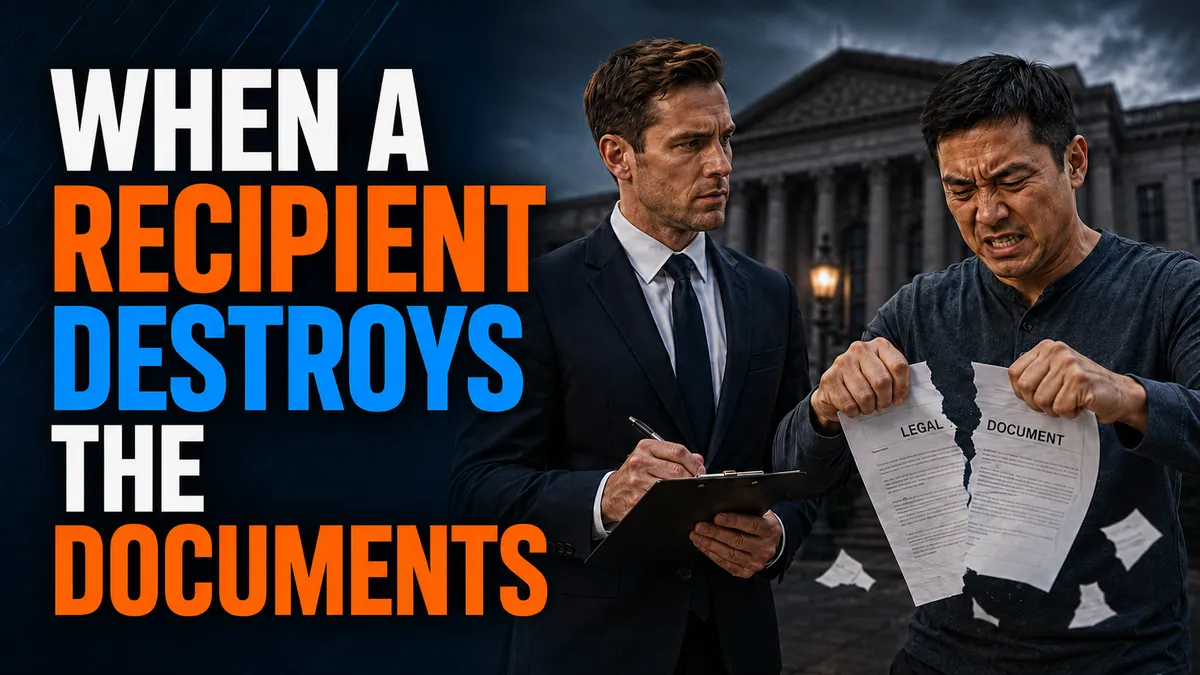
You hand them the papers. They look at the first page. Then they rip the whole stack in half, maybe twice, and toss it in the trash can right in front of you.
It happens. Most people take the papers and shut the door. Some refuse to touch them. Some throw them in the yard. And some tear them up like that's going to make the lawsuit go away. Anger, fear, confusion, or a real belief that no papers means no case. Whatever the reason, it's not your problem to fix in the driveway.
Your job right then is simple. Stay calm. Figure out if service was completed. Keep yourself safe. Write it all down. Tell your client.
Does tearing up the papers undo the serve?
Not usually.
The question that matters is whether you completed service the way the law and the court rules for that case require. If you did, what they do with the papers afterward generally doesn't erase it. A person can't make a valid serve disappear by throwing it in the trash.
It gets less clear when they refuse before the papers ever hit their hands. Some jurisdictions let you announce service and leave the papers near a person you've identified. Others have different rules. Know yours before you go out.
And don't play judge at the scene. If you're not sure the serve is good, report the facts to the client or the supervising attorney and let them decide.
Is it a crime to destroy served papers?
Not automatically. Tearing up their own copy is not automatically contempt, obstruction, or anything else. It depends on what the document is, who owned it, whether it was an original, and whether they were trying to hide evidence or mess with a case.
It gets more serious when someone:
Destroys original evidence or somebody else's property
Violates a court order to preserve something
Threatens or assaults the server
Tries to keep another person from getting notice
Destroys documents tied to pending litigation
Does something that could count as obstruction under the law that applies
That's the attorney's call. Your job is to give an accurate account. You are not there to accuse anybody of a crime.
Right there on the porch: what not to do
Safety first. Somebody who's shredding paper and yelling can get worse if you push back.
Don't:
Argue about the lawsuit
Try to grab the papers back
Touch or restrain the person
Block a doorway or a car
Threaten them with arrest
Walk onto private property to pick up what they threw
Give legal advice about the case
Tell them what penalties they're facing
If it turns threatening, leave. Now. Call law enforcement if there's a real threat, an assault, property damage, or another emergency. Then get somewhere safe and write your notes while it's still fresh.
Was service actually completed? Walk it back
Before you touch the affidavit, rebuild what happened in order:
Did you have the right person?
How did you confirm who they were?
Did you announce what you were delivering?
Did you have the right documents?
Did they physically take them?
If they refused, where did the papers end up?
Did they see or acknowledge the papers?
Did the destruction happen before or after delivery?
Was anybody else there?
Write what happened. Don't write what you think they were feeling.
They took the papers, then tore them up
Let them. Don't step in. Watch from a safe, lawful spot and get the order of events right.
A good report reads something like this:
"After confirming the recipient's identity, I handed him the documents. He accepted them, looked at the first page, tore the papers into several pieces, and placed the pieces in a trash container."
That's proof from your own eyes. It beats "he went crazy" or "he was trying to dodge the case" every single time.
Keep the two things separate: he received them, then he destroyed them. That order matters if anybody challenges the serve later.
They refused, then trashed what you left
People won't put a hand out. They shut the door. They walk away. They say "I'm not taking anything." Refusal doesn't always stop a valid serve.
Where the law allows it, announce service clearly and set the papers down near them or in another proper spot. The exact steps depend on where you are.
Never throw papers at a person, stuff them in their clothes, stick them on a moving car, or jam them through a door in a way that could hurt somebody.
If they destroy the papers you left after a refusal, your report needs to say where you put them, whether they saw them, what you said, and what they did next.
Build your evidence while it's fresh
Good evidence starts with notes you write right away, not three days later at your kitchen table.
Get down:
Date and exact time
Full service address
How you verified identity
The words you used to announce service
How you delivered
Anything relevant they said
Exactly what they did
Where the torn papers ended up
Names or descriptions of witnesses
Any threats or safety concerns
When you left
Photos or video, when it's lawful
Keep what you saw separate from what somebody told you. If a neighbor says something, write down who said it and quote them as close as you can.
This is exactly what Mighty Process Server is built for. Tore 'em up in front of you? Log it in the attempt record with a photo. Every attempt gets a GPS pin and a timestamp from your phone, and your notes stay private to the job. That's your proof, not your memory.
Do you need video to prove it?
No. A detailed affidavit from a neutral process server can be strong evidence by itself, especially when it's clear and consistent.
You can back it up with lawful photos, witness statements, security footage obtained the right way, the torn pieces themselves, GPS records, the notes you wrote on the spot, and the message you sent the client right after.
Get all of it legally. Don't trespass, don't look through windows, don't record conversations you're not allowed to record, and don't break local privacy laws to build your file.
Keep it locked down too. Your photos and reports belong in your case-management system, shared only with the client, the attorney, the court, or whoever else is allowed to see them.
Tell the client fast
Let the client know as soon as you reasonably can. Say whether service was completed, then what happened after.
Something like:
"Personal service was completed at 6:42 p.m. The recipient accepted the documents and immediately tore them into pieces. I left the location safely and documented the incident. A complete affidavit and incident report will follow."
Now the attorney can decide what's next: send another copy, take legal action over the destroyed papers, preserve the evidence, or do nothing at all.
Don't promise anybody sanctions. Whether there's any legal recourse is the attorney's call, based on the law and the facts.
Write the affidavit straight
The proof of service names the recipient, the documents, how you delivered, the date, the time, and the place. If the destruction matters, describe it in the affidavit or in a separate declaration.
Don't write that they committed contempt, obstruction, or any other offense unless the right legal authority already decided that. Describe what you saw. That's it.
You're signing this under penalty of perjury. Read it. Make sure it matches your field notes. Fix anything that doesn't.
When it's ready, Mighty Process Server builds the affidavit from your attempt history right in the app, and with the Mighty Notary integration you can get it signed and notarized electronically without driving across town. Sign it yourself, every time. Nobody signs an affidavit for somebody else.
Can the server get in trouble?
Normally, no. You're not responsible for somebody's choice to destroy papers after you lawfully delivered them.
Where you can get in trouble is excessive force, trespassing, damaging property, breaking privacy laws, or signing a false affidavit. Follow your local service rules and your company's procedures, and your notes will show you stayed professional.
If it got threatening, report it internally, keep all the evidence, and talk to the client or a lawyer if anybody files a complaint.
Keep it from blowing up in the first place
Nothing guarantees they'll keep the papers in one piece. But you can turn the heat down.
Walk up calm. Keep some distance. Identify the person carefully. Don't argue about the case. Bring a witness along when it makes sense, as long as you respect confidentiality and the law.
Know your local refusal rules before you ever leave the house. Keep your document sets organized, keep your exit clear, and use a reporting system you trust.
And don't try to explain the lawsuit. "These are legal documents and they have important information in them" is usually all you need to say.
Hiring a server? Here's what to look for
If you're the attorney, paralegal, or firm sending the job out, ask one question: when things go sideways at the door, what will this server hand me? You want exact times, GPS, photos where lawful, and an affidavit that describes conduct instead of guessing at motives.
On MightyProcessServer.com you can find professional process servers by location, here and now internationally with international address search, see their pricing up front, and get an instant quote right on the form. Then you can watch every attempt come in with GPS and notes, so you know what happened on that porch before the court asks.
Where to learn more
State and national process server associations, experienced servers you trust, continuing education, agency supervisors, attorneys, and your court rules are all good places to start. Look for safety training, affidavit templates, incident report forms, local service manuals, privacy law guidance, and professional standards from established associations.
Get the training before the bad day, not after. When you already know how to handle a refusal, an angry recipient, or a stack of shredded paper, you act with a lot more confidence.
Wrap
When somebody tears up the papers, don't argue, don't grab them back, and don't accuse them of anything. Stay safe, figure out whether delivery was completed, document it like a pro, and tell your client.
Tearing up their copy doesn't automatically erase a valid serve or stop the case. The attorney and the court decide what happens next. You just bring them the facts. Be safe out there.
Stay sharp. Stay informed. Live Mighty!
Read the full article at www.mightyprocessserver.com
This article is published by Process Server Daily, powered by MightyAutomation.ai, the leader in legal support intelligence.