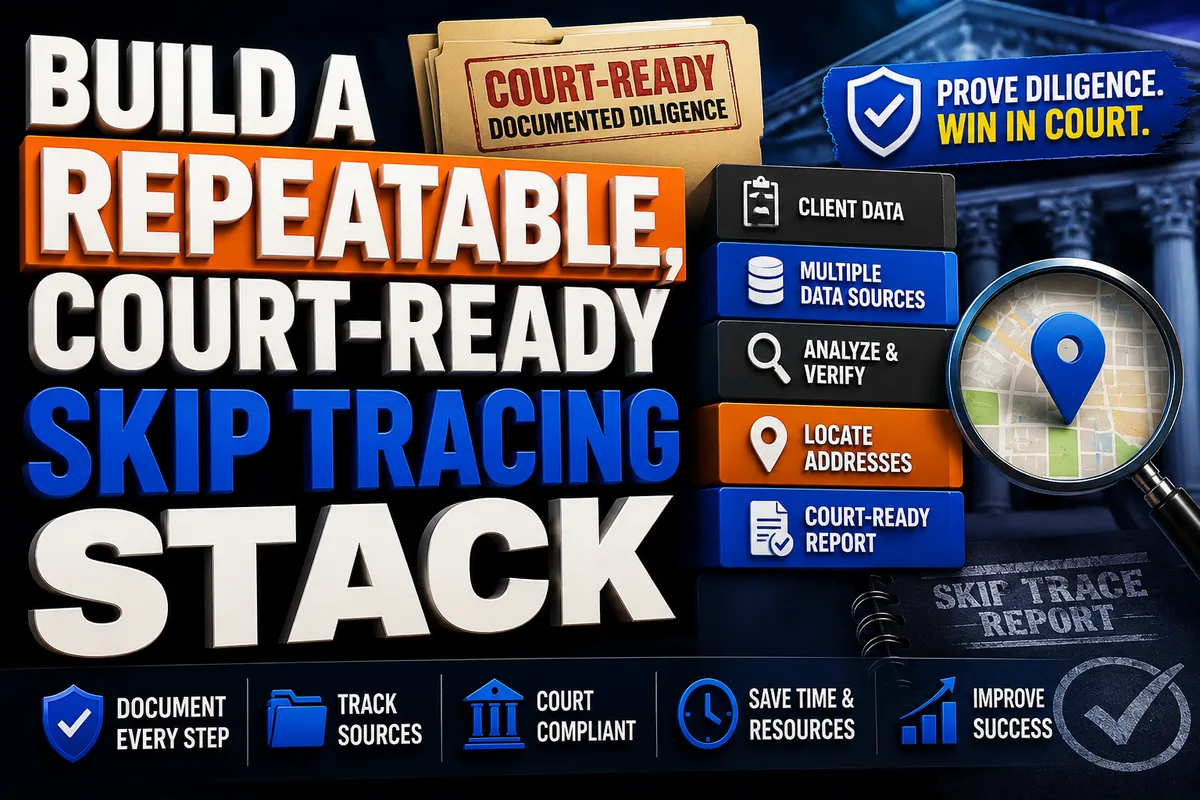
Build a Repeatable, Court-Ready Skip Trace Stack for Modern Process Serving
Skip tracing has always been an important part of process serving. But today, simply finding a possible address is not enough. Attorneys, law firms, process servers, and investigators increasingly need a repeatable skip tracing process that produces accurate leads, documents reasonable diligence, and supports service decisions that may later be reviewed by a court.
A court-ready skip trace stack combines reliable data sources, public records, open-source intelligence, field verification, standardized workflows, and detailed documentation. The objective is not merely to locate someone—it is to create a defensible record showing how the information was obtained, how it was verified, and what actions followed.
For process serving agencies, that distinction matters. When service is challenged or an attorney seeks authorization for alternative service, the quality of the diligence record can become just as important as the address discovered.
What Is Skip Tracing?
Skip tracing is the process of researching available information to locate an individual, verify an address, identify possible contact information, or develop additional leads.
In legal services, skip tracing may be used to:
Locate defendants or witnesses
Verify residential addresses
Identify possible employment information
Investigate conflicting address information
Eliminate outdated addresses
Support additional service attempts
Document reasonable diligence
Assist attorneys seeking alternative or substituted service
For a professional process server, skip tracing should be treated as a structured investigative workflow rather than a one-time database search.
The strongest results come from combining multiple sources, evaluating their reliability, and documenting the reasoning behind each decision.
Why a Court-Ready Skip Trace Stack Matters
A skip trace can produce a promising address without producing a defensible investigation.
That distinction becomes important when service efforts are questioned.
Depending on the jurisdiction and circumstances, a party seeking substituted, alternative, or other court-authorized methods of service may need to demonstrate that reasonable or diligent efforts were made to locate or serve the person through conventional means.
A court-ready skip tracing system helps create a record showing:
What information was available at the beginning
Which sources were searched
When searches were conducted
What each source revealed
Which addresses were considered
How information was corroborated
Why certain leads were pursued or eliminated
What service attempts followed
What additional investigation was performed
Instead of producing an unexplained address, the process produces a chronological record of diligence.
Skip Tracing Is Also a Documentation Process
Many professionals think of skip tracing primarily as research. For legal work, documentation deserves equal attention.
A useful skip trace file should answer two basic questions:
Where is the subject most likely located?
What reasonable steps led to that conclusion?
If an attorney reviewing the assignment months later cannot quickly reconstruct the investigation, valuable context may have been lost.
Professional agencies can reduce that problem by establishing standardized procedures for recording searches, findings, verification steps, service attempts, and follow-up actions.
The goal is not to generate unnecessary paperwork. It is to preserve the information necessary to explain what happened.
How to Build a Repeatable Skip Tracing Process
A repeatable workflow helps process servers perform investigations consistently across different assignments and researchers.
Step 1: Collect and Normalize the Starting Information
Before searching databases, gather the information already available from the client or case file.
That may include:
Full legal name and known aliases
Current or previous addresses
Phone numbers
Email addresses
Date of birth, when lawfully available
Employer or business information
Vehicle information, where legally accessible
Names of associated individuals
Previous service attempts
Case-related address information
Review the information for inconsistencies before beginning the investigation.
For example, different spellings of a name, unit numbers, outdated ZIP codes, or incomplete addresses can significantly affect search results.
Step 2: Use Multiple Independent Data Sources
One of the most important skip tracing best practices is avoiding dependence on a single database.
No database is perfect. Records may be outdated, incomplete, incorrectly associated, or based on information that has not been independently verified.
A layered approach may incorporate lawful sources such as:
Property ownership records
Business registrations
Court records
Professional licensing databases
Tax or assessment records
Voter information where legally available
Publicly accessible online information
Commercial skip tracing databases
Other authorized records relevant to the investigation
The key is corroboration.
If several independent sources point toward the same address, the lead may deserve greater confidence than an address appearing in only one source.
Step 3: Score Leads by Reliability and Recency
Not every record deserves equal weight.
A ten-year-old address should generally not be treated the same as several recent, independently corroborated indicators.
Agencies can improve consistency by developing an internal framework that considers factors such as:
Recency
Source reliability
Number of independent matches
Consistency with known information
Evidence of current occupancy
Contradictory information
Results of previous service attempts
A simple confidence classification—such as high, medium, or low—can help researchers communicate why a particular address deserves field investigation.
It should not replace professional judgment, but it can make that judgment easier to document.
Essential Skip Tracing Tools for Process Servers
A strong skip trace stack usually combines several categories of research tools rather than relying on a single platform.
Commercial Skip Tracing Databases
Commercial databases can provide useful starting points for an investigation.
Depending on the platform, authorized use, and available records, results may include:
Address histories
Possible telephone numbers
Associated individuals
Property information
Business affiliations
Other identifying or locating information
Database results should generally be treated as investigative leads rather than unquestionable facts.
Whenever practical, significant findings should be corroborated through additional lawful sources.
Public Records Research
Public records remain valuable for legal skip tracing because they can provide independent evidence that supports or contradicts commercial database results.
Potential sources include:
Property records
Court records
Business filings
Tax assessments
Professional licenses
Other government records available for lawful public use
Availability and permissible use vary by jurisdiction.
Open-Source Intelligence
Open-source intelligence, commonly called OSINT, can provide context that structured databases may miss.
Potential sources include:
Business websites
Public professional profiles
Public social media content
News reports
Organization directories
Public announcements
OSINT information should be evaluated carefully. A profile may be old, inaccurate, impersonated, or unrelated to the intended person.
Use open-source information as another signal—not automatic proof of current residence.
Standardize Search Procedures Across Your Team
Skip tracing becomes difficult to audit when every researcher follows a completely different process.
A professional agency should consider establishing standard procedures for common searches involving:
Individuals
Businesses
Addresses
Employers
Associated persons
Property ownership
Public online information
Standardized workflows can improve:
Training
Research speed
Quality control
Consistency
File review
Documentation
Handoffs between researchers and field servers
The objective is not to eliminate professional judgment. It is to create a reliable baseline that ensures important research steps are not accidentally skipped.
Create Standardized Search Strings
Search engines and public websites can produce dramatically different results depending on how queries are structured.
Agencies can develop approved search patterns for common investigations, such as combinations of:
Full name + city
Full name + state
Full name + employer
Full name + known address
Business name + owner
Address + associated business
Phone number + public references
Researchers should still adapt searches to individual circumstances, but standardized starting points make investigations more repeatable.
They also make training new staff easier.
Move From Data to Field Verification
A common mistake is continuing online research long after sufficient information exists to justify a field attempt.
Skip tracing rarely produces absolute certainty.
When several reliable indicators identify a plausible location, the next useful source of information may be the field itself.
Depending on applicable laws, court rules, agency policies, and assignment requirements, field verification may involve:
Attempts at different times of day
Weekday and weekend attempts
Observing lawful occupancy indicators
Comparing names or unit information
Documenting relevant property observations
Conducting lawful inquiries when appropriate
Field observations can confirm a research lead—or eliminate it.
The important point is that skip tracing and service attempts should operate as a feedback loop.
Research informs field activity. Field activity generates new information. That information then informs the next research or service decision.
Build a Court-Ready Diligence Log
One of the most valuable products of a skip trace investigation may be the diligence log.
A strong log creates a chronological account of the research and service process.
Depending on the assignment and applicable requirements, document:
Date and time of research
Sources consulted
Material results
Addresses identified
Verification steps
Addresses eliminated and why
Dates and times of service attempts
Relevant field observations
Follow-up research
Subsequent actions
Reasoning behind significant decisions
Avoid vague notes such as "ran skip trace" when more useful detail can be recorded.
Instead, preserve enough information for another qualified professional to understand what was searched, what was found, and why the investigation progressed as it did.
Preserve Source Provenance
A court-ready workflow should also preserve where important information came from.
For each significant lead, consider recording:
Source name
Search date
Relevant result
Whether the information was independently verified
How the information affected the next action
This creates an audit trail.
It also helps prevent an important operational problem: a team member finding an address but later being unable to explain where it came from.
Legal and Compliance Considerations in Skip Tracing
Skip tracing must always be conducted lawfully and for permissible purposes.
Depending on the assignment, jurisdiction, data source, and professional role, relevant requirements may include:
Privacy laws
Consumer protection laws
Data-access restrictions
Licensing requirements
Court rules
State-specific service requirements
Contractual database restrictions
The Fair Debt Collection Practices Act when applicable
Other federal, state, or local regulations
Access to information does not automatically mean every use of that information is permitted.
Process servers, investigators, agencies, and law firms should establish policies governing authorized access, permissible purposes, data retention, documentation, and disclosure.
When legal requirements are unclear, consult applicable rules or qualified legal counsel rather than relying on generalized skip tracing practices.
Account for Modern Contact Avoidance
Locating and contacting individuals has changed significantly.
People can now:
Screen unknown calls
Filter text messages
Use video doorbells
Restrict social media visibility
Remove information from people-search websites
Ignore unfamiliar visitors
Use virtual or alternative contact methods
These behaviors do not necessarily prove intentional evasion.
For process servers, however, they can make traditional contact strategies less productive and increase the importance of careful documentation.
Rather than assuming why someone could not be reached, document the observable facts: attempts made, dates and times, information available, observations, and subsequent investigative steps.
That creates a stronger record than speculation about intent.
Using Skip Tracing to Support Alternative Service
Skip tracing may become especially important when an attorney considers asking a court for authorization to use an alternative method of service.
Requirements vary substantially by jurisdiction and case type, so the applicable rules must always control.
However, a well-organized diligence package may help counsel demonstrate the history of efforts made before seeking additional relief.
A useful file may contain:
Known and verified addresses
Research results
Address histories
Attempt records
Relevant occupancy observations
Contact-path research
Eliminated addresses and supporting reasons
Chronological diligence logs
Supporting documentation permitted by applicable rules
The purpose is to make the progression clear.
A reviewer should be able to see how conventional service was pursued, what obstacles arose, what additional investigation occurred, and why another service method may be requested.
A Practical Court-Ready Skip Trace Stack
For agencies building or improving their workflow, a repeatable stack can be organized into five layers:
Layer 1: Intake
Collect and normalize all client-provided information.
Layer 2: Research
Search multiple lawful commercial, public-record, and open-source resources.
Layer 3: Corroboration
Compare findings and assign confidence based on reliability, recency, and independent confirmation.
Layer 4: Field Verification
Use service attempts and lawful observations to confirm or eliminate promising leads.
Layer 5: Documentation
Create a chronological diligence record connecting research findings to field decisions and subsequent actions.
This structure turns skip tracing from an isolated research task into an integrated process serving diligence workflow.
Choosing a Process Server With Skip Tracing Capabilities
Law firms and legal departments using a process server directory to locate providers should evaluate more than whether a company advertises skip tracing.
Useful questions include:
Does the provider use multiple research sources?
How are addresses verified?
Are research steps documented?
Can the agency provide a clear diligence timeline?
How are conflicting records handled?
Does the provider understand local service rules?
Are research and field attempts integrated?
How are sensitive records protected?
Can documentation be provided in a client- or court-ready format?
The strongest providers understand that successful service often begins before the process server reaches the address.
The Future of Skip Tracing Technology
Skip tracing technology will continue to evolve as privacy expectations, data availability, and legal requirements change.
Likely areas of continued development include:
Address confidence scoring
Automated data verification
Integrated research and service platforms
Structured diligence reporting
Digital audit trails
Automated timeline generation
Better duplicate and identity matching
Stronger access and data-security controls
Technology can make research faster, but automation does not eliminate the need for professional judgment.
As information becomes more fragmented, the ability to verify, document, and explain a conclusion may become even more valuable.
Frequently Asked Questions About Skip Tracing
What is skip tracing in process serving?
Skip tracing is the process of researching lawful information sources to locate an individual, verify an address, develop additional leads, or support service-of-process efforts.
What makes a skip trace court-ready?
A court-ready skip trace emphasizes documentation and traceability. The file should show which sources were searched, what was found, how important information was verified, what service attempts occurred, and how those results influenced subsequent actions.
What are the best skip tracing methods for process servers?
Effective skip tracing generally relies on multiple lawful sources, including commercial databases, public records, open-source information, and field verification. No single source should automatically be treated as definitive.
Why should process servers use multiple skip tracing sources?
Individual databases can contain outdated, incomplete, or incorrect information. Comparing independent sources helps identify inconsistencies and increases confidence in promising leads.
Can skip tracing help with alternative service?
Yes. Depending on applicable court rules, documented research and unsuccessful service efforts may help attorneys establish the diligence necessary to request alternative or substituted service. The exact requirements vary by jurisdiction.
What should a skip tracing diligence log include?
A diligence log should generally document relevant research dates, sources reviewed, material findings, address verification, service attempts, observations, eliminated leads, follow-up actions, and the progression of the investigation.
Conclusion: Build a Skip Trace Process That Can Be Explained
A successful skip trace stack is more than a collection of databases.
It is a repeatable system for gathering information, corroborating leads, transitioning from research to field verification, and documenting reasonable diligence throughout the assignment.
For process servers, investigators, attorneys, and law firms, the strongest workflow is one that another professional can understand without having to reconstruct the investigation from scattered notes.
Research. Corroborate. Attempt. Document. Reassess.
That cycle creates more than a possible address. It creates a defensible record of the work performed.
In modern process serving, finding the individual is only one measure of success. Being able to clearly demonstrate the reasonable, lawful, and well-documented steps taken to find and serve that individual can be just as important.
Article provided by MPS (Mighty Process Server), helping process servers, attorneys, and law firms improve documentation, strengthen diligence records, and build more effective skip tracing workflows.
Stay sharp. Stay informed. Live Mighty!
Read the full article at www.mightyprocessserver.com
This article is published by Process Server Daily, powered by MightyAutomation.ai, the leader in legal support intelligence.