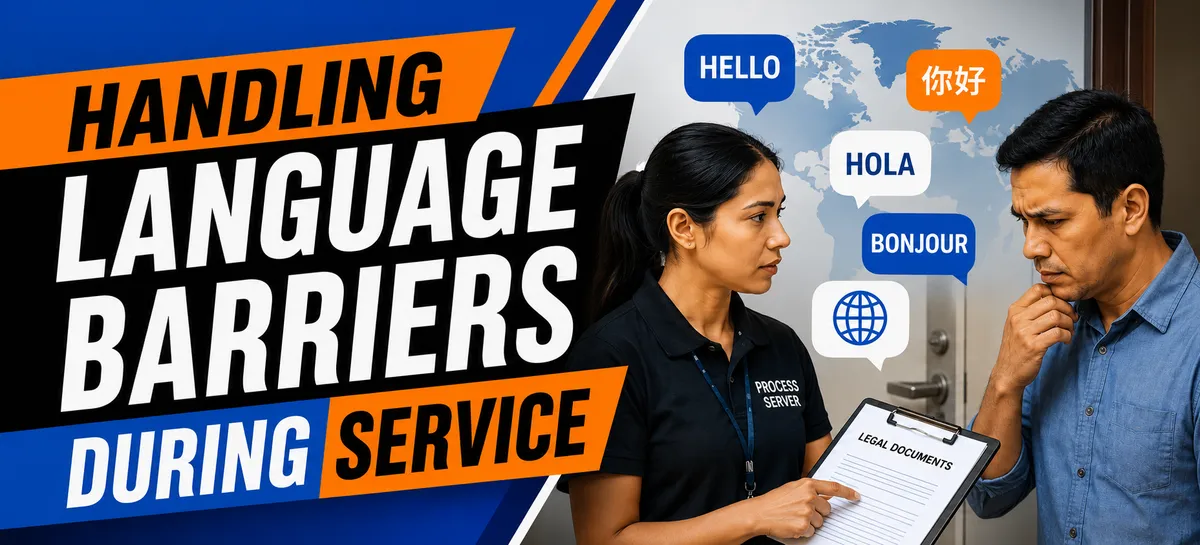
Handling Language Barriers During Service
Introduction
The legal support industry serves individuals from every cultural and linguistic background. As communities become increasingly diverse, language barriers in process serving have become a common challenge for licensed process servers. Serving legal documents to individuals who speak little or no English requires professionalism, patience, and a clear understanding of legal responsibilities.
While communication difficulties can complicate an assignment, they do not prevent a process server from performing lawful service when all legal requirements are met. Developing strategies for overcoming language barriers in legal service helps improve professionalism, reduce misunderstandings, and strengthen client confidence.
Why Effective Communication Matters
Why is effective communication important in process serving?
Effective communication in process serving helps ensure interactions remain professional, respectful, and efficient. Although process servers are not responsible for providing legal advice or interpreting court documents, they should clearly identify themselves and explain the purpose of their visit when appropriate.
Clear communication helps:
Reduce confusion
Minimize confrontation
Improve cooperation
Protect the integrity of the service
Support accurate documentation
Good communication also reflects positively on both the process server and the hiring law firm.
Common Process Server Communication Challenges
Every assignment is different, but process server communication challenges often arise when serving individuals with limited English proficiency.
Common situations include:
Non-English speaking recipients
Elderly individuals who primarily speak another language
Recently arrived immigrants
Tourists or temporary residents
Households where multiple languages are spoken
Regional dialects that create communication difficulties
These situations require flexibility while maintaining professionalism throughout the service attempt.
Understanding the Role of the Process Server
A process server's responsibility is to lawfully deliver legal documents according to applicable statutes and court rules.
Process servers should never:
Interpret legal documents
Explain legal rights
Offer legal advice
Recommend legal strategies
Answer legal questions on behalf of attorneys
When recipients request legal guidance, they should be encouraged to consult an attorney or the issuing court.
Preparing Before the Service Attempt
Preparation can significantly reduce communication difficulties.
Before arriving at the service location, process servers should:
Review available case information
Verify the address
Research common languages spoken in the area
Carry multilingual identification cards when available
Prepare a brief professional introduction
Understand jurisdiction-specific service requirements
Preparation allows process servers to respond more confidently when language differences arise.
Handling Non-English Speaking Clients
Serving individuals who speak another language requires patience and professionalism.
When handling non-English speaking clients, process servers should:
Speak slowly and clearly
Use simple words and short sentences
Avoid slang or technical expressions
Remain respectful at all times
Use visual cues only when appropriate
Stay calm if communication becomes difficult
Respectful communication often reduces unnecessary tension.
Cross-Cultural Communication in Legal Service
Language differences are frequently accompanied by cultural differences.
Successful cross-cultural communication in legal service requires awareness that customs vary between communities.
Examples include:
Greeting styles
Eye contact expectations
Personal space
Family involvement
Communication preferences
Perceptions of authority
Showing cultural respect helps establish professionalism even when verbal communication is limited.
Translation Services for Process Servers
There are situations where translation services for process servers can improve communication while supporting legal compliance.
Professional translation services may assist with:
Language identification
Explaining the purpose of the interaction
General communication
Translated informational materials
Coordination with attorneys when appropriate
However, translation services should never replace legal advice or alter the contents of official court documents.
Legal Document Translation
Some jurisdictions or legal matters may require legal document translation.
Whenever translations are needed:
Use qualified translators
Ensure translations accurately reflect the original documents
Follow applicable court requirements
Avoid unofficial alterations
Preserve the integrity of the legal paperwork
Accurate translations help minimize future legal disputes regarding document content.
Interpreters for Process Servers
In certain situations, interpreters for process servers may assist during communication with recipients.
When working with interpreters:
Continue addressing the recipient directly
Keep communication professional
Avoid discussing confidential information beyond what is necessary
Allow the interpreter to translate accurately without adding opinions
Certified interpreters may be especially valuable during complex interactions.
Process Server Tools That Improve Communication
Modern process server tools make multilingual communication more accessible than ever.
Helpful technology includes:
Mobile translation applications
Language identification software
Speech-to-text translation tools
Digital phrase libraries
GPS-supported case management systems
Secure communication platforms
Technology should support communication but should never replace compliance with legal procedures.
Process Server Training for Language Barriers
Professional education helps prepare servers for increasingly diverse communities.
Effective process server training for language barriers may include:
Cultural awareness
Basic multilingual greetings
Communication techniques
Conflict de-escalation
Proper documentation
Legal compliance requirements
Appropriate use of translation resources
Ongoing training improves confidence and professionalism in the field.
Language Challenges in Legal Documents
One of the more complex issues involves language challenges in legal documents.
Legal terminology often contains technical language that should not be simplified or interpreted by the process server.
Instead:
Deliver documents exactly as provided
Avoid explaining legal terminology
Refer legal questions to attorneys
Document any communication difficulties
Maintaining professional boundaries protects both the process server and the legal process.
Legal Compliance in Multilingual Service
Maintaining legal compliance in multilingual service requires careful attention to applicable laws.
Process servers should:
Follow all jurisdictional service requirements
Verify recipient identity when required
Document communication attempts
Record the presence of language barriers
Note whether translation resources were used
Complete affidavits accurately
Detailed documentation can be valuable if service is later challenged.
Documenting Language Barrier Encounters
Whenever communication difficulties occur, thorough documentation is essential.
Include details such as:
The language spoken
Communication attempts made
Translation tools or interpreters used
Recipient responses
Service method completed
Any unusual circumstances
Accurate records help demonstrate professionalism and compliance.
Real-World Examples
Language barriers are encountered in legal support work every day.
In one assignment, a process server serving a Mandarin-speaking defendant coordinated with a certified interpreter to communicate the purpose of the visit while ensuring the legal documents remained unchanged. The service was completed efficiently, and detailed notes documented the communication process.
In another case, a process server used a translation application to communicate basic instructions to a Spanish-speaking recipient while avoiding any interpretation of the legal documents. The interaction remained professional, and service was completed according to state requirements.
These examples demonstrate how preparation, appropriate resources, and professionalism can help overcome communication challenges.
Best Practices for Multilingual Process Serving
Successful multilingual process serving often includes several consistent practices:
Prepare before every assignment
Remain patient and respectful
Speak clearly using simple language
Avoid providing legal advice
Utilize qualified translation resources when appropriate
Respect cultural differences
Document every interaction carefully
Follow all applicable service laws
These practices improve communication while protecting the integrity of the legal process.
Conclusion
The importance of language in legal service continues to grow as communities become more diverse. Successfully addressing language barriers in process serving requires preparation, professionalism, cultural awareness, and careful adherence to legal requirements. By investing in process server training for language barriers, utilizing appropriate translation services for process servers, employing reliable process server tools, and understanding legal compliance in multilingual service, process servers can confidently serve individuals from a wide variety of linguistic backgrounds.
Professional communication is not simply about speaking the same language. It is about demonstrating respect, maintaining legal compliance, and ensuring that every assignment is completed with accuracy and integrity. As the legal support industry evolves, process servers who master effective communication in process serving will be better equipped to serve clients, strengthen professional relationships, and uphold the fairness of the legal system.
Stay sharp. Stay informed. Live Mighty!
Read the full article at www.mightyprocessserver.com
This article is published by Process Server Daily, powered by MightyAutomation.ai, the leader in legal support intelligence.