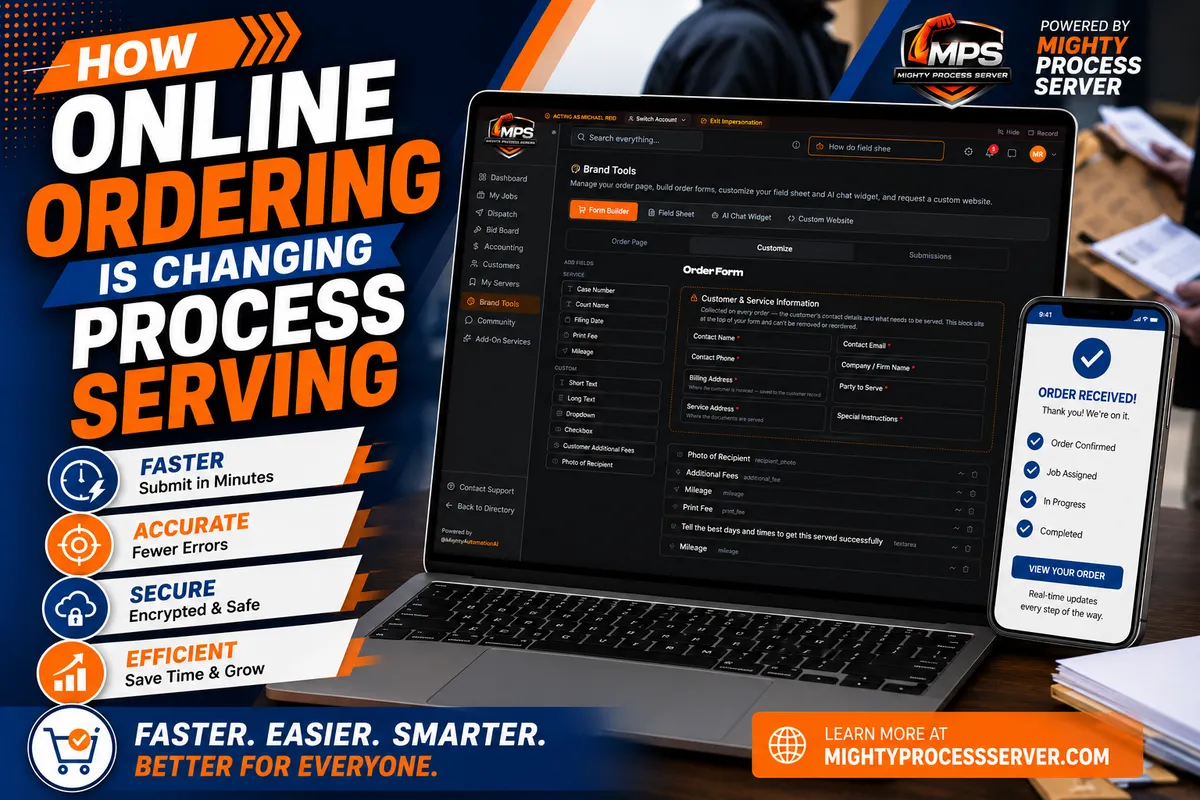
How Online Ordering Is Changing Process Serving
The process serving industry is becoming faster, more digital, and increasingly client-driven. Attorneys, law firms, collection agencies, property managers, and other legal professionals no longer want to rely solely on phone calls, email chains, paper intake forms, and manual data entry to place service requests.
That shift is accelerating the adoption of online ordering for process serving.
With a secure online ordering system, clients can submit service requests, upload legal documents, provide service instructions, select additional services, and enter case information from virtually anywhere. For process serving companies, digital intake can reduce administrative work, improve order accuracy, accelerate assignment creation, and provide clients with a more convenient experience.
As expectations for legal technology continue to rise, online ordering is becoming more than a convenience. It is an important part of building an efficient, scalable, and competitive process serving business.
What Is Online Ordering for Process Serving?
Online ordering for process serving is a digital intake process that allows clients to submit service requests through a web-based order form or client portal.
Instead of calling an office or sending case information across multiple emails, a client can enter the necessary details in one structured submission.
A typical online process serving order may include:
Plaintiff and defendant information
Recipient or subject name
Service address
Court and jurisdiction information
Case number
Hearing or filing dates
Service deadlines
Special service instructions
Client and billing information
Legal document uploads
Recipient photographs
Additional addresses
Optional services such as skip tracing or court filing
Once submitted, the information can be routed directly into the process serving company's workflow for review, assignment, dispatch, and tracking.
The result is a more standardized process server order management system with less dependence on manual intake.
Why Traditional Process Serving Intake Can Create Delays
Traditional ordering methods can work for a small number of assignments, but they become increasingly difficult to manage as service volume grows.
A typical manual intake process might involve receiving a phone call, waiting for documents by email, requesting missing information, downloading attachments, entering case details into another system, confirming pricing, and then assigning the job to a process server.
Common problems include:
Incomplete service addresses
Missing case numbers
Unclear deadlines
Documents spread across email threads
Duplicate data entry
Incorrectly entered information
Delayed responses outside business hours
Lost or overlooked instructions
Each additional manual step creates another opportunity for delay or error.
An online process serving order system can standardize intake by requiring clients to provide important information before an order is submitted.
Benefits of Online Ordering for Process Serving Companies
Online ordering does more than replace a paper form. When connected to modern process serving software, it can improve the entire workflow from initial order submission through completion.
1. Faster Process Serving Job Intake
One of the biggest advantages of online ordering is speed.
Clients can submit service requests 24 hours a day without waiting for an office to open or an employee to return a phone call.
This can be particularly useful for:
Rush process service
Same-day assignments
Emergency filings
Upcoming hearings
Statute or deadline-sensitive matters
Last-minute service requests
When complete order information and documents arrive together, staff can review and dispatch assignments more quickly.
For clients, that means less time spent coordinating intake. For process serving companies, it means jobs can move into production sooner.
2. Improved Efficiency in Process Serving
Administrative work can consume a significant amount of time in a busy process serving office.
Staff may repeatedly copy names, addresses, case numbers, deadlines, and instructions between emails, spreadsheets, billing platforms, and case management software.
Online ordering can reduce this repetitive work.
Structured forms collect information in a consistent format, making it easier to organize assignments and integrate them with existing process server case management software.
This allows office personnel to spend less time assembling orders and more time managing service attempts, communicating with clients, and completing assignments.
3. Better Process Serving Accuracy
Accurate information is critical to successful service of process.
A typo in an address, an incorrect recipient name, a missing deadline, or incomplete instructions can create unnecessary delays.
Online forms can make critical fields mandatory, helping ensure that clients provide necessary information before submitting an order.
Required fields may include:
Recipient name
Service address
Court information
Case number
Client contact information
Service deadline
Documents to be served
Special instructions
Dropdown menus, checkboxes, validation rules, and standardized fields can further reduce inconsistent submissions.
Better information at intake can improve process serving accuracy throughout the life of the assignment.
4. A Better Client Experience
Convenience has become an important part of professional legal services.
Clients increasingly expect vendors to provide digital tools that make routine tasks easier. A streamlined process server online order form allows clients to submit a job when it is convenient for them instead of coordinating every detail by phone or email.
Depending on the platform, clients may be able to:
Place orders online
Upload documents securely
Select service options
Enter detailed instructions
Receive confirmation of submission
Check case status
Access completed documents
Maintain organized digital records
A smoother ordering experience can help strengthen client relationships and encourage repeat business.
5. Centralized Process Server Case Management
Online ordering can also create a more organized source of information for each assignment.
Rather than storing documents in one inbox, instructions in another email, and case details in a spreadsheet, information can be associated with a centralized digital case record.
Depending on the software, that record may contain:
Client information
Case details
Uploaded documents
Service addresses
Special instructions
Assignment history
Attempt information
Status updates
Billing information
Proof of service documentation
Centralized case management can make it easier for dispatchers, office staff, servers, and managers to work from consistent information.
6. Faster Communication With Clients
Online ordering can also improve communication between process servers and their clients.
A structured order creates a clear starting point for everyone involved. When the system also supports automated notifications or a client portal, routine updates may be delivered without requiring staff to manually write an email for every development.
Clients may receive updates when:
An order is received
An assignment is dispatched
A service attempt occurs
Additional information is needed
Service is completed
Proof of service becomes available
This type of process serving automation can provide greater transparency while reducing repetitive administrative communication.
How Online Ordering Fits Into Process Serving Automation
Online ordering becomes even more valuable when it is connected with other process serving technology.
Modern process serving software may combine digital intake with:
Cloud-based case management
Automated assignment workflows
Mobile process server applications
GPS-assisted attempt documentation
Digital document management
Electronic affidavits
Automated status notifications
Client portals
Billing and invoicing tools
Reporting and analytics
Secure document storage
Instead of operating as separate tools, these features can create a connected workflow.
For example, an attorney submits an order online, uploads the documents, and enters the service deadline. The assignment is then reviewed and dispatched. The field server records attempts digitally, and the client receives status updates as the job progresses.
When service is completed, the appropriate documentation can be prepared and added to the case record.
The goal is not simply to digitize a paper form. It is to reduce unnecessary steps throughout the process serving workflow.
Online Ordering and Process Server Scalability
Manual processes often become bottlenecks as a company grows.
A workflow that is manageable at 10 orders per week can become difficult to maintain at 100 or 1,000 orders without additional staff.
Online ordering helps process serving companies standardize intake regardless of volume.
Businesses can establish consistent requirements for every new order, including:
Required client information
Service details
Document uploads
Pricing selections
Billing information
Deadlines
Additional service options
Standardization makes it easier to train employees, reduce exceptions, measure performance, and handle larger numbers of assignments.
For growing agencies, process serving automation can therefore become an important component of scalability.
Why Law Firms Prefer Digital Process Serving Solutions
Law firms are adopting cloud-based case management, electronic filing, digital signatures, online billing, document automation, and other legal technologies.
Their expectations for outside vendors are changing as well.
A process serving provider that offers digital ordering can make it easier for legal teams to submit assignments without disrupting their existing workflow.
Benefits for law firms can include:
Faster order submission
Secure document uploads
Less repetitive data entry
Clearer service instructions
Faster order confirmations
Organized digital case records
Improved status visibility
Easier communication with service providers
For high-volume firms, even small improvements in intake efficiency can save significant administrative time across hundreds of assignments.
Security Considerations for Online Process Serving Orders
Because process serving requests may contain confidential or sensitive legal information, security should be an important consideration when implementing an online ordering system.
Process serving companies should evaluate features such as:
Secure connections and data transmission
User authentication
Role-based access controls
Secure document storage
Account management practices
Data backup procedures
Software updates
Access logging where appropriate
Businesses should also establish internal policies for handling client documents and limiting access to sensitive information.
Moving intake online should improve convenience without sacrificing responsible information management.
Challenges of Moving to Online Ordering
Adopting a new digital workflow requires planning.
Potential challenges include:
Training staff
Transitioning existing clients
Configuring order forms
Establishing consistent intake requirements
Integrating software with existing workflows
Addressing cybersecurity and privacy considerations
Maintaining reliable internet access
Adjusting established office procedures
The transition can be made easier by introducing clear procedures, testing forms before launch, training employees, and giving existing clients simple instructions for using the new system.
Businesses may also choose to maintain alternative ordering methods for clients who require them while encouraging digital intake whenever practical.
How MPS Simplifies Online Ordering for Process Servers
MightyProcessServer.com (MPS) provides an Online Order Form Builder designed for the needs of process serving businesses.
Instead of relying on a generic website contact form, agencies can build an ordering experience around the information and services their operation actually requires.
With the MPS Online Order Form Builder, process serving companies can create branded forms and configure fields for information such as:
Client and billing details
Recipient information
Court information
Case numbers
Filing and service dates
Service addresses
Legal document uploads
Recipient photographs
Custom instructions
Agencies can also configure pricing and additional service options based on their business model.
Optional services may include:
Skip tracing
Court filing
Record retrieval
Notarization
Electronic filing
Weekend service
Wait time
Second-address service
Printing or mileage charges
Other custom fees
Businesses can use dropdown menus, checkboxes, custom questions, and required fields to collect the information they need before an assignment enters the workflow.
By standardizing intake at the beginning of the process, MPS can help agencies reduce back-and-forth communication, minimize incomplete orders, and move assignments into production more efficiently.
Online Ordering Can Help Process Servers Generate More Business
Online ordering is not only an operational tool. It can also remove friction from the sales process.
Consider what happens when a potential client visits a process server's website after normal business hours.
If the only option is to call an office, the visitor may leave and contact another provider. If the website provides a clear order process service online option, that prospective client may be able to submit the assignment immediately.
An effective order page should make important information easy to understand, including:
Areas served
Available service speeds
Pricing or quote options
Documents required
Additional services
Expected turnaround procedures
Contact information
A clear call to action
Reducing the number of steps between discovering a process server and submitting an order can help convert more website visitors into clients.
The Role of Process Server Directories
A process server directory can complement online ordering by helping attorneys, businesses, and individuals locate service providers in specific jurisdictions.
Directories can help users compare available providers based on service area, capabilities, and other relevant criteria. For process serving companies, directory visibility can create another channel through which prospective clients discover their services.
When discovery and ordering work together, the customer journey becomes simpler:
Search → Find a Process Server → Review Services → Submit an Order → Track the Assignment
Reducing friction at each stage can create a more convenient experience for both clients and process serving agencies.
The Future of Online Process Serving
Digital intake is likely to become increasingly connected with automation and intelligent legal technology.
Future developments may include:
AI-assisted order intake
Automated document classification
OCR-based extraction of case information
Address validation
Intelligent assignment routing
Automated deadline detection
Predictive workflow management
Enhanced mobile applications
Client self-service portals
Real-time operational dashboards
Advanced reporting and analytics
Expanded integrations with law firm software
As these technologies mature, process serving companies may be able to automate more administrative work while keeping human oversight focused on decisions that require experience and judgment.
Frequently Asked Questions About Online Process Serving Orders
Can clients order process serving services online?
Yes. Process serving companies can use online order forms or client portals that allow clients to submit case information, service addresses, instructions, and documents digitally.
What information is needed to order a process server?
Requirements vary by assignment, but clients commonly need the recipient's name and address, case information, documents to be served, service deadlines, contact information, and any special instructions.
Can legal documents be uploaded with an online order?
Many online process serving platforms allow clients to upload summonses, complaints, subpoenas, notices, photographs, and other relevant files as part of the order submission.
Does online ordering make process serving faster?
Online ordering can accelerate the intake process by collecting necessary information and documents in a structured submission. Actual service time still depends on factors such as location, recipient availability, service level, and applicable legal requirements.
Is online process serving secure?
Security depends on the technology and practices used by the provider. Process serving companies should use appropriate safeguards for transmitting, storing, and accessing client and case information.
Can process servers customize online order forms?
With configurable platforms such as MPS, agencies can tailor forms to collect the information their workflows require and offer relevant service options and fees.
Online Ordering Is Becoming a Competitive Advantage
The process serving industry has always depended on accuracy, speed, communication, and reliable documentation. Online ordering strengthens each of these areas by creating a more structured path from client request to active assignment.
For process serving companies, the benefits can include faster intake, fewer administrative tasks, better data accuracy, improved client communication, and greater scalability.
For attorneys and other clients, digital ordering provides the convenience of submitting service requests and documents without relying on lengthy email exchanges or business-hour phone calls.
As legal services continue to digitize, process serving companies that make it easy to order process service online will be better positioned to meet changing client expectations and compete in a technology-driven market.
Conclusion
Online ordering has fundamentally changed how process serving businesses receive and manage assignments. By replacing manual intake with digital workflows, agencies can improve efficiency, reduce administrative burdens, enhance accuracy, and deliver a better client experience.
MightyProcessServer.com (MPS) supports this transformation with its customizable Online Order Form Builder, giving process serving companies the tools to accept orders around the clock, collect complete case information, automate intake, and create a professional ordering experience for attorneys, businesses, and legal support professionals.
As technology continues to shape the legal industry, adopting online ordering and modern process serving software is becoming an essential investment for agencies that want to improve productivity, strengthen client relationships, and position themselves for long-term growth.
Stay sharp. Stay informed. Live Mighty!
Read the full article at www.mightyprocessserver.com
This article is published by Process Server Daily, powered by MightyAutomation.ai, the leader in legal support intelligence.