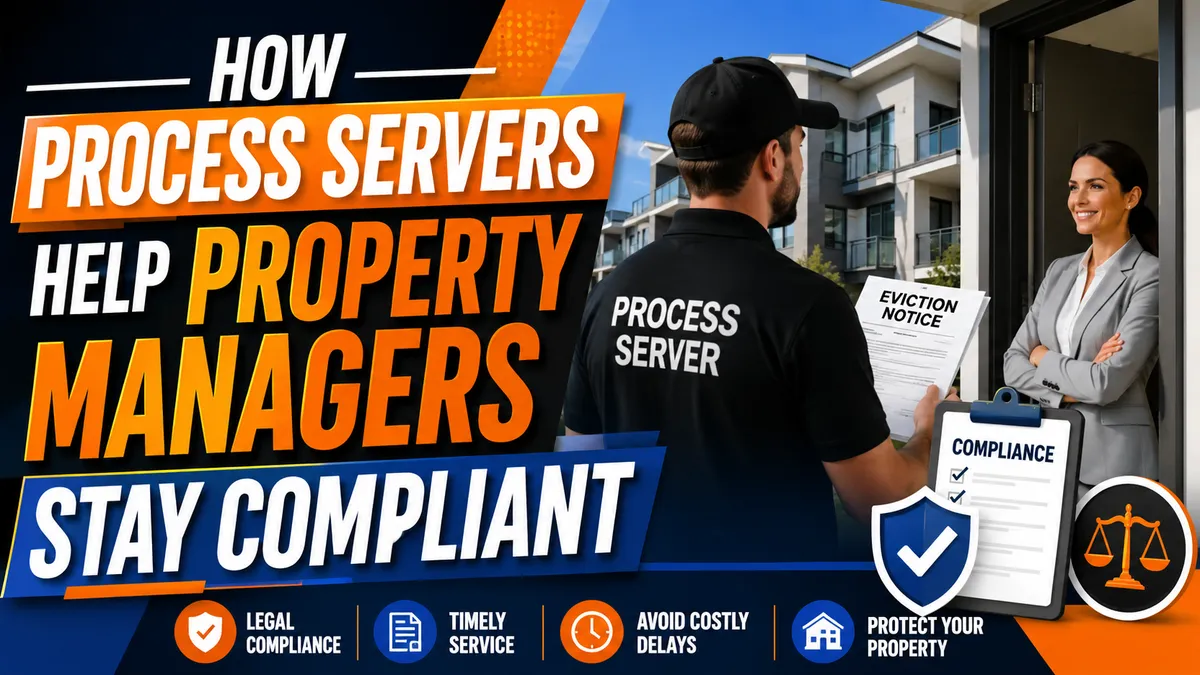
How Process Servers Help Property Managers Stay Compliant
Property managers operate in a highly regulated environment where a missed deadline, improper notice, or incomplete service record can create costly delays. From lease disputes and eviction proceedings to subpoenas and other court matters, property management compliance often depends on following precise legal procedures.
Professional process servers can play an important role in that compliance strategy. By handling legal document delivery, documenting service attempts, following jurisdiction-specific rules, and providing timely Proofs or Affidavits of Service, experienced process servers help property managers and their attorneys create a reliable record of what was served, when, where, and how.
For property management companies managing multiple properties or high volumes of legal matters, working with a dependable process serving provider can also reduce administrative burden and help keep cases moving.
What Is Property Management Compliance?
Property management compliance means operating rental properties in accordance with applicable federal, state, and local laws, regulations, lease requirements, and court procedures.
Depending on the property, jurisdiction, and circumstances, compliance responsibilities may involve:
Fair housing requirements
Tenant notice requirements
Lease enforcement procedures
Eviction laws and court rules
Recordkeeping requirements
Filing and service deadlines
Tenant privacy and other legal rights
State and local landlord-tenant laws
Failure to follow required procedures can have significant consequences. A defective notice or improper service may result in delays, additional expenses, challenges to service, or the need to repeat part of the legal process.
Because requirements vary significantly by jurisdiction, property managers should work with qualified legal counsel when determining which notices must be served and which methods of service are permitted.
Why Legal Compliance Matters for Property Managers
Property managers routinely make decisions that affect both property owners and tenants. When those decisions lead to formal legal action, following the correct procedure becomes especially important.
Strong compliance practices can help property managers:
Protect the legal rights of tenants and property owners
Enforce lease terms through appropriate procedures
Reduce avoidable legal and administrative risks
Meet important court and statutory deadlines
Maintain complete records
Minimize disputes about whether notice was provided
Improve communication with attorneys and property owners
Keep legal matters progressing efficiently
A professional process server does not replace an attorney or determine which legal procedure should be used. Instead, the server helps execute authorized service correctly and creates documentation that can support the legal proceeding.
The Role of Process Servers in Property Management
A process server for property managers delivers legal documents to tenants, occupants, witnesses, businesses, or other parties in accordance with applicable service rules.
Depending on the case and jurisdiction, property managers or their attorneys may use process servers for documents such as:
Summonses and complaints
Eviction-related court documents
Unlawful detainer documents
Subpoenas
Court orders
Small claims documents
Post-judgment documents
Other notices or legal documents when service by a process server is authorized or appropriate
The exact rules governing service depend on the document and jurisdiction. Some landlord-tenant notices have different delivery requirements from formal court papers, making it important to confirm the proper method before service begins.
7 Ways Process Servers Help Property Managers Stay Compliant
1. Following Authorized Methods of Service
Different documents may require different service methods. Depending on applicable law, service may involve personal delivery, substituted service, posting and mailing, service on an authorized agent, or another court-approved method.
Professional process servers understand that service is not simply about delivering paperwork. It must be performed according to the rules governing the particular assignment.
Using an experienced server can help reduce errors that could otherwise result in service being challenged or repeated.
2. Supporting Eviction and Unlawful Detainer Proceedings
Eviction proceedings can involve strict procedural requirements and deadlines. Even a seemingly minor mistake may affect how quickly a case moves forward.
Process servers can support property managers and landlord-tenant attorneys by:
Making service attempts promptly
Following instructions and applicable service requirements
Recording the date, time, and location of attempts
Documenting the method of completed service
Preparing Proofs or Affidavits of Service
Providing updates when service is unsuccessful
This documentation can help attorneys determine the appropriate next step and establish a clear record of service.
Importantly, eviction service requirements vary by state and locality. Property managers should not assume that a method permitted in one jurisdiction is valid in another.
3. Creating Detailed Proof of Service
Documentation is one of the most valuable components of professional process serving.
Depending on the assignment, service records may contain:
Date and time of each attempt
Address or location visited
Method of service
Description or identity information where appropriate
Notes regarding the service attempt
GPS data when available and appropriate
Photographs when lawful and permitted
Proof or Affidavit of Service
Details regarding unsuccessful attempts
If service is later questioned, organized records can help establish what occurred and provide attorneys with information needed to respond.
4. Helping Property Managers Meet Legal Deadlines
Property-related litigation often operates on strict timelines. Delayed service can affect hearings, filings, possession proceedings, and other stages of a case.
Professional process servers can help by:
Beginning attempts promptly
Prioritizing time-sensitive assignments
Tracking multiple attempts
Communicating unsuccessful service quickly
Providing completion updates
Returning service documentation without unnecessary delay
For property management companies handling multiple cases simultaneously, reliable status reporting can be particularly valuable.
5. Reducing Disputes Over Tenant Notice Delivery
Questions about whether a tenant or other party received legally required notice can become a significant issue in landlord-tenant disputes.
Professional service creates an independent record of delivery or attempted delivery. Rather than relying solely on informal communication or internal recollection, property managers and attorneys can maintain documentation showing when and how service occurred.
This does not guarantee that service will never be challenged, but accurate records can make it easier to establish the facts surrounding the service.
6. Providing Greater Visibility Through Technology
Modern process serving technology gives property managers and attorneys greater visibility into assignments.
Depending on the provider, technology may include:
GPS-verified attempts
Electronic status updates
Digital Proofs of Service
Time-stamped field notes
Secure document storage
Online client portals
Electronic assignment submission
Digital photographs where legally appropriate
These tools can make it easier to track active assignments, retrieve service records, and communicate with legal teams.
For property management companies overseeing multiple properties, centralized digital records can also improve organization and reduce time spent requesting updates.
7. Reducing the Administrative Burden on Property Management Teams
Property managers already balance tenant communication, maintenance, inspections, rent collection, vendor coordination, owner reporting, and numerous other responsibilities.
Managing legal document service internally can add another time-sensitive workflow.
Outsourcing appropriate legal service assignments to a professional process serving company allows property management teams to focus on property operations while receiving documented updates throughout the service process.
Process Servers and Eviction Compliance
One of the most common areas where property managers encounter process serving is during an eviction or unlawful detainer case.
The process can include several distinct stages, and the rules for notices that precede a lawsuit may differ from the rules governing service of the lawsuit itself.
For example, depending on the jurisdiction and circumstances, the process may involve:
A legally required notice before filing
Filing an eviction or unlawful detainer action
Service of the summons and complaint
Filing Proof of Service
Court proceedings
Enforcement of a judgment through legally authorized procedures
A process server's role may apply to one or more stages, but the server generally does not decide which notice to use, calculate legal deadlines for the client, or provide legal advice.
Working with both qualified counsel and an experienced process server helps property managers keep the legal strategy and the physical service of documents appropriately coordinated.
How Accurate Service Documentation Helps Reduce Risk
Imagine that a tenant challenges service and claims the court papers were never properly delivered.
Without detailed records, reconstructing the circumstances of the service may be difficult.
A professional service record may show the date and time of attempts, address, service method, field notes, and other relevant information. The completed Proof or Affidavit of Service can then provide the formal documentation required for the proceeding.
This level of recordkeeping is particularly useful for property management companies handling large portfolios, where numerous legal matters may be active at the same time.
Benefits of Hiring a Professional Process Server
Property managers can gain several operational advantages from using a qualified process serving company.
Reliability: Professional servers are accustomed to working with time-sensitive legal assignments and court-related deadlines.
Accuracy: Experienced servers understand the importance of following authorized service methods and preparing complete documentation.
Efficiency: Dedicated service professionals can make attempts while property management staff remain focused on day-to-day operations.
Accountability: Status reports and service records create a clearer audit trail for the assignment.
Professionalism: Experienced process servers understand how to approach sensitive situations professionally and document what occurs.
Scalability: Property management companies with multiple locations or high case volumes can use a process serving provider to manage assignments more consistently.
What Property Managers Should Look for in a Process Serving Company
Not every provider offers the same capabilities. Property managers and law firms should evaluate a potential process serving partner carefully.
Important considerations include:
Experience with landlord-tenant and property-related matters
Knowledge of applicable service requirements
Coverage in the jurisdictions where properties are located
Clear communication and status reporting
Accurate Proofs or Affidavits of Service
Secure handling of legal documents and client information
Technology for assignment tracking
GPS verification when appropriate
Responsive customer support
Transparent turnaround times and fees
Procedures for urgent or difficult-to-serve assignments
The lowest-priced provider is not necessarily the best choice. Reliability, documentation, communication, and knowledge of service requirements can be more important when court deadlines are involved.
Best Practices for Property Managers Handling Legal Documents
Process serving works best as part of a broader compliance workflow. Property managers can improve that workflow by following several best practices.
Keep Tenant and Property Records Current
Maintain accurate lease records, tenant names, unit numbers, contact information, and other relevant documentation. Accurate information helps reduce avoidable delays when an assignment is sent for service.
Send Assignments Early
Waiting until immediately before a deadline can limit available options. When possible, provide documents to counsel and the process server well before the service deadline.
Provide Complete Service Information
Include all known addresses, unit numbers, access instructions, identifying information, and other lawful details that may help the server locate the correct recipient.
Preserve Proofs of Service
Maintain Proofs or Affidavits of Service with the corresponding case and tenant records according to applicable record-retention requirements.
Use Secure Communication
Legal documents may contain sensitive information. Work with providers that use appropriate safeguards for transmitting and storing documents.
Coordinate With Legal Counsel
Landlord-tenant laws can change, and local requirements can be highly specific. Legal counsel should determine the appropriate notice, deadlines, and legal strategy when necessary.
Frequently Asked Questions About Process Servers for Property Managers
Why do property managers use process servers?
Property managers use process servers to deliver certain legal and court documents according to applicable rules and to obtain reliable documentation showing when and how service was completed or attempted.
Can a process server serve eviction papers?
Process servers commonly serve eviction-related court documents, but the documents they may serve and the permitted methods vary by jurisdiction and stage of the eviction process.
What is a Proof of Service?
A Proof of Service is a document recording details about how legal papers were served. Depending on the jurisdiction, it may identify the person served, date, location, method of service, and other required information.
What happens if a tenant cannot be served personally?
The available next steps depend on the document and applicable law. Some jurisdictions permit alternative methods after specified conditions are satisfied. The process server should follow authorized procedures and document unsuccessful attempts so the attorney or client can determine the appropriate next step.
Do process servers provide legal advice to property managers?
No. A process server performs service according to applicable rules and client or attorney instructions. Questions about legal strategy, notice requirements, deadlines, or the appropriate type of document should be directed to qualified legal counsel.
Can process servers provide GPS verification?
Many modern process serving companies use GPS technology to document the location of service attempts. Availability and appropriate use depend on the provider, jurisdiction, and circumstances.
How can process serving help with property management compliance?
Professional process serving can support compliance by helping ensure authorized documents are delivered using appropriate procedures, creating detailed records of attempts, meeting service deadlines, and providing Proofs or Affidavits of Service.
Professional Process Serving for Property Managers
Property managers need service partners who understand that legal document delivery involves more than simply handing someone paperwork. Accuracy, timeliness, communication, and documentation all matter.
Mighty Process Server (MPS) provides professional process serving support for property managers, landlords, attorneys, and other legal professionals. Whether an assignment involves eviction-related court papers, a subpoena, summons and complaint, or another authorized legal document, working with an experienced process server can help create a more organized and dependable service process.
Conclusion
Process servers help property managers stay compliant by supporting accurate legal document delivery, documenting service attempts, helping meet important deadlines, and providing the Proofs or Affidavits of Service needed for court proceedings.
For property management companies, these services can reduce administrative burden while improving visibility and accountability throughout legal matters.
Because landlord-tenant and service requirements vary by jurisdiction, process serving should be coordinated with applicable law and qualified legal counsel. With the right legal and process serving partners, property managers can manage legal matters more efficiently while maintaining the records and procedures necessary to protect property owners and tenants.
This article is for general informational purposes only and does not constitute legal advice.
Presented by MPS
MPS provides professional process serving solutions, nationwide resources, and innovative technology that help property managers, landlords, attorneys, and legal professionals streamline legal document delivery while maintaining compliance and accurate documentation.
Stay sharp. Stay informed. Live Mighty!
Read the full article at www.mightyprocessserver.com
This article is published by Process Server Daily, powered by MightyAutomation.ai, the leader in legal support intelligence.