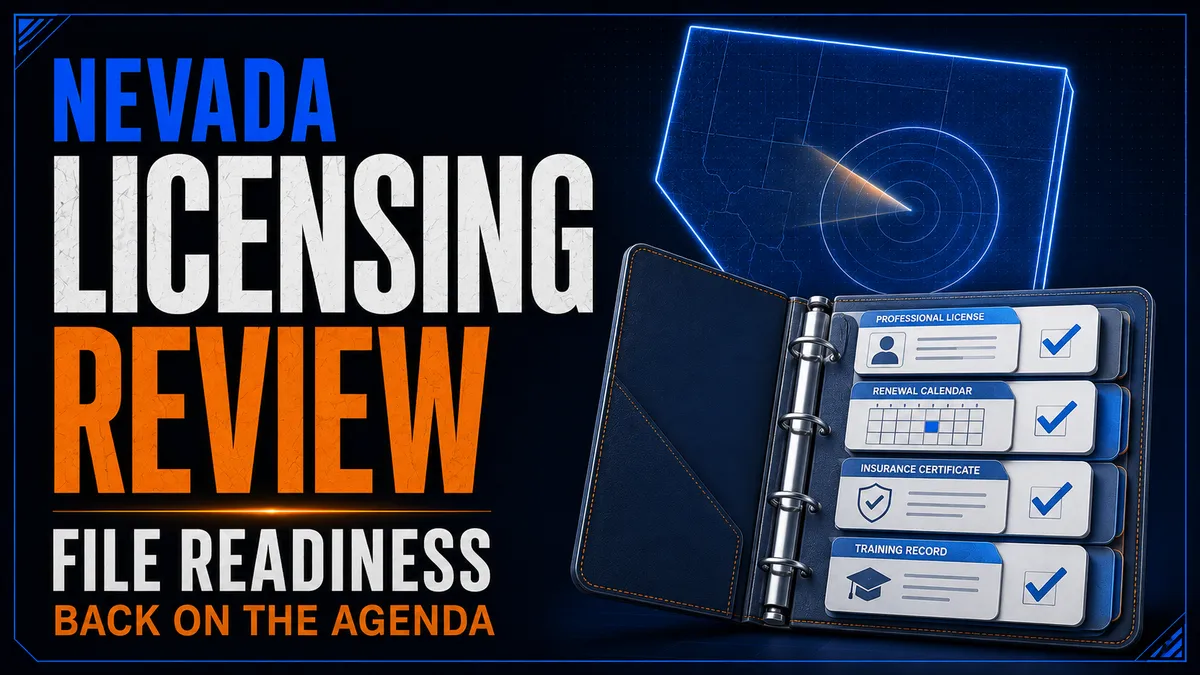
Nevada Licensing Review Puts File Readiness Back on the Agenda
Here's a question for every process server in Nevada. If somebody from the licensing board, a judge, or your biggest client asked you tomorrow morning to prove you were licensed on the day you served a job last spring, and to show them every attempt you made on it, how long would it take you?
If the answer is "give me a week and a shoebox," this article's for you.
On July 14, 2026, Nevada's Department of Business and Industry put out a statement backing a full review of the Nevada Private Investigators Licensing Board. That's the board that licenses process servers too. Nothing about your license changed that day. But it's a good reminder that a license isn't something you get once and forget about. It's a promise that your records are in order whenever somebody asks.
By Mighty Mike Reid
What Nevada Actually Announced
The Nevada Department of Business and Industry statement said the Department is in full support of a thorough and objective review of the Private Investigators Licensing Board, which everybody calls the PILB. The Director, Dr. Kristopher Sanchez, said they welcome an independent review of the Board's operations.
A few details from the statement are worth knowing:
The concerns came up at a public meeting of the Legislative Commission while the Board was trying to get a proposed regulation approved.
The Department said some of the issues involve how Nevada law is being interpreted, and where the law is unclear, it's up to the Legislature to fix it.
Right now, complaints about licensing boards go to the Office of Nevada Boards, Commissions and Councils Standards, but that office can mostly just help with mediation. It can't order a board to change how it operates.
Now here's what the statement did not do. It did not create:
A new process server license
New continuing education requirements
A new background check standard
A mandatory training program
Changes to how papers can be served
New record retention periods
New fees or renewal dates
So don't let anybody tell you the rules changed. If something does change, it'll come through the Legislature, a regulation, a Board notice, or new licensing instructions. Until then, keep an eye on it and keep doing what the current rules say.
Yes, the PI Board Licenses Process Servers
People outside Nevada are always surprised by this one. Despite the name, the Private Investigators Licensing Board handles more than PIs. Under Chapter 648 of the Nevada Revised Statutes, it also licenses process servers, private patrol officers, repossessors, security consultants, polygraph examiners, and interns.
And Nevada takes it seriously. Under NRS 648.060, you can't run or advertise a process serving business there unless you're licensed under that chapter.
What It Takes to Get Licensed in Nevada Right Now
According to the Board's current licensing page, before it grants a license the applicant (and every director and officer of a corporate applicant) has to:
Be at least 21 years old
Be a U.S. citizen or lawfully entitled to stay and work in the U.S.
Be of good moral character
Have no felony convictions, and no convictions for crimes of moral turpitude or illegal use or possession of a dangerous weapon
Pass an FBI and Nevada Department of Public Safety background check
Pass the exam with a 75 percent or better (individual and qualified agent applicants)
Meet the experience or education requirement
The process server exam is one hour and 32 true/false and multiple choice questions. The Board's study list is NRS Chapter 648, NAC Chapter 648, NRS Chapter 14, and the Nevada Rules of Civil Procedure.
Licenses are good for one year and expire June 30. The Board's renewal window is May 15 through June 30. Put both dates on your calendar now, with a reminder a few weeks ahead, so June 30 never sneaks up on you.
If you're going to work for a licensed company instead of running your own, you don't apply for a license. You apply for a work card. Owners should check the status of every person on the team directly with the Board: the owner, the qualified agent, every employee, and every subcontractor.
Go by what the Board publishes. There are a lot of summaries floating around online that are old or flat wrong.
Why This Matters on Every Single Proof
Here's the part a lot of servers coming in from other states miss. In Nevada, your license shows up on your paperwork.
Under NRS 14.025, a proof of service filed with a Nevada court has to include:
The name, residential or business address, and phone number of the person who served it
The date and time it was served
How it was served
If practical, the name or a physical description of the person served
The license number of the process server, or the registration number of the licensed server's employee who served it, or the reason the person didn't need a license
A proof missing any of that can be treated as legally insufficient.
And it gets worse. Under NRS 14.027, if somebody who isn't licensed as a process server files a proof of service in violation of the licensing law, the court has to treat that proof as legally insufficient, and any judgment based on it is void. Void. The attorney wins the case, and it can come undone because the server's paperwork wasn't right.
That's why file readiness isn't busywork in Nevada. Your license status is tied to every serve you make.
What File Readiness Really Means
File readiness just means you can prove what you did and that you were allowed to do it, without tearing the office apart looking for it.
You don't need to save every scrap of paper you ever touched. You need records that answer the questions people actually ask:
Is the business licensed?
Was the license current on the day of service?
Who's authorized to serve under it?
Were renewals filed on time?
Was the job done under the right rules?
Can you show the attempt history?
Does the affidavit match the original field notes?
Is confidential info protected?
Can you tell if a finished record was changed?
I used to send my invoices with two attachments: my proof of service and my field sheet. A lot of times the client got all three together, the field sheet, the proof, and the invoice. When the attorney had a question, the answer was already sitting in their inbox.
Build a Licensing Binder
Keep your licensing records in their own binder, digital or paper, separate from your client jobs. That way you can hand it over fast, and you're not passing around employee background info with every case file.
A good binder can hold:
Your current process server license
Past licenses and renewal records
Qualified agent info
Business registration documents
Work cards for employees, where they apply
Exam or experience records
A current list of everybody authorized to serve
Insurance or bond records, if they apply to you
Your renewal calendar and filing receipts
Your policy for handling client info
Your complaint and incident procedures
Training records
Copies of important letters from the Board
Dates of your internal reviews
Links to the current statutes and regulations
For each item, write down when it took effect, when it expires, who's responsible for it, and where it came from.
One word of caution. Check which of these are actually required for your type of business. Your binder can hold more than the law demands, and that's fine, but don't go telling people that a voluntary record is a legal requirement.
Keep Licensing Records and Job Files Apart
Your licensing binder proves you're allowed to work. Your job file proves what happened on one particular serve. Mix them together and you either expose employee info you shouldn't, or you can't find anything when you need it.
Every job file should have:
The client and who ordered the serve
The court and case number
The names of the parties
What documents you received
The date and time you received them
The service deadline
Any instructions or restrictions
Who was assigned
The address info
Every attempt date and time
What you saw and who you talked to
Photos and location data you collected lawfully
Client communications
The affidavit or return
The invoice and when the job closed
Keep your original notes. If somebody in the office turns a short field note into a polished affidavit, save the original note and write down who approved the final wording.
And if you served it, it makes more sense for you to be the one doing the proof. You're the one who was there.
Write What You Saw, Not What You Think
This is where a lot of reports go sideways. A good report keeps three things apart: what the server saw, what somebody told them, and what the server figured out from it.
"A blue car was parked in the driveway" is something you saw. "The subject was home and refusing to answer" is a guess, unless you've got more to back it up.
If a neighbor tells you the guy moved, write "neighbor stated the subject moved." Don't write "subject moved" like you checked it yourself.
And please don't just write "no answer." There's no such thing as a no answer status. One client I worked with wouldn't accept it, because he couldn't take "no answer" back to his own client. I had notes saved so I could give at least two sentences on every attempt. Something like: There was no answer at the door. There was a red Chevy in the driveway, and I wrote down the plate. The lights were off at the neighbor's, but it looked like somebody was inside not answering the door.
That's a lot of detail on a first attempt. And it teaches you as a server to get it on the first or second try instead of coming back 500 times.
I'll be honest with you. When I had 40 or 50 serves in the bucket and went house to house to house, and then tried to put statuses in the next day without using the app, the default was "no answer," because I couldn't remember which was which. That's how you end up with a file that won't hold up.
It helps to label your info by where it came from:
Something you saw yourself
Something somebody else told you
Something the client gave you
A database result
Your own conclusion
A conflict you haven't sorted out yet
That way the attorney can judge every fact for what it's worth.
Serving Isn't Investigating
The same Board licenses PIs and process servers, but that doesn't mean the two licenses let you do the same things. Don't assume your process server license covers every kind of surveillance or investigation.
Sitting on an address so you can serve somebody the moment they show up is one thing. Following them around is surveillance, and that's PI territory. If a job needs long surveillance, hidden monitoring, interviews, or special database access, check the licensing and legal side before you start.
If you lawfully take photos or video on a job, keep the originals. Write down the date, the device, the location, who uploaded it, and any edits. Never let an edited copy quietly replace the original.
Same goes for body cams and dash cams. They're a good idea, but remember, if it exists, it can be subpoenaed. Your own footage can be used against you. If you're above board and doing everything right, you'll be fine.
And only collect what you need for the job. Just because a tool can pull somebody's whole life doesn't mean you should.
Make Yourself a Nevada Rules Sheet
Nevada service rules come from a bunch of places: statutes, administrative rules, court rules, local practice, and requirements for specific kinds of documents. One generic checklist won't cover it all.
So build a simple sheet that lists:
The document type
The rule that governs it
Who's allowed to serve it
How it can be served
The deadline
What the affidavit has to say
Filing instructions
Any special fees or witness requirements
A link to the source
The date somebody last checked it
Put one person in charge of keeping it current. When a rule changes, write down the old version, the new version, when it took effect, and which jobs it hits.
Now your team can see where every procedure came from instead of going off memory.
Training and Checking Your Own Work
Start your training with what the Board tells you to study: NRS Chapters 14 and 648, NAC Chapter 648, and the Nevada Rules of Civil Procedure.
Then add your own training on:
Reviewing new orders
Making sure you've got the right version of the documents
Confirming identity
How to write attempt notes
Safety
Privacy and data security
Writing affidavits
Reporting incidents
Talking with clients
Keeping records
The July 14 announcement didn't create any new required continuing education for process servers. But a quick refresher now and then catches mistakes before they turn into client complaints or licensing problems.
Every so often, pull a few of your own files and check them. Was everybody's license current? Were the attempts written down? Do the affidavits match the notes? Were the files stored safely? Better you find the problem than somebody else.
For Attorneys and Firms Hiring a Nevada Server
If you're sending work into Nevada, a few things will save you a lot of grief.
Check the license before you send the job. A directory listing isn't a license check. Confirm the server's current status with the Board and make sure they actually cover the area.
Look for the license number on the proof. NRS 14.025 requires it, or a reason the person didn't need one. If it's missing, send it back before you file.
Remember the stakes. A proof filed by an unlicensed server can be treated as legally insufficient, and a judgment based on it can be void. That's your case, not just the server's problem.
Ask for the attempt history, not just the final proof. Dates, times, what the server saw, and photos where they're allowed. A file with real details beats a proof that says "no answer" three times.
Ask how they keep their records. A server who can pull up a job from six months ago in a minute is a server who'll hold up if service gets challenged.
Where Mighty Process Server Fits
All of this is a lot easier when your records live in one place instead of a truck, a notebook, and three email accounts. Mighty Process Server keeps every job together: the documents, every attempt, your notes, GPS, and photos, all timestamped.
Every server on your team gets their own login, so you always know who made which attempt. That matters a lot in a state where the person who served it has to be named, with their license number, on the proof. Clients get their own private dashboard, so when an attorney wants the attempt history, they can see it themselves.
When the job's done, the affidavit builds right from the job record, even from the mobile app. If it needs a notary, the Mighty Notary integration gets it signed and notarized right in the app.
And if you're an attorney looking for a server, the Mighty Process Server directory lets you find one and get an instant quote. Just do your own license check with the Board before you send a Nevada job.
When the Defendant Isn't in Nevada
Nevada cases don't always stay in Nevada. Plenty of Las Vegas and Reno cases have a defendant who moved back to California, Arizona, or overseas.
Mighty Process Server's address search covers more than 171,000 cities worldwide. Servers set their prices area by area or upload a fee schedule as a CSV, and clients get an instant quote. So when the address turns out to be in Phoenix or Manila, you can find a local server there and order the serve on the spot. Just make sure the server follows the rules where the serve happens, and that the proof meets what the Nevada court needs.
Being Ready Is How You Win Clients
Nevada's review might lead to recommendations, admin changes, or new bills. Until something official actually passes, follow the rules that are in effect now and keep watching the official sources.
You don't have to wait for a new law to clean up your files. A current licensing binder, an accurate list of who's on your team, a rules sheet, secure job files, original notes and photos you never overwrite, and a regular review of your own work will make you ready for the Board and make clients trust you more.
Attorneys notice when you can answer a question fast and back it up with a clean record. In a state where your license number rides on every proof, that's not just good admin. It's what keeps you, your client, and the serve safe.
Be safe out there.
Stay sharp. Stay informed. Live Mighty!
Read the full article at www.mightyprocessserver.com
This article is published by Process Server Daily, powered by MightyAutomation.ai, the leader in legal support intelligence.