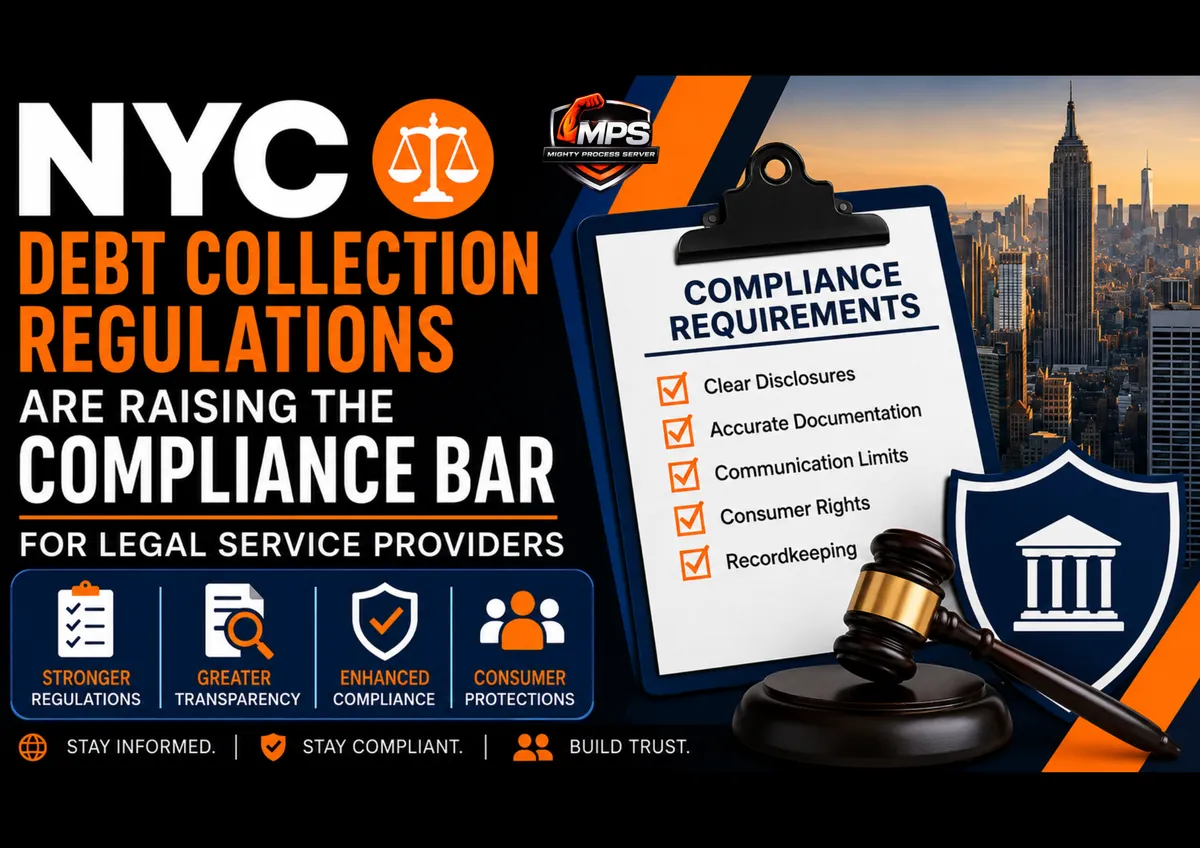
NYC Rewrites the Debt Collection Playbook, and the CFPB May Not Be Around to Enforce the Federal Rules
New York City keeps raising the bar on debt collection. At the same time, nobody can say for sure what the Consumer Financial Protection Bureau is going to look like a year from now. Put those two things together and you get a question every collection attorney, agency, and process server working those files should be asking: if Washington steps back, who steps in?
My short answer is that the rules do not go away just because one enforcer gets quieter. States, cities, courts, and private lawyers are all still in the game. And when a debt case goes sideways, one of the first things anybody looks at is service.
That is where we come in.
I have been serving papers since I started my process serving company in Redding, up in Northern California, and I can tell you the debt docket is where sloppy service gets caught. It is high volume, it is heavily scrutinized, and the defendants who do show up often show up with a lawyer who wants to know exactly how they were served.
This is not legal advice. Debt collection and service rules depend on the entity, the activity, and the jurisdiction. Check the rules that apply to your work and talk to a lawyer when you are not sure.
Why NYC matters so much here
Debt collection has drawn regulators for a long time, and for good reason. Wrong balances, misleading letters, thin paperwork, and consumers who never really understood what they were being sued over are all real problems.
New York City built its own layer of rules on top of the federal baseline. For a collection agency or another covered business, that can mean obligations that go further than what federal law alone requires.
That makes NYC a good example of a bigger trend. State and local debt collection laws can stay just as important, or get more important, no matter what happens with federal enforcement priorities.
If you handle debt collection matters as an attorney or a legal support provider, you have to understand both layers.
Federal rules vs. NYC rules, in plain terms
At the federal level, the Fair Debt Collection Practices Act (FDCPA) sets the ground rules for a lot of third-party debt collection. The CFPB's Regulation F filled in more detail on things like communications, disclosures, validation information, and electronic contact.
New York City can add its own requirements for businesses under its jurisdiction. Depending on who is collecting and what they are doing, local rules can touch on:
Required consumer disclosures
Debt validation and verification
How and when collectors communicate
Recordkeeping
Licensing
Disputed debts
Consumer complaints
Practices that are flat out prohibited
Here is the part people miss. Being compliant with federal law does not automatically mean you are compliant in New York City. A business working there has to figure out which federal, state, and city rules apply to what it actually does.
Why the CFPB's future matters
Since it was created, the CFPB has shaped debt collection through rulemaking, supervision, enforcement actions, its consumer complaint database, and its interpretations of federal law.
Collection agencies, banks, law firms, and compliance people have built their internal policies around what the Bureau was doing and saying. So when the Bureau's direction gets uncertain, that uncertainty ripples through the whole collection industry.
What happens if federal enforcement pulls back?
This is the distinction that matters most: a change in enforcement is not a change in the law.
Even if the CFPB's priorities, staffing, or strategy shift, the FDCPA and Regulation F are still on the books until someone actually changes them. Businesses still have to meet those obligations.
Meanwhile, state attorneys general, state regulators, city agencies, and private plaintiffs can keep enforcing consumer protection laws. That points toward a more fragmented system.
Collection businesses used to be able to ask one question: what does federal law require? Now the better question is: what does federal law require, what does the state require, and what extra rules apply in this city?
If you work across several states, that gets complicated fast.
Could NYC get even more important?
New York City already has serious consumer protection rules on the books. If federal oversight gets lighter, those local rules carry more of the weight for anyone doing business in the city.
That does not mean NYC replaces the federal government. It means nobody should build a compliance program around federal enforcement priorities alone. A national company can face very different requirements depending on where the consumer lives or where the collection activity happens.
For legal professionals, it is one more reason to watch New York State law, NYC rules, court requirements, and federal developments all at the same time.
Where process servers fit in
A process server's job is to deliver legal documents, not to collect the debt. Serving papers in a collection lawsuit does not, by itself, make you a debt collector.
But we serve a huge share of the summonses, complaints, subpoenas, and notices in consumer debt cases. So the quality of our work matters a lot.
New York City also licenses process servers and process serving agencies through its Department of Consumer and Worker Protection, and it expects detailed, accurate records of service. If you serve in the five boroughs, know those requirements cold and check them for changes.
When service gets challenged, attorneys and judges start asking about details like:
When service happened
Where it happened
Who received the documents
What method was used
Whether required follow-up steps, like mailing, were done
What the server wrote down at the time
Whether the affidavit matches what actually happened
If your notes can answer those questions, you are helping the attorney prove the case was started properly. If they cannot, you are handing the other side an opening.
Why proper service is everything in debt cases
Few things damage a debt collection case faster than a claim that the defendant was never properly served.
New York knows this better than anywhere. "Sewer service" is the old term for when a server says papers were delivered when they really were not, and the debt docket is exactly where that problem got its reputation.
The fallout from bad service can include:
Challenges to the court's jurisdiction
Motions to vacate default judgments
Delays and extra cost for the client
Regulatory attention
Damage to the reputation of everyone on the file, including the server
That is why collection firms are better off with process serving companies that take documentation, training, accountability, and accurate affidavits seriously. Serving papers is not just dropping off an envelope. It is protecting the integrity of the whole case.
Documentation is a competitive advantage
In a heavily regulated part of the legal world, the quality of your records is one of the clearest ways to stand out.
Law firms, creditors, and collection agencies want vendors who hand them consistent, defensible records every time. That usually means:
Accurate affidavits of service
Detailed attempt notes
Reliable dates and timestamps
The address and location of every attempt
Any descriptions the rules require
A complete, chronological service history
Fast status updates
Supporting records where they are legal and appropriate
The goal is simple. Build a record that shows what happened, when, where, and how the job was handled. A client who never has to call you to ask what happened is a client who keeps sending you work.
Technology helps you prove it
The tools have come a long way. Depending on the platform and the privacy rules where you work, good process serving software can give you:
Electronic timestamps
GPS-supported attempt records
Mobile updates from the field
Automatic status notifications to the client
Digital document storage
Standardized service notes
Affidavit preparation
Audit trails
A client portal
Long-term record retention
Software does not replace knowing the service rules. But it makes it a lot easier to show that you followed your procedures the same way on every job. For a firm running hundreds or thousands of collection files, that consistency is worth a lot.
This is a big part of why we built Mighty Process Server around the job record. Attempts, notes, and documents stay with the job, so when it is time to prepare the affidavit or answer a client's question, the details are already there instead of in somebody's memory.
How collection firms and process servers can get ready
Here is what I would focus on right now.
1. Watch federal, state, and NYC rules
Do not just follow Washington. New York State and New York City can add obligations of their own, and those are the ones that tend to surprise people.
2. Standardize your service documentation
Every server should log attempts, notes, timestamps, and client updates the same way. Write it down while it is fresh, not at the end of the day.
3. Keep strong records
Service records can matter months or years after the job closes, especially when a default judgment gets challenged. Have a retention policy and follow it.
4. Train your servers
Technology will not stop a compliance problem on its own. Your people need to know the service rules and understand why accurate notes matter.
5. Audit yourself
Pull a sample of affidavits and service records on a regular schedule. Catching an inconsistency in your own review is a lot cheaper than having opposing counsel catch it.
6. Talk to your clients up front
Many collection firms have their own reporting or documentation requirements. Get those expectations set before the work starts so you are not redoing affidavits later.
Where this is all heading
Nobody can promise what federal consumer finance regulation will look like next year. It depends on courts, politics, and agency decisions that are out of our hands.
But one thing is already clear. Changes in Washington do not wipe out debt collection compliance. New York City proves that. States and cities can write their own consumer protection rules, and existing statutes, court rules, licensing requirements, and private lawsuits keep applying no matter who is running the CFPB.
For collection agencies and attorneys, that means planning for several layers of regulation at once. For process servers, it means the basics matter more than ever: accurate service, detailed reporting, and records you can defend.
Frequently asked questions
What are the NYC debt collection rules?
New York City has its own rules for certain debt collection activity, covering things like licensing, communications with consumers, disclosures, recordkeeping, and prohibited practices. Businesses should look at NYC requirements alongside New York State and federal law.
Are NYC debt collection laws stricter than federal law?
In some areas, yes. City requirements can go beyond federal minimums, so a business operating in NYC should not assume that FDCPA compliance alone covers everything.
Does the FDCPA apply in New York City?
Yes. Federal debt collection law can apply in New York City alongside state and city rules. Which parts apply depends on the business, the debt, the activity, and the circumstances.
Are process servers considered debt collectors?
Serving legal documents in a collection lawsuit does not automatically make a process server a debt collector. The answer can change if a server starts doing things beyond service, so stay in your lane unless you understand the legal consequences.
Why does documentation matter so much for NYC process servers?
Detailed records show when, where, and how service was attempted or completed. If service gets challenged, accurate notes and affidavits can be the evidence that holds it up.
What happens if the CFPB cuts back on debt collection enforcement?
The FDCPA, Regulation F, and state and local laws do not disappear because enforcement changes. Other regulators and private plaintiffs can still enforce consumer protection rules.
The bottom line for NYC process servers
What is happening with debt collection in New York City is part of a bigger shift toward accountability and documentation across the whole legal services industry.
We are not the ones deciding whether a debt is valid. That is not our job. Our job is making sure the defendant gets the legally required notice that a case has been filed. That responsibility is exactly why proper service and accurate reporting are non-negotiable.
Whatever happens with the CFPB, if you serve in New York City, keep your focus on:
Following the service rules that apply to you
Accurate affidavits
Detailed service records
Reliable technology
Training your team
Staying on top of regulatory changes
Clear, honest reporting to your clients
The firms that can show reliable, documented, compliant work are the ones collection attorneys will keep calling as the rules get more complicated.
Get your records in order before someone asks for them
The best time to tighten up your service records is before a default judgment gets challenged, not after. If you want every attempt, note, and document organized job by job, take a look at Mighty Process Server or book a quick call with our team.
Stay sharp. Stay informed. Live Mighty!
Read the full article at www.mightyprocessserver.com
This article is published by Process Server Daily, powered by MightyAutomation.ai, the leader in legal support intelligence.