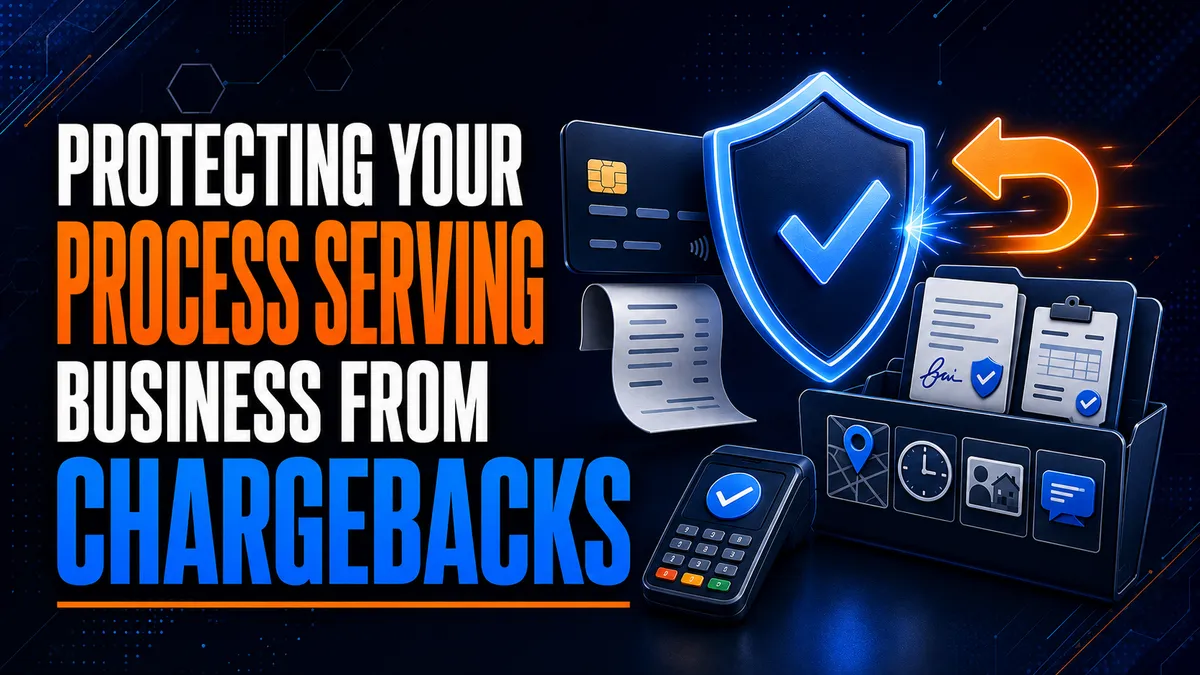
Protecting Your Process Serving Business From Chargebacks
You made the attempts. You sat on the house. You wrote up the declaration. And three weeks later your processor emails you that the money's gone, plus a fee, because the client told their bank you never did anything.
That's a chargeback. If you take cards from the public long enough, you're going to get one. I've had it happen to me at least twice, maybe three times. The third time I think they changed their mind before I had to fight it.
Here's the good news. If you set your business up right before the card ever gets run, you can win these. And better than winning them, you can stop most of them from happening at all.
By Mighty Mike Reid
What a Chargeback Actually Is
A refund is when you give the money back. A chargeback is when the cardholder skips you and goes straight to their bank and says, "Reverse this."
The bank pulls the money back out of your account while it looks at the claim. With Stripe, for example, they debit the disputed amount plus a dispute fee right away. Then you get a short window to fight it. Stripe says it's usually 7 to 21 days depending on the card network, and if you miss the deadline you lose automatically. After you send your evidence, the card issuer usually takes another 60 to 75 days to decide.
And the client doesn't have to move fast. Card networks typically let a cardholder dispute a payment up to 120 days after it went through, sometimes longer. So that pro per who seemed fine in March can still come back at you in June.
Now here's the part every server needs to understand. When I fought one of these, the way the credit card company saw it was simple. You're a delivery company and you didn't deliver. Period.
Think about Amazon. What happens if you say your package never showed up? They don't hesitate. They give you your money back, and the seller's out of luck. That's how the card companies look at us. They don't care that service of process is a personal, attempt-based job. Unless you can show them what the client agreed to, you look like a guy who took money and didn't deliver the package.
Why Clients Dispute a Process Server's Charge
Here's what I've found over the years. It's almost always communication. Money is rarely the primary issue. Most of the time there was a breakdown in what the client expected from you.
They thought they were paying for a result. This is the big one. The client thinks the fee buys a served defendant. You think it buys three attempts and a declaration. If nobody said that out loud before the card got run, you've got a problem.
They don't recognize the charge. Your website says one name and their card statement says something else, like an LLC name they've never heard of. Their first thought is fraud.
The amount isn't what they expected. A duplicate charge, mileage they didn't approve, an extra attempt you added without asking. Any surprise on the bill can turn into a dispute.
The card wasn't theirs. Stolen cards and somebody ordering on another person's card do happen. That's a fraud dispute, and it's a different fight.
They didn't hear from you. Silence makes a good job look like a scam.
I had an attorney ask for a refund once, and attorneys almost never do that. He was probably 70 or 80 years old and he wanted somebody on the phone right now, every time. My phone was on the charger while I was in a meeting for maybe an hour and a half, two hours. By the time I got back I had six or seven nasty emails. I didn't tell you to attempt that address. The communication is terrible. All of it.
Here's the thing. I'd won his business in the first place by calling him when nobody else would pick up. So when he couldn't reach me, he figured, I knew it. Everybody's out to screw me. That's what happens when the expectation you set and the experience you deliver don't match.
Pro Pers Will Ask for Their Money Back
I'm telling you, if you take work from pro pers, somebody is eventually going to ask for a refund. Just how it is. That's not a reason to run from them. Pro pers pay your website rates, which should be your premium rates, and nine out of ten will leave you a review. But you have to handle them differently.
Here's the rule I made in my business. If a pro per orders online, somebody calls them. Right now they don't know what to expect. To them it's like an Amazon order they submitted and now they're waiting for a confirmation email.
So you call and say something like this: "Hey, we got your order. Just want to make it clear, you're paying for the attempts to serve, and we're going to give it our best shot. Is there anything else you can tell me that'll help us get this done?" Ask about work, work hours, the car, and a photo.
Then, if you can't get them, you call back and say, "We made our three attempts and couldn't get him. Here's your declaration for the judge. Before you go that route, we could do a skip trace and try a second address. Want me to do that?"
When I told pro pers up front that the service is fulfilled at three attempts and a declaration, and any other address works the same way, I never had any other problems after that. It became an upfront contract they understood.
Now imagine that second call is your first call. "Hey Julie, we made attempts and weren't successful. What do you want to do?" That's where you get the flak. "What do you mean you went to the house? I put in the notes that he works 4 to 9. I thought you were going to his work." You're not the professional anymore, because you never called in the beginning.
The Chargeback That Taught Me the Hard Way
We had one where we had everything you'd want. A picture of the guy. His car, a really nice red convertible. A stakeout set up around that car with two people on it. There was no way he was getting away if he came out and got in his car.
He walked out the front of the building, got into somebody else's car, and left. We couldn't go inside the building to look for him. Nobody could have served him that day.
The client's response? "You didn't serve it. I want my money back." He did a chargeback on the card.
I fought it. There was a $500 arbitration fee, and if you lose, you're the one paying it. I learned the lesson the hard way that you have to have an agreement in place before you ever go out on the job.
If you're just taking emails, printing papers, and going out to serve, what's your agreement? They called you and said, "How much?" and you said, "100 bucks." Prove it. Do you record your calls? You see where it gets hazy? You need a written agreement.
The Chargeback I Won With One Form
Here's the other side of that.
A lady ordered online. We attempted, nobody ever answered, and she turned around and said I never served it. She did a chargeback.
This time I had my form. When she ordered, she acknowledged my terms of service, and those terms said there were no refunds and that any arbitration had to happen in California, where I was at the time. When the credit card company told me it was headed to arbitration, I replied and said there was no need. The customer already agreed to my terms.
Their arbitration was handled in New York. According to the terms she agreed to, they couldn't handle it there. The card company came back, said she'd confirmed that was her signature, and told her there was no way she could get a refund.
That's basically the cheat code. People want to request refunds? Have them sign the contract up front.
I paid a couple thousand dollars for an attorney to draft my terms way back when I set up my first company. I'd tell you to do the same thing for your state, because the rules on things like refund policies and finance charges aren't the same everywhere. But do it before you need it, not after.
Put the Agreement in the Order Form
Your online order form should do the heavy lifting. Mine has the terms of service right at the bottom, and the client has to check a box acknowledging them before they pay. If you ever end up in court, those terms are what rule. The judge looks at what they agreed to on your website.
A good agreement covers:
Who the client is and who the company is
The person being served and the service address
How many attempts are included
Routine, rush, or same day, and what each one means
The price and when it's charged
Mileage, extra addresses, and any add-on fees
Your cancellation and refund policy
What happens if service isn't successful (a declaration, a skip trace option, a second address)
A plain statement that you're paying for attempts, and successful service isn't guaranteed
How and when the client will get updates
Make the client actually agree to it with a checkbox, a signature, or a confirmation email, and keep that approval in the job file.
One more thing on attorneys. I had one attorney read my terms and message me, "Mike, if I sign this, technically you could charge whatever you want on my card and I couldn't contest it." I said, "Exactly. How much do you trust me?" He started laughing and asked if he could just send me a check. Fine. Most people won't read it. That's okay. It's there when you need it.
Make the Charge Easy to Recognize
The name on the client's card statement, called the billing descriptor, should look like the name on your website, your invoice, and your order form. If your company name is Albuquerque Server and the statement says some holding company LLC, you're asking for a "what is this?" dispute.
If the descriptor has to be different, tell them before they pay. Put a line on the invoice and the receipt: "This charge will appear as..." And make sure the phone number tied to the charge actually rings somewhere. A client who can call you is a client who asks a question instead of filing a dispute.
Itemize the Invoice
"Legal services" on an invoice is useless when you're fighting a dispute. Write down what they bought:
"Routine process service at one residential address, including three attempts and a proof of service or declaration of non-service."
List every add-on on its own line: rush, extra attempts, mileage, second address, skip trace, printing, wait time, e-filing, notarization. Get written approval before you add anything that wasn't in the original order. Then send a receipt right after payment with the date, amount, what they bought, the descriptor, and how to reach you.
Don't Refund It. Credit It.
Not every refund request is a fight. Some of them are a gift if you handle them right.
I had a pro per find me on Google and pay my rush rate, about $170. Then he emailed and said it turned out he could just mail it, and could I do that instead, and bill him for any difference. So I'm thinking, I get to certified-mail this document and keep $170, and you don't want a refund?
I asked him, "You want a refund? Why don't I give you a credit for your next one?" He said, "I hope I never have to go through this again." Ha.
So instead of plain certified mail, I sent it FedEx overnight with signature confirmation, about $47, and paid extra for the option where they keep trying for days until somebody signs. He got more than he paid for, and I kept the client and the review.
And when somebody does ask for their money back, here's your first question, every time: What did I do wrong? Most of the time, it's on you. Take personal responsibility. Then fix it.
Your Job File Is Your Evidence
When a dispute comes in, your job file is the whole case. It needs to show who placed the order, what they agreed to, what you did, and what you sent them.
Keep:
The signed agreement or checked terms, with a date and time
The intake form and any instructions or uploaded notes
The invoice and the payment receipt
Every email and text with the client
Each attempt's date, time, and what you saw
GPS and photos, where you're allowed to take them
The proof of service or declaration of non-service
Any cancellation or refund conversations
Write attempt notes like a pro. There's no such thing as just "no answer." Two sentences: lights on, red Chevy in the driveway, dog barking, nobody came to the door. That's the kind of note that wins a dispute, because it shows a person was actually standing there.
And whoever made the serve signs the proof. Keep it clean.
Keep the Client Posted
Send a confirmation when the job comes in. Confirm the service level, the price, the address, the deadline, and how many attempts are included. Then update them after each attempt, or on whatever schedule you promised.
This gets harder when you're sending work to other servers around the country. I had a rural mountain serve where the client paid me $100 online. Three days went by and the server I'd sent it to hadn't called or emailed. Turned out he'd handed it off to somebody else, who then went quiet. Meanwhile my client's hearing was coming up. By the time it was all sorted, I was going to owe the servers about $200 on a job the client paid $100 for, and we still hadn't served it.
What do you do? Fall on the sword. Call the client, tell them exactly where it stands, and give them options. With attorney clients you're only as good as your last serve, and that client could be worth thousands a month. A dispute you head off with a phone call never makes it to the bank.
When the Dispute Notice Shows Up
Move fast. That 7 to 21 day window goes quick.
Read the dispute reason. Fraud, "service not provided," and "amount incorrect" each need different evidence.
Pull the whole job file.
Write a short timeline: ordered, agreed to terms, paid, attempts made, declaration delivered, every update sent.
Send evidence that answers the actual claim. If they say you never did the work, lead with the attempt log, GPS, photos, and the declaration. If they say they didn't authorize it, lead with the order form and the terms acceptance.
Follow your processor's format and get it in before the deadline.
Write down what happened so you can fix the hole in your process.
Don't dump 80 pages on the reviewer. Keep it organized, and black out any personal information about the defendant that the reviewer doesn't need. Stripe also has dispute prevention tools that send extra transaction details to help a cardholder recognize a charge before they file a dispute, which is worth a look if that's your processor.
And one thing from the other side of this. Never hold the proof hostage over a payment fight. Always give the proof of service. Blasting a client on social media isn't going to get you paid either. If you ever want to see that money, you don't do it.
For Attorneys and Firms Paying a Server by Card
If you're the one hiring, a few things will keep you out of this mess.
Know what you're buying. Most servers charge for attempts and diligence, not a guaranteed serve. Read the terms on the order form. If you need more attempts, a stakeout, or a skip trace, ask for it up front.
Give the server everything. Where the person works, their hours, their car, a photo. The more you give, the better the odds on the first attempt.
Call before you dispute. If a charge doesn't look right, call the server. Most problems are a missing update or a mislabeled charge, and a two-minute call fixes them. A chargeback over a misunderstanding can cost a small company the fee, the money, and its standing with the processor, and it costs you a server who used to answer the phone for you.
Ask how you'll get updates. A server who gives you a login to see attempts as they happen is a server you won't have to chase.
Where Mighty Process Server Fits
All of this gets a lot easier when the whole job lives in one place instead of your truck, your email, and a notebook.
Mighty Process Server keeps every job together: the documents, every attempt with GPS and photos, your notes, all timestamped. Every server on your team gets their own login, so you always know who made which attempt. When a dispute shows up, the evidence is already sitting in the job record.
Your clients get their own private dashboard where they can see status and attempts as they happen. That's the "they didn't hear from you" problem solved before it starts. Once I've got a relationship with a client, that's exactly what I do. I give them login access to the portal so they can see the attempts themselves, and they're like, "Oh, wow, that's great."
When the job's done, the affidavit builds right from the job record, even from the mobile app. If it needs a notary, the Mighty Notary integration gets it signed and notarized right in the app, so the client has their proof fast.
Clients who find you through the Mighty Process Server directory get an instant quote, so the price is set before they ever order. No surprise mileage, no "that's not what you told me on the phone." And with worldwide address search across more than 171,000 cities and global pricing you can set area by area or upload as a CSV, the quote's right even when the defendant turns out to be in another state or another country.
And if you want the follow-up, the reminders, and the whole client conversation history in one place, Mighty Automation has a CRM built in that keeps every call, email, and text with the client. That's one more piece of evidence the next time somebody says you never called.
Build It In Before You Need It
You don't beat chargebacks after the money's gone. You beat them when the order comes in.
Verify who's ordering.
Put your terms in the order form and make them check the box.
Call every pro per before the first attempt.
Charge the card through a secure page, not over email.
Send an itemized receipt.
Write real attempt notes.
Keep the client posted.
Deliver the proof or declaration fast.
Keep the whole file.
When somebody's unhappy, ask what you did wrong first.
Do that, and when the credit card company calls you a delivery company that didn't deliver, you can show them exactly what was delivered.
Be safe out there.
Stay sharp. Stay informed. Live Mighty!
Read the full article at www.mightyprocessserver.com
This article is published by Process Server Daily, powered by MightyAutomation.ai, the leader in legal support intelligence.