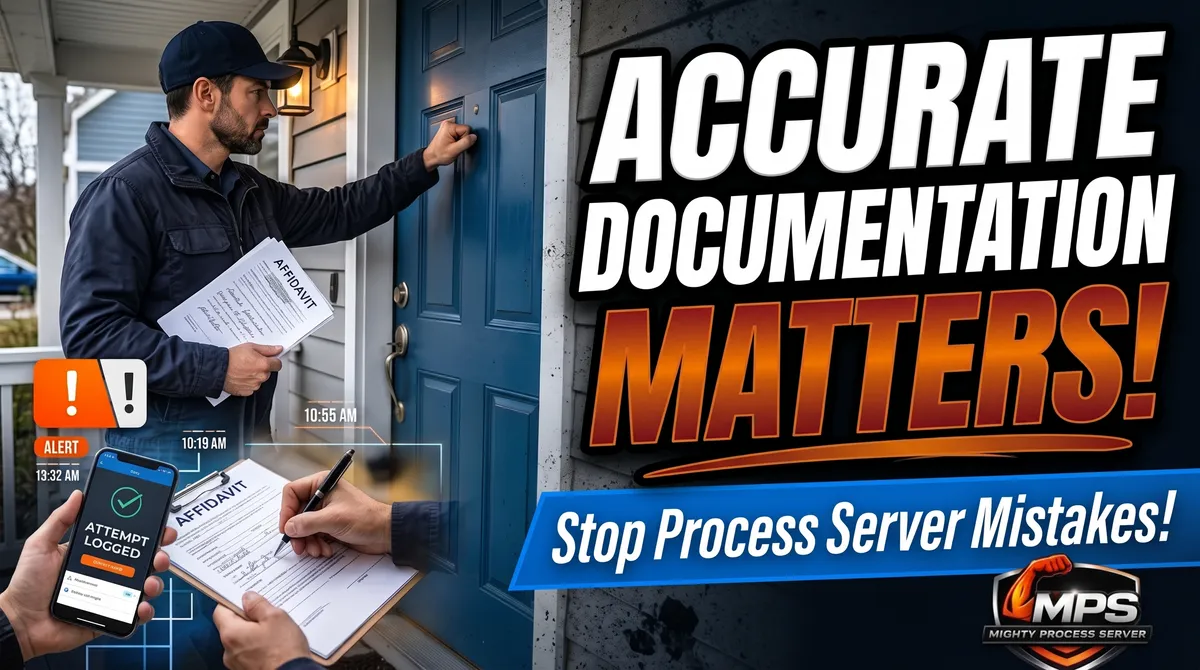
One Small Detail, One Big Problem: Why Accurate Service Documentation Matters
By Mike Reid for Process Server Daily. Practical commentary from the field, not legal advice. Service rules vary by state and court, so always follow the requirements that apply to your job.
A wrong apartment number. A time written as 7:15 when it was really 7:51. A middle initial that doesn't match the summons.
Each one might seem like a small mistake when you're finishing paperwork after a long day. But when a proof of service lands in front of a judge or opposing counsel starts asking questions, those little details can become a much bigger problem.
In this business, completing the serve is only half the job. The other half is being able to prove exactly what happened, when it happened, where it happened, and how it was completed.
Let's look at why accurate documentation matters, where common mistakes happen, and what you can do to keep your records reliable.
Your Paperwork Tells the Story of Your Serve
The judge wasn't standing on that porch with you. Neither was the attorney who hired you.
When questions come up about service, your proof of service, affidavit, and supporting attempt notes are what tell the story.
That means your documentation represents your work to everyone who wasn't there. Even a properly completed serve can become difficult to defend if the paperwork contains missing or conflicting information.
A documentation error can lead to:
Service being challenged, requiring the attorney to spend additional time defending it.
The client needing to arrange another service attempt.
Requests for clarification, additional declarations, or even testimony in court.
Damage to your professional reputation and the trust you've built with clients.
And it doesn't always take a major mistake. Sometimes, one incorrect detail is enough to raise questions.
Where Documentation Mistakes Usually Happen
Most documentation errors don't happen because servers don't care about their work. They happen because of the process surrounding it.
Here are some common situations to watch out for.
Writing everything down later.
You make several attempts throughout the day and wait until evening to document them. By then, times and details can start blending together.
Manually copying information.
Every time you retype a name, case number, or address, there's another opportunity for a typo.
Leaving incomplete attempt notes.
Writing "No answer" doesn't tell the whole story. It doesn't explain what you observed, how long you waited, or what happened during the attempt.
Confusing observations with assumptions.
Saying "The subject was home but avoiding me" is a conclusion.
Describing what you actually observed, such as a vehicle in the driveway, lights on, or no response after several knocks, provides more useful information.
Working with outdated information.
The client sends an updated address, but the original job sheet still contains the old one. If the correction isn't updated everywhere it needs to be, the wrong information can end up on the affidavit.
Rushing the final review.
You're tired, the paperwork is due, and you send it without checking every detail against your notes.
These situations are common, but they're also preventable.
The Details You Should Always Double-Check
Requirements vary by state and court, so make sure you're following the rules that apply to each assignment.
However, these are some of the most important details to verify:
Who was served: The full name as it appears on the documents. For substitute service, include the required information about the person who accepted service and their relationship to the party.
Where service occurred: The complete address, including apartment, unit, or suite number.
When it happened: The correct date and exact time of service or each attempt.
What was served: An accurate list of the documents delivered.
How service was completed: The correct method of service.
Physical description: Any description required by the applicable proof or affidavit form, based on what you actually observed.
Attempt history: Dates, times, and results of each attempt, especially when documenting diligence or non-service.
Case information: Correct case number, court, and party names that match the legal documents.
One incorrect detail can create questions about the entire record. That's why accuracy matters from the first attempt to the final signature.
Seven Habits for Better Service Documentation
You don't need complicated procedures to improve your paperwork. You need consistent habits that become part of your daily routine.
1. Record Every Attempt Right Away
Whenever possible, document the attempt while you're still at the location or immediately after leaving, provided it's safe to do so.
Don't rely on remembering everything at the end of the day. The sooner you record what happened, the more accurate your notes are likely to be.
2. Write What You Actually Observed
Stick to facts instead of assumptions.
Record details about the surroundings, people, vehicles, conversations, and anything else relevant to the attempt.
Your observations should speak for themselves.
3. Be Precise With Dates and Times
Exact times matter, especially when you're making multiple attempts throughout the day.
Keep your timestamps consistent with your notes and any supporting records. If something doesn't match, it may raise unnecessary questions later.
4. Keep One Reliable Job Record
Make sure updated addresses, client instructions, corrections, documents, and attempt notes are kept together.
Working from several versions of the same job increases the chance of using outdated information.
5. Reduce Manual Data Entry
The less information you have to retype, the fewer opportunities there are for mistakes.
Whenever possible, use a system that carries case details from job intake through attempt tracking and affidavit generation.
6. Review Your Affidavit Before Sending
Before submitting anything, compare the completed document against your attempt notes.
Double-check the name, address, date, time, method of service, and documents served.
A quick review can prevent hours of unnecessary follow-up.
7. Keep Your Supporting Records Organized
Keep your attempt notes and supporting documentation organized and accessible.
If service is questioned months later, you should be able to retrieve the complete job history without digging through old notebooks, emails, and text messages.
A Real-World Example: One Missing Apartment Number
Here's a situation that can easily happen in the field.
A server receives an assignment for an apartment complex. The original job information doesn't include an apartment number.
Later that afternoon, the client sends an email correcting the address to Unit 14B.
The server makes the attempt at Unit 14B and successfully serves the party.
Everything goes well until the server completes the proof of service that evening using the original job sheet, which still shows the address without the unit number.
Nobody catches the mistake, and the proof gets filed.
Weeks later, opposing counsel questions whether service was completed at the correct residence.
Now the attorney is requesting clarification, the server is searching through old emails for the address correction, and everyone is spending time resolving an issue that could have been avoided.
The serve was completed correctly. The paperwork wasn't.
If the updated address had been entered into the job record, the correct information could have carried through to the proof of service.
One small update could have prevented a much bigger headache.
Your Pre-Submission Documentation Checklist
Before sending your proof of service or affidavit, take a moment to review these ten things:
Does the name match the legal documents?
Is the complete address correct, including the unit or suite number?
Are the date and time accurate and consistent with my notes?
Is the method of service correctly documented?
Are all documents served listed accurately?
If substitute service was used, did I record the required information about the person who accepted service?
Are the case number and court information correct?
Does the attempt history match what actually happened?
Am I using the correct form for the applicable state and court?
Have I reviewed everything one more time before submitting?
A few extra minutes of checking can save you and your client a lot of trouble.
How Mighty Process Server Helps Keep Everything Organized
I've spent many years in this business, and I wanted a system that makes it easier for process servers to manage their jobs while keeping important details organized.
That's a big part of how Mighty Process Server (MPS) is designed.
Here are some of the tools that can help:
Document Upload and Case Detail Extraction
When you create a job in MPS, you can upload the legal documents and use MightyAutomationAI to extract important information, including case numbers, court details, servee names, addresses, and filing dates.
You can review the extracted information alongside the original documents before saving, helping reduce repetitive typing while keeping you in control of the details.
Service Attempt Tracking
Each attempt can be recorded directly on the job, including its date, timezone-aware time, result, and notes.
For substitute service, MPS requires the person served to be entered, helping ensure that this important information isn't overlooked.
Affidavit Generator
The Affidavit Generator can recommend a template based on the state and document type and populate available merge fields using the job information.
Available options include a Nationwide Declaration, an Affidavit with Notary Block, state-specific forms such as California's POS-010, and a Non-Service / Due Diligence template.
You still need to review the completed document and confirm that it meets the applicable requirements, but you don't have to start from scratch.
Send Affidavits for Signature
You can send affidavits for signature through a link or email directly from the Affidavit Generator, making it easier to move the paperwork forward.
One Place for the Entire Job
Job intake, uploaded documents, service attempts, and affidavits stay connected within the same job record.
That makes it easier to find updated information and reduces the need to search through separate emails, messages, and paper files.
Technology doesn't replace your judgment or your responsibility to follow local court rules. But having the right tools can help reduce repetitive work, keep information organized, and make accurate documentation easier.
The Takeaway: Small Details Protect Your Work
Accurate documentation isn't just paperwork for the sake of paperwork.
It's what helps support your service, protects your client's interests, and builds the kind of professional reputation that keeps attorneys coming back.
If there's one thing I'd encourage every process server to work on this week, it's these two habits:
Record every attempt as soon as possible.
Check every proof of service against your notes before submitting it.
Those two simple steps can catch many of the small mistakes before they turn into bigger problems.
And if you're looking for a better way to manage your jobs, attempts, and affidavits, you can get started with the free plan at MightyProcessServer.com.
You can also explore the available features and subscription options on our Pricing Page.
Keep your records organized, double-check the details, and make every serve count.
Mike Reid, Process Server Daily