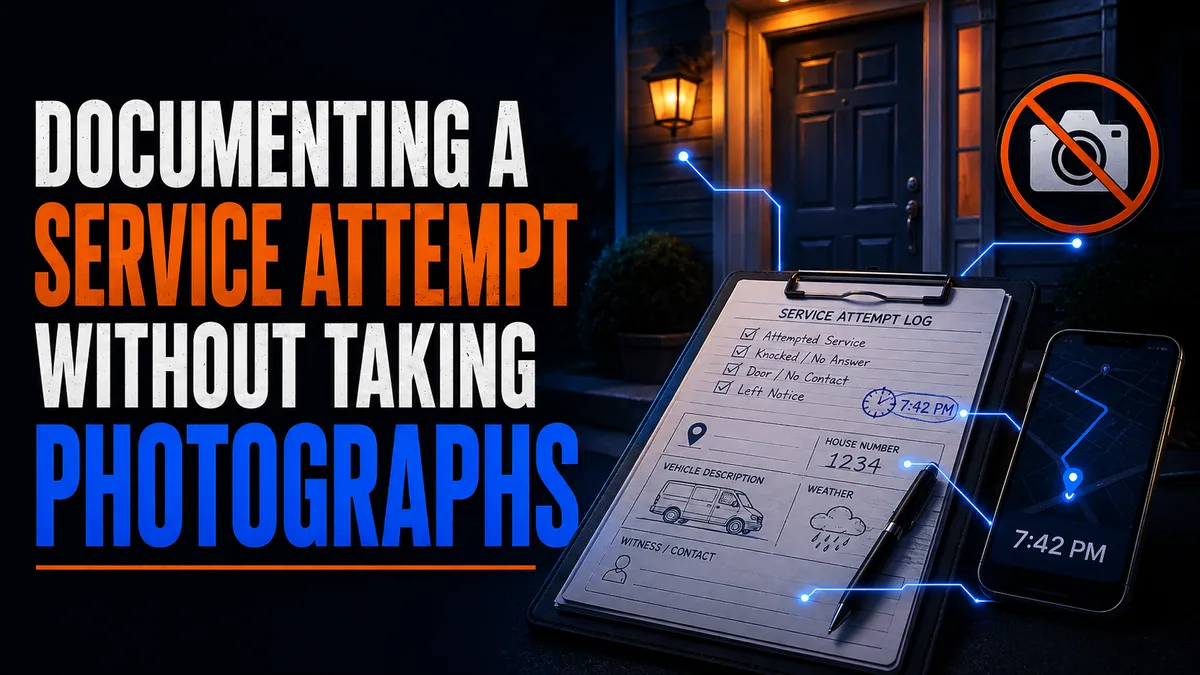
Documenting a Service Attempt Without Taking Photographs
There's no such thing as a "no answer" status. I'll say it again. There's no such thing as a "no answer" status.
I love a good photo. When I post a notice, I take a date and timestamp photograph of every single posting, and I put it on the back of my proof. But you don't always get to take a picture. You're in a courthouse that bans phones. You're in a secured office building where security watches you like a hawk. The client told you no photos. The guy at the door is getting loud and the last thing you want to do is pull out a phone and point it at him. Or your phone just dies at 6:40 at night on attempt number two.
So now what? Now your words have to do the work the picture would have done. And most servers are terrible at that. They write "no answer," "bad address," "unable to serve," and call it a day. That's a conclusion, not a record. Nobody reading it can tell what you actually did out there.
Let's fix that.
Why the Written Record Carries the Weight
Every attempt is part of the history of the job. Even when you strike out, that visit can show you went to the right address, you showed up at a reasonable time, you tried to make contact, you hit an access problem, or you learned something about where this person really is.
Think about who reads your notes. The client. The attorney. Sometimes a judge. Sometimes the next server on the job, who's trying not to repeat your mistakes. Your notes back up your affidavit, prove diligence, set up the next attempt, and answer the questions when somebody says service never happened.
And somebody will say it. On evictions, the notice is the number one most contested thing in court. "Well, I never got notice." When I can take that photo, it's never been successfully overturned. When I can't take that photo, the only thing standing between my client and "I never got notice" is my written narrative and my GPS. That narrative better be good.
Every attempt record should answer five questions:
Where did the attempt happen?
When did you arrive and when did you leave?
What did you do?
What did you see, hear, or learn firsthand?
What was the result, and what's the next step?
If a stranger can read your note and answer all five without calling you, you wrote a good note.
Here's How I Learned This (the Hard Way)
When I built my process serving company, I used to do 30 or 40 serves a day. Some days it was 40 or 50 papers in the bucket. I'd go house to house to house to house, then get back to the office the next day and try to put statuses in. If I hadn't used the app out in the field, I wasn't completely sure which notes went with which address.
So what did I type? "No answer."
And I'm going to be honest with you, because I want you to be honest with yourself. There were times "no answer" really meant "I didn't make it there." That's the truth. If all you're writing is "no answer," a lot of the time you didn't really make the attempt. I know because I did it.
So here's my rule. When you feel tempted to type "no answer" with nothing after it, I want you to type the rest of the sentence: "No answer, because I didn't go there." Ouch, right? That's the point. If that sentence makes you uncomfortable, go back and make the attempt.
What I wanted instead was at least two sentences of real status on every job. I had some saved. Something like this:
There was no answer at the door. There was a vehicle in the driveway, license plate number 44270, a red Chevy. The lights were not on at the neighbors', but it appears that somebody is inside not answering the door.
That's a lot of detail on a first attempt. And here's the thing nobody tells you. Writing it down like that trains you as a server. You start noticing the car, the plate, the lights, the time. You stop having to come back 500 times. The goal should be to serve it on the first or second attempt, and those details are how you get there.
Why does this matter for the business? Because it makes your company more valuable. I promise you.
Write It Up While It's Fresh
Take your notes as soon as it's safe. Not the next morning at the office, like I used to. Every hour you wait, the addresses blur together and the times drift.
If hanging around the property feels sketchy, leave. Drive to a safe spot and then write it up. Your notes can wait five minutes. You can't.
Every entry starts with the basics:
Date
Arrival time and departure time
Full address, with unit or suite number
Result of the attempt
If your job software captures the time and GPS automatically, keep that data with the written entry. But don't confuse the two. GPS shows your phone was at a location. Your narrative explains what actually happened there.
Prove You Were at the Right Address
When you can't snap a picture of the house, describe how you knew it was the house. The street number by the door. The unit letter. The business sign. The building directory. The cross street. Stick to what identifies the place. Don't pad the note with private details that have nothing to do with the job just to make it look longer.
Here's weak:
Arrived at residence.
Here's strong:
Arrived at 1842 Westfield Avenue at 6:17 p.m. The number 1842 was displayed beside the front entrance. Two-story beige residence with a detached garage. Address matched the assignment.
If you couldn't confirm the address, say why. No numbers on the house. Unit labels that don't match. Construction blocking the entrance. The map pin dropped you in the wrong cul-de-sac. All of that changes what happens next, so write it down.
Tell It Like a Timeline
A good attempt note reads in order. Arrival. Address confirmed. How you approached. What you did to make contact. What you observed. Any conversations. The result. Departure.
Instead of "knocked, no response," write:
Knocked on the front door three times and rang the doorbell twice. Waited about two minutes between attempts. No one answered. No voices or movement observed from the front entrance.
If you used a call box, an intercom, the front desk, the leasing office, or a security station, put it in. If somebody refused you access, write who refused, the reason they gave, and what else you tried. Plain, neutral details are easy for an attorney or a judge to follow. Drama isn't.
What You Saw vs. What You Think
This is where good servers get sloppy. A light on inside doesn't prove the defendant is home. A car in the driveway doesn't tell you who's inside. Somebody moving behind the curtain doesn't confirm who it is.
Look at my red Chevy note again. I didn't write "the defendant was home and hiding." I wrote "it appears that somebody is inside not answering the door." That's the line. Facts, and an honest read on the facts, clearly labeled.
Don't write:
The recipient was home and refused to answer.
Write:
After the second knock, a shadow moved behind the front window and the blinds closed. No one answered the door. I could not identify the person inside.
The second one keeps everything useful and doesn't claim something you can't back up. Even when it smells like avoidance, and sometimes it really does, stay factual. An attorney I worked for told me once that giving a false representation can get a case thrown out. That's true at the door, and it's true in your notes. Don't dress it up. Don't fill in the blanks.
Write Down Every Conversation Right
When a roommate, neighbor, receptionist, property manager, or security guard tells you something, say who it came from. Get the name if they give it willingly. Note their relationship to the address or the person. Add a general description if it matters. Then record what they said. If they won't give a name, write that. Don't guess.
An adult woman answered the door and identified herself as Maria Lopez, the recipient's sister. She stated the recipient moved about three months ago and she did not know the new address. She declined to give further information.
Use quotation marks only when you remember the exact words. Otherwise paraphrase, and make it clear you're paraphrasing. A neighbor saying "he moved to Phoenix" isn't a verified fact. It's a lead. Write it like a lead.
And keep your mouth shut about what the papers are with people who have no business knowing. The neighbor doesn't need to know it's a divorce.
This is also where your intake pays off. When a client orders, I ask: Do they work? What time do they work? What kind of car do they drive? And do you have a picture of them? A photo of the person from the client is a totally different thing from photographing the attempt. One helps you recognize who opens the door. The other is evidence you were there. When you can't take the second one, the first one helps you write an honest identification note.
Other Ways to Back Up the Attempt
No photo doesn't mean no evidence. Depending on your local rules, your client's instructions, privacy rules, and your own company policy, you can lean on:
GPS coordinates and route history
Automatic arrival and departure timestamps
Activity logs from your job software
Written or voice notes made at the time
Call logs for authorized contact attempts
Building visitor logs or access records
Dispatch messages sent during the attempt
A statement from a second server or witness who was with you
These back up your narrative. They don't replace it. Keep each one tied to the right job and stored securely. And don't record audio or scoop up personal info unless it's legal where you are, necessary, and authorized.
My old habit with paperwork was simple. My field sheet and my proof of service traveled together, attached right to the invoice. That way the client had the whole story in one place. Same idea here. The attempt record, the timestamps, and the proof should all live on the same job.
Gates, Guards, Dogs, and Danger
If you can't reach the door or the person, describe exactly what stopped you. A locked gate. A key-card entrance. A guarded community. A dead call box. A restricted workplace. A loose dog. A property that's falling down.
Entrance gate required a resident access card. Pressed the directory button for Unit 405 twice. No response. The on-duty security officer declined to give access or confirm residency. No other public entrance available.
Safety problems go in the same way. Objective. Write down threats, aggressive behavior, visible hazards, or anybody trying to block you in. If you called police or emergency services, note the agency, the time, the incident number, and any instructions they gave you.
This is exactly the situation where I don't want you reaching for your camera. If the guy's yelling, leave. Get to a safe spot. Then write it up while it's fresh. A great note written from your truck down the block beats a blurry photo that got you hurt.
Your Notes Become Your Affidavit
Your affidavit or proof of service is built on your attempt notes. So finish the notes before you prepare the affidavit. Names, dates, times, addresses, descriptions, method of service, and who's related to who need to match across the job record and the final filing.
Before you sign, put the affidavit next to your original notes and the client's instructions. Read them together. Never add a detail just because it makes the affidavit look stronger. If you don't know something, say it's unknown. Don't fill the gap with a guess.
And always give the proof of service. That's your job. One attorney I worked for was so ticked off at his old server that he fired him. He told me, "He's got one job. Serve the paper, sign the proof of service, and communicate status." That's it. Good attempt notes are how you communicate status when there's no picture to send.
Know Your Rules
The rules change with the state, the court, and the kind of case. They can cover which service methods are allowed, what attempt details you need, how affidavits are done, how long you keep records, privacy, recording audio, going onto property, and what you can tell people.
In New Mexico, for example, when I called around to Albuquerque competitors, one told me that on evictions they post on the third attempt, take a picture, and send it by mail, and that they document each attempt and can provide an affidavit of non-service when the person never answers. That's how they described their process. Check the controlling court rules and statutes in your state, plus your client's instructions and your company policy, on every job. When photos are part of the requirement and you can lawfully take them, take them. When you can't, your written record has to stand on its own.
What Attorneys Actually Want From Your Attempt Notes
If you're on the law firm side reading this, here's why attempt quality matters even when there's no photo.
A paralegal can't file "no answer." She can't answer a judge with "unable to serve." When a defendant claims he was never served, or a motion for alternative service needs a showing of diligence, the firm needs specifics: the date, the time, the address confirmation, what was tried, what was seen, who was talked to, and what happens next. Photos help when they're allowed. A courthouse with a no-phones rule, a secured office building, or a client that bars images doesn't change what the firm needs to show.
So when you hire a server, ask to see a sample attempt record. If all you get back is "no answer, no answer, no answer," you don't have diligence. You have three trips you can't prove.
Where Mighty Process Server Fits
I built Mighty Process Server because I lived the "no answer" problem. Every job gets its own record, with GPS, timestamps, and attempt notes logged in the field, plus photos when they're lawful. So the narrative gets written at the door, not the next morning from a fuzzy memory of 40 houses.
Every server gets their own login, not one shared office login. That way you know exactly who made which attempt and who wrote which note. Your clients can see job status on a private client dashboard, so they're not calling you for updates. When it's time for the affidavit, the notes feed the affidavit workflow, and the Mighty Notary integration handles e-notarization right from the mobile app.
Attorneys can get instant quotes and find servers through the directory, which covers 171,226 cities and 4,530 regions. Servers can upload their worldwide pricing as a CSV using the fee schedule template.
And if you want the marketing and follow-up side handled too, Mighty Automation (mightyautomation.com) gives you a CRM and automates the outreach, so the firms that love your attempt notes keep sending you work.
Sample Attempt Record Without Photographs
Here's what a full attempt record looks like when there's no picture. Steal it.
Date: August 5, 2026
Arrival: 6:32 p.m.
Departure: 6:41 p.m.
Location: 427 Oak Ridge Drive, Unit B
Arrived at the address and confirmed Unit B by the letter displayed beside the front door. Two-story duplex with separate entrances. Knocked three times and rang the doorbell twice. Heard movement inside after the second knock. No one answered. At 6:38 p.m. an adult male exited Unit A. He declined to give his name but stated the recipient still lives in Unit B and is usually home later in the evening. Did not disclose the nature of the documents. No contact with the recipient. No documents left. Recommend next attempt after 8:00 p.m. based on the neighbor's statement.
Look at what that does. Where. When. What I did. What I saw and heard. What the neighbor said, labeled as what the neighbor said. The result. The next move. Nobody reading that has to call you.
One Last Look Before You Hit Submit
Before that attempt goes to the client, run through it:
Did I answer all five questions: where, when, what I did, what I observed, what's next?
Did I explain how I confirmed the address?
Is it in time order?
Did I keep what I saw separate from what I think?
Did I say who told me what?
Did I note every gate, guard, and safety problem?
Does it match what's going on the affidavit?
Is there a single "no answer" with nothing after it?
If that last one is a yes, you know what to type next. "No answer, because I didn't go there." Then go back and do it right.
The photo is nice to have. The written record is the job. Write it like a judge is going to read it, because one day a judge will.
Be safe out there.
Stay sharp. Stay informed. Live Mighty!
Read the full article at www.mightyprocessserver.com
This article is published by Process Server Daily, powered by MightyAutomation.ai, the leader in legal support intelligence.