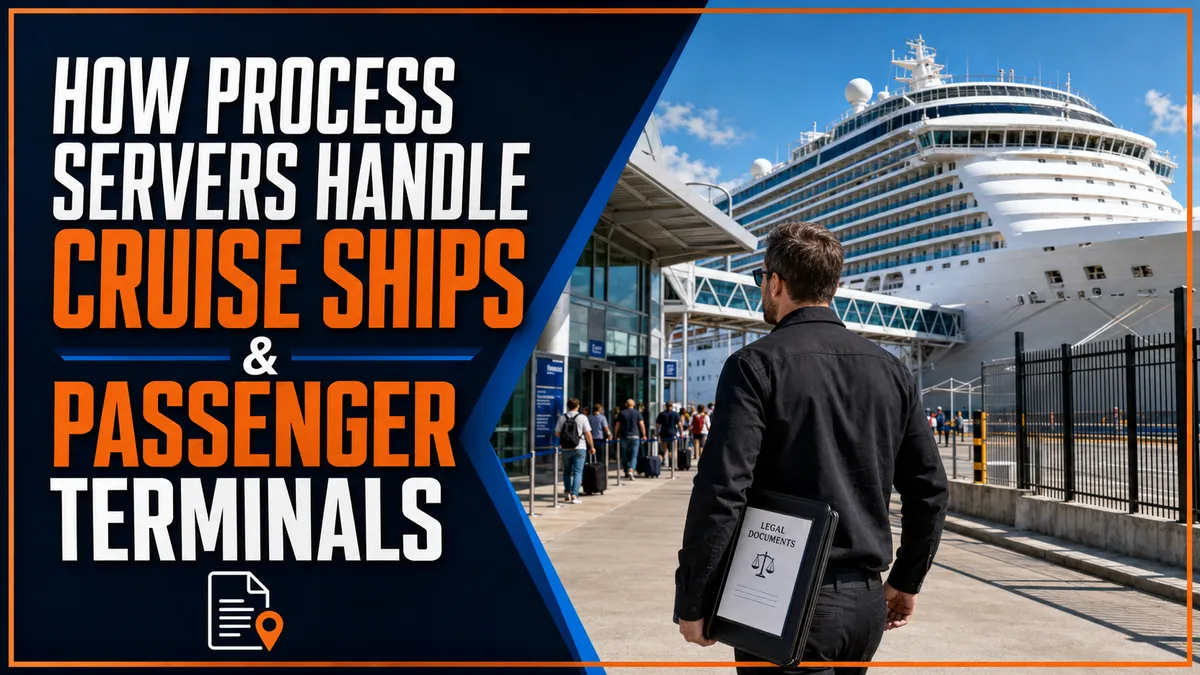
How Process Servers Handle Cruise Ships and Passenger Terminals
A cruise ship is the hardest moving target you will ever chase. It shows up late, switches berths, skips a port, and leaves with your defendant on it. I'm telling you, a ship does not care about your deadline.
So here's how I think about it. Carrying papers does not get you through a security gate and it does not get you up the gangway. Not ever. The job is to be in the right public spot, at the right time, with the right face in mind. Then serve and leave.
What makes ships so tough
The problems come down to movement, timing, ID, and security. A ship can run late, change terminals, or sail before you find anyone. On top of that you have:
Restricted terminal areas and ship access
Customs and immigration checkpoints
Huge crowds at embarkation and disembarkation
No easy way to confirm someone is even aboard
Cruise-line privacy rules (they will not confirm a passenger for you)
Crew who can't leave the vessel
More than one terminal in the same port
Weather and operational changes
International itineraries and questions about which court has reach
That's a different animal from knocking on a front door.
Can you board the ship?
No, not without permission. A court document is not a key card. Never follow a passenger through a secured entrance, never walk past security, and never pretend to be someone you're not. Pretexts get cases thrown out, and they can get you in real trouble.
When you're told no, ask who can help. Terminal security, port administration, the cruise line's legal department, the vessel's port agent, or a shoreside operations rep. They probably can't accept papers for your defendant, but they can tell you how their facility works. Be polite. You will need them again.
Know which rules apply
Before you even drive to the port, think through the questions below. Your hiring attorney should answer most of them, because you are not there to make legal calls.
Where was the case filed, and which court rules allow the service method?
Where will the person physically be on the day?
Is the ship docked or at sea?
Is the person a passenger or a crew member?
Do the papers need to go to another country? If so, does the Hague Service Convention or another treaty apply?
Is the cruise line itself the defendant?
A foreign-flagged ship or an international passenger does not automatically mean the Hague Service Convention applies. Someone standing in a U.S. terminal may be treated very differently from someone you need to reach in another country. Get the instructions from the attorney in writing, and check your own state's rule too.
If the papers do need to go abroad, that is exactly where Mighty Process Server can help. International address search is live, and our global pricing tier lets a server upload a CSV of worldwide pricing so the customer sees the right fee for their location automatically.
Who are you serving?
A passenger. You get a short window, either before boarding or after they leave the ship. Nail down the ship's full name, the cruise line, the right terminal, the date, the berth, and what the person looks like. Cruise lines won't confirm a reservation or a cabin, so you'll lean on a recent photo and a physical description. Here's a trick from my own work: find the in-person look photo. People are always a little different in real life than in their filtered pictures.
A crew member. They may stay aboard or have limited time ashore. A cruise-line rep might be willing to ask the person to meet you in a public terminal area. The line doesn't have to do it, and they don't have to accept papers for the person.
The cruise line. If the company is the defendant, the right move is usually its registered agent or another legally authorized corporate representative. Handing papers to a terminal employee or a crew member may not count as service on the company.
A subpoena witness. Same rules as anywhere else. A witness being aboard a ship doesn't wipe out the court rules. Confirm with the attorney whether it has to be personal delivery, whether the witness fee must go with it, and whether the person leaves the area after sailing. And a subpoena doesn't get you on the vessel either.
My game plan for the port
Research the itinerary. Ship, berth, terminal, and how long it's in port. Check again the morning of, because schedules change.
Get there early. Parking, security lines, and finding the right terminal eat time.
Coordinate when it makes sense. A call to the port authority, terminal management, the ship's port agent, or the cruise line's legal team can save your whole day.
Stay in the public or approved areas. Wait there. Don't chase anyone past a checkpoint.
Confirm who it is. Use the photo, the description, or a verbal acknowledgment before you hand over anything.
Protect the privacy. Don't announce case details in a crowd.
Write everything down. Times, schedule changes, who you spoke with, where you were allowed to go, and why it didn't work if it didn't.
The best way to get people is when they're going from one place to another. It really is. A passenger terminal is one big going-from-one-place-to-another, so that works in your favor. Be in the public spot where people come out, serve discreetly, and leave. There's only pain in sticking around.
If they refuse the papers, follow your jurisdiction's rule. In some places you can state what the papers are and leave them near the person you positively identified. Other places differ, so check yours. And don't ever throw papers, block someone's path, make a scene, mess with customs processing, step into a secured area, or photograph security systems or credentials.
Tools that help
Port schedules, the cruise line's published itinerary, a vessel-tracking app, GPS maps, a phone, a recent photo of the person, and good case software with time-stamped attempt records and photo documentation. The tracking app is handy, but don't trust it over the official port info. It can lag, and it won't always show a last-minute terminal change.
This is where the Mighty Process Server mobile app earns its keep. Time-stamped notes and photos go right into the job, and it can generate affidavits, send them, and have them signed for notarization right in the app. Need documents notarized the fast way? That's Mighty Notary.
At sea?
Can you serve someone in international waters? Maybe, in some cases, but it brings up tough questions about jurisdiction, access, treaties, and the ship's flag state. Being at sea doesn't make service valid or invalid on its own, and it still doesn't let you board. Have the attorney sign off on the method first. Honestly, a scheduled port call is almost always the more practical shot.
Quick tips
Verify the ship, terminal, berth, and sailing time.
Confirm the legal name and how the person connects to the ship.
Carry your ID and whatever credentials your state requires.
Get there before embarkation or disembarkation starts.
Cooperate with terminal and vessel security.
Never misrepresent who you are.
Stay out of restricted areas unless someone authorizes you.
Tell the client right away if the ship sails before you serve.
When it doesn't work
If you can't serve, your notes are the product. Put down the date and exact time, the port and terminal, the ship and cruise line, the berth, scheduled versus actual arrival, which areas you were allowed into, names or titles of everyone you spoke with, what security told you, whether you confirmed the person was there, why service failed, when the ship left, and any other address or port call worth trying.
With that, your client can pick the next move: another attempt, a different address, a different method, or international procedures. I can't tell you how much goodwill a clean set of notes buys you. Communicate status. That's the job.
And if you run a serving business and want more of these jobs, Mighty Automation is a complete marketing resource that automates your marketing integrations, content generation, and sales, and it includes a CRM. Get found by the attorneys who need a server who gets this stuff.
Be safe out there. Go get your money.
Stay sharp. Stay informed. Live Mighty!
Read the full article at www.mightyprocessserver.com
This article is published by Process Server Daily, powered by MightyAutomation.ai, the leader in legal support intelligence.