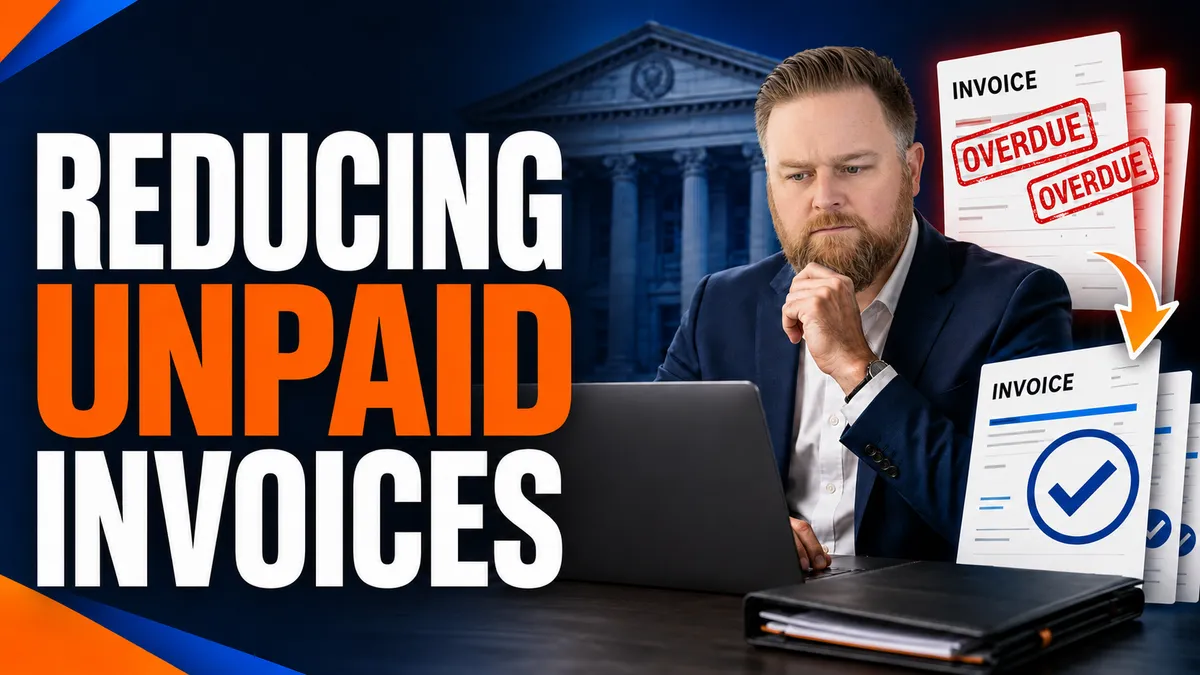
Reducing Unpaid Invoices in a Process Serving Company
Always give the proof of service. I'm telling you, holding it hostage is how you lose the next ten jobs, not how you get paid on this one.
That one rule stops more collection disasters than any late-fee clause I've ever written. You already spent the fuel, the tolls, the printing, the court fees, and the skip-trace money before the client ever writes a check. Cash flow in this business is front-loaded pain. So you need a system that gets you paid without turning you into the guy who won't release the affidavit.
Tim Santoni said it best on EP 22: "Accounts receivable will kill you." You can have tons of cases and tons of invoices out there, but until they get you paid, you've got a problem. Tim works with a lot of process servers and investigators, and his take across the board is that we're usually terrible at accounting. So are the attorneys we work for. That's two groups of people who hate paperwork trying to settle up with each other. You need a system.
Here's how I run it.
Set the Clock Before You Take the Work
Most companies are net 30. Attorneys especially. If you didn't get paid up front, stop complaining at day 20. You're early. Give them the billing cycle they actually run on: first of the month, after their client payout, whenever their bookkeeper opens the stack.
At day 60, the work stops. Not the proof. The new work. That's the line. Thank them for the order, then say you've got an outstanding balance and you'd love to take the new serve as soon as a card clears the old one. Bill them for the new job at the same time. Does that sound fair?
Practice that line. Fair puts the scales on the table. Most people hear it and realize you're not being overbearing. You're asking to get paid for work you already did and work they just asked for.
Put the terms where they can't miss them: contracts, account apps, rate sheets, online order forms, and the invoice itself. Due date. Advance pay or not. Payment methods. When mileage and extra attempts kick in. Whether rush and same-day fees are refundable. How to dispute a charge. Late fees if you use them. When the account gets suspended.
Due upon receipt, Net 15, Net 30. Pick one and stick to it. Longer terms are for clients who've already proven they pay. New clients, pro ses, one-time customers? Pay before you leave the office. High-mileage, rush, same-day, out-of-area? Deposit or full payment before dispatch.
Price It Up Front and Half the Fights Go Away
A lot of invoice fights start the day the order comes in. Nobody said what it would cost, so the bill shows up and somebody in AP has a heart attack.
Paralegals don't want to call you. They want a number. Give them one right on the form. With the instant quote on your Mighty Process Server order form, the client sees the price before they ever hit submit. Pick your rush tier, see the fee, place the order. When the invoice matches the quote, there's nothing to argue about.
And the first server to give a price usually gets the job anyway. So you win twice.
Don't Hand Out Credit Like Candy
Not every new client gets to run a tab. Verify the business name and address. Confirm the billing contact. Look them up. Ask for a reference. Set a credit limit. Get a signed agreement.
A new firm can start on advance pay or a small limit. Earn the longer terms. Clients who pay late every month don't get unlimited serves. Adjusting terms to match payment behavior isn't rude. It's how you stay in business.
I learned this the hard way. When I talked with Tim on EP 22, I told him about a stretch where I had, let's just say, 100 cases, and about 80 of them were coming from one client. I'd have to do five or six attempts on their stuff when I normally only provide three, and they were paying me half of what I charged everyone else. I was always so busy, but I was always so broke. That's the 80/20 rule biting you.
Tim nailed why: the client that wants to pay less for more, that's a trend. They're going to keep pressing on it. More admin, more support, more information on the proofs, more follow-up. So run the numbers on your biggest client before you brag about how much work they send you.
Why Invoices Die on Somebody's Desk
Most overdue invoices aren't a client refusing to pay. They're a paperwork mess.
Wrong billing contact. Missing matter or PO number. Fuzzy service description. Wrong rate or surprise add-ons. Missing affidavit. Confusing pay instructions. Invoice that landed outside their billing cycle. Fight over mileage, attempts, or rush fees. Client cash-flow problems. Soft follow-up. No written approval on extras.
Steve Glenn put it straight on EP 11: "Our work product is the affidavit." If clients are always telling you that you misspelled a word, the affidavit's wrong, you forgot to notarize it, or the invoice is wrong, that's on you. And when they call, call them back. Steve misses a lot of calls, but he calls his people back five, ten minutes later. That's what they want.
Fix the admin mistakes the same day. Treat the chronic late payer like a credit risk, because that's what they are.
Send a Bill a Human Can Approve
Every invoice should answer the questions on the other end without a phone call: who you served, where, when, what you charged, and why.
Client name and billing info. Case name and number. Who got served. Service address. Assignment and completion dates. Itemized fees and expenses. Total. Due date. How to pay.
Send it when the job closes, not in a month-end pile. Attach the proof of service, attempt log, receipts, whatever supports the charge. A complete package gives them fewer excuses to sit on it.
This is where the tools pay for themselves. In Mighty Process Server, every attempt gets a GPS pin and a timestamp. When somebody says you were never there, your phone already answered them. That attempt log backs up every attempt charge on the bill.
And get the proof done fast so the invoice can go out the same day. Serve them, then generate the affidavit right there in the mobile app before you even start the truck. Send it and get it signed for notarization without going back to the office. Mighty Notary handles remote notarization, and the notarized affidavit comes right back to the job. No driving across town to find a notary at 4:55. Your proof is done before the next stop, and so is your invoice.
Make paying easy. Card, ACH, e-check, portal, a link on the invoice. Recurring billing for the clients you've vetted. If they still want to mail a check, give them clear instructions. Don't make them hunt for AP. Invoice it, take the card through Stripe or take a check, and keep your statements clean. Go get your money.
Automate the Boring Parts
When a job closes, the invoice should go out. Due dates tracked. Reminders on a schedule. You want a screen that shows sent, viewed, due soon, partial, overdue, history, aging buckets, and notes.
Connect invoices, expenses, and payments in one place so you can see who's always late before the balance gets ugly. Then change their terms while you still can.
Talk Like a Pro and Keep Talking
Rates, expected charges, and how billing works should be clear when they submit the order. Extra fee? Get written approval before you do the work. Extra attempts, mileage, wait time, notary, skip trace, second address. If they didn't approve it, don't be shocked when they fight it.
Half the "we'll pay when we hear something" excuses go away when the client can see the job for themselves. Clients stop calling "any update?" when they can look. Live job status in the Mighty Process Server client portal does that. Transparency wins clients, and it takes the "we didn't know it was done" excuse off the table.
Once the invoice is out, run a reminder cadence and don't improvise it:
Courtesy reminder before the due date
Notice on the due date
Follow-up at seven days late
Call billing at fifteen
Stronger notice at thirty
Suspension talk when it's still open
Be polite. Be specific. Invoice number, amount, original due date, how to pay. When you call, ask if it was received, approved, or scheduled. The person who ordered the serve is often not the person who cuts the check. Find AP.
Keep your billing contacts and your AP people in the Mighty Automation CRM so nobody falls through the cracks. Following up isn't pushy when it's organized.
Look at AR Every Week
Aging report. Current. 1-30. 31-60. 61-90. 90+. Do it weekly.
Watch average days to pay, on-time percentage, total overdue, dispute count, collection rate by client, and write-offs. If you're only chasing money when you're mad, you're already behind.
Tim's advice on EP 22 fits right here. You don't need to be an expert in the P&L or the balance sheet. Figure out which numbers matter in your business and measure those. Don't try to measure them all at once. Just start, and make sure whoever is doing your books is doing it right.
Early-Pay Discounts, Carefully
A small discount for paying early can make sense when cash now beats full price later. Run the math. The reduced payment still has to cover labor, travel, tech, and admin. Prepaid balances for high-volume clients work too. They fund the account, you deduct as jobs close.
Disputes: Move Fast
Disputed invoice? Same day. Match it to the order, the rates, the notes, and the proof. If you blew it, fix it and own it. If the charges are right, send a clean written explanation with the records attached. Letting a dispute rot for a month is how a $400 bill becomes a relationship you never get back.
Same goes for card disputes. When a client files a chargeback, your signed proof of service and your payment record are your exhibit. Keep them together on the job.
When They Still Don't Pay
Call first. Then email from a system that shows opens. Then a demand letter.
Certified mail. Return receipt. The little green slip. Signature required. Don't put your name or company on the envelope or the green card. Use a neutral sender line so they actually pick it up at the post office instead of tossing "another invoice." The letter needs the amount and the pay-by date. That's the whole point.
I served one attorney a demand letter before I went near the state bar. He called the same day. Invoice got lost. He felt terrible. Card over the phone. Done. No Facebook post. No nuclear option. Just a hard conversation on paper that made it official.
Payment plan in writing. Suspend the account. Collection agency if the dollars justify it. Small claims when they don't. Attorney when it's big. Before you sue, weigh cost, time, and odds. Keep every contract, invoice, email, promise, and approval. That's your case file.
State bar complaints on attorneys? Last resort, and only when the balance is serious. Most of the time more phone work gets you further.
The People Who Hurt You Worst
In my experience, big process serving companies are the worst payers. Attorneys run late and still usually pay. The volume shops that buy your serve for sixty and bill their client a hundred will partial-pay you forever. Three hundred on a four-hundred balance, roll the rest, blame missing proofs, blame their client not paying them yet.
My first partner, Diane, died of cancer owed tens of thousands by outfits like that. Rest in peace. I told Brendon Carl about her on EP 34. Late 2013, up in the Chico area, she had five servers and she gave me work. She dealt with me being a knucklehead many, many times, like trying to sign the proof of service before it was all filled out. I'd say, just sign for me. She'd say, you can't sign for other people. That's called forgery. She had a big heart and people took advantage of it. I saw that before I really built my own company. That's why I push payment up front. Not because I'm hard. Because I watched what happens when you're soft and the balance just keeps rolling.
If you're going to work affiliates, set reciprocal rates and hold them to it. When the gatekeeper "doesn't know" about the deal you made with the owner, that's not a misunderstanding. That's a company that doesn't honor its word. Next order, your full rate.
Brandon Yadegar had the right idea on EP 24. Good affiliates aren't trying to make a big profit off each other. His rates are set so the other company can make a decent profit, not so he can gouge them. Undercut each other by ten bucks a serve and we price cut each other to death. Work with the shops that think like Brandon. And when you need coverage out of your area, throw the job on the Mighty Process Server bid board and let a server who's actually there bid on it.
Don't Poison the Well
Never blast a non-payer on Facebook if you want to get paid again. I'm serious. The long rant that makes the whole group sour is time you could have spent calling three new clients. Money is rarely the primary issue. There's almost always a communication story on the other side: attempts they think you skipped, a proof that sat two weeks, a status update that never came. Hear it. Then collect.
And if you'd rather spend that energy on growth, put it there. That firm that stopped sending work? It's sitting in your CRM. Mighty Automation is the whole marketing shop in one place: the integrations, the content, the sales follow-up and the CRM. Send them a campaign and remind them you exist.
An attorney once vented to me about a server he'd just fired. One job: serve the paper, sign the proof, communicate status. That's it. Once you say received, the ball's in your court until that proof is in their hands, and until you've been clear about when you expect to get paid.
What I Want You to Walk Away With
Get paid up front when you can. Expect net 30 when you can't. At 60 days, stop new work. Always deliver the proof. Quote it up front. Invoice like a professional. Make paying easy. Review AR weekly. Demand letter before drama. Never shame people online.
Build a system the whole company runs: field notes in on time, approved charges recorded, invoices accurate, credit policy enforced. Mighty Process Server puts the quote, the GPS attempts, the affidavit, the notarization, the live status, and the Stripe invoice on the same job, so the whole story is in one place when it's time to get paid. You're not chasing overdue bills for sport. You're building a company that doesn't bleed while it waits.
Be safe out there.
Stay sharp. Stay informed. Live Mighty!
Read the full article at www.mightyprocessserver.com
This article is published by Process Server Daily, powered by MightyAutomation.ai, the leader in legal support intelligence.