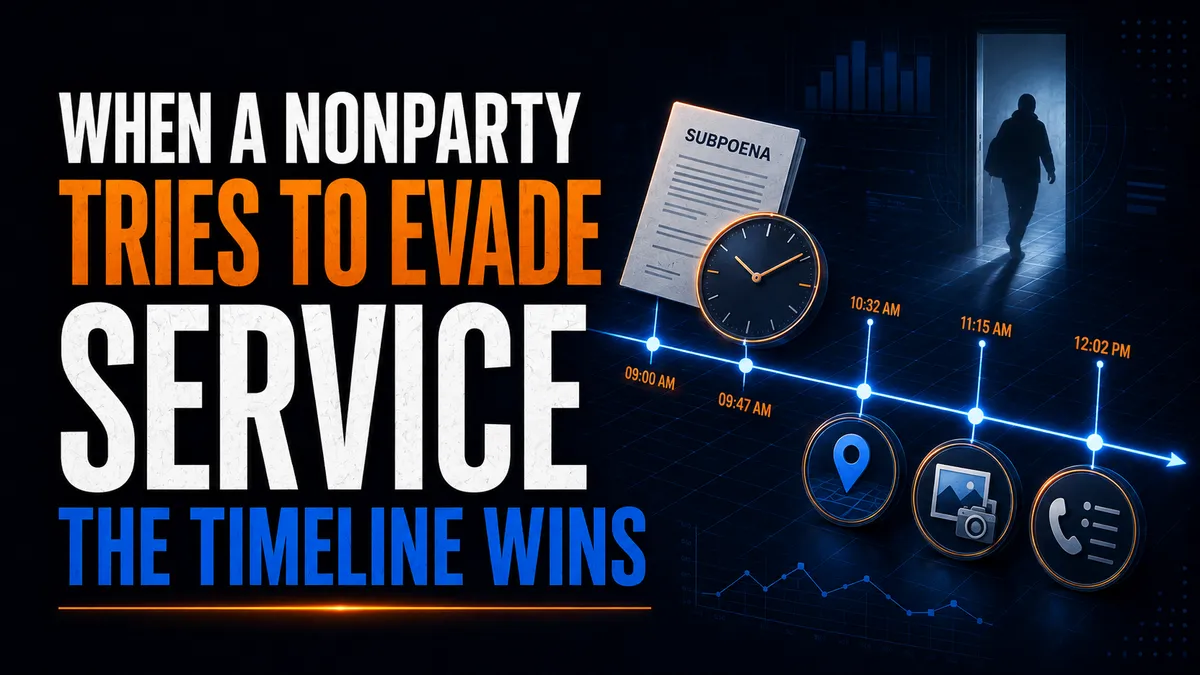
When a Nonparty Tries to Evade Service, the Timeline Wins
Some of the hardest serves you'll ever get aren't on the defendant. They're on somebody who isn't even in the lawsuit. A records custodian. A business owner. A guy who knows something and would really rather not talk about it under oath. They're not named in the case, so a lot of them figure the papers aren't really their problem. Then they duck you.
When that happens, your timeline becomes evidence. Not your opinion of the guy. Not "he was obviously dodging me." Your dates, your times, what you saw, who you talked to, and what the court actually authorized.
A federal case out of Puerto Rico this summer shows exactly why. Let's break it down, then talk about what it means for your files.
By Mighty Mike Reid
What Happened in Starling v. Navlan PR
Here are the real facts, straight from the court's memorandum and order in Starling v. Navlan PR, LLC, Misc. No. 26-129, signed July 17, 2026, by Senior U.S. District Judge Francisco A. Besosa in the District of Puerto Rico.
Kimberly Starling sued Allstate in the Northern District of Illinois, saying she got an unsolicited robocall in violation of the Telephone Consumer Protection Act. She wanted discovery from Navlan PR, LLC and its principal, Ryan Blackman. Both are alleged to live in Puerto Rico. Neither one is a party to the Illinois case. Nonparties.
Personal service of the subpoenas didn't work. So Starling went back to the Illinois court and got permission to serve the subpoenas by mail and email. One subpoena asked Navlan for documents by October 31, 2025. The other told Blackman to show up for a deposition on November 7, 2025. They went to last-known physical addresses and to email addresses Starling had already used to correspond with them.
Neither one responded on time. On November 26, 2025, a law firm emailed to say it represented them, objected to the form of service, and agreed to send some documents anyway. Some documents reportedly showed up. Blackman never sat for the deposition.
So Starling filed a motion to enforce in Puerto Rico, the district where compliance was required. And this is where the process server's part of the story gets good.
The server tried to personally serve the motion. The registered agent address listed for Navlan with the Puerto Rico Department of State was occupied by an accounting firm with no knowledge of Navlan. Blackman lived in a gated community in Dorado, and a security officer stopped the server at the entrance, reportedly saying he had standing instructions not to let process servers in. The server called the respondents' own law firm and was told the firm had no information about Blackman.
Every door closed. Every one of those closed doors got written down.
The motion was mailed to Navlan, Blackman, and their attorneys on May 1, 2026. Starling asked the court for permission to deliver it by email on May 28, and the court granted it on May 29. On June 15, the respondents showed up through counsel with a "limited appearance" to fight service. Their argument: the motion wasn't served the way you serve a summons under Rule 4, so the court had no personal jurisdiction over them.
The judge said no, on both points.
Serving the motion. A motion to enforce a subpoena is governed by Federal Rule of Civil Procedure 5, not Rule 4. Rule 5 lets you serve a represented person by mailing it to their attorney and their last known address, and service is complete on mailing. Starling did that. The court said the mail service was enough on its own, which made the email service extra.
Serving the subpoenas. For personal jurisdiction, what matters is service of the subpoena itself, and that's Rule 45, not Rule 4. The court noted that the longstanding reading of Rule 45 is that personal service is required, but that a growing number of courts approve alternative service as long as it's calculated to give timely actual notice. It pointed to Ott v. City of Milwaukee (7th Cir. 2012), which allowed certified mail. Starling got court approval for alternative service after trying personal service, and the respondents obviously got the subpoenas, because they answered them.
Motion to quash denied.
What This Case Does Not Say
I want to be really clear here, because somebody is going to read a headline and start emailing subpoenas to everybody who doesn't answer the door.
This case does not say you can switch to email when you get frustrated. It doesn't say evasion automatically counts as service. It doesn't say mail is always fine for a subpoena. Starling worked because a court said yes first, the record showed real attempts, and the respondents clearly got notice.
Your job as the server is to follow the order the court actually issued. Not invent a better one in the parking lot.
A Nonparty Isn't a Defendant
Don't treat a witness subpoena like a summons and complaint. Different rule, different traps.
A subpoena can tell a nonparty to:
Produce documents or electronically stored information
Sit for a deposition
Testify at a hearing or trial
Let someone inspect property
Under Federal Rule 45, serving a subpoena means delivering a copy to the named person, and if it requires them to attend, tendering the fees for one day's attendance and the mileage allowed by law. Forget the witness fee on an attendance subpoena and you just handed the other side an easy objection. Rule 45 also has geographic limits on where a person can be made to comply, generally within 100 miles of where they live, work, or regularly do business in person.
State rules have their own flavor. In California, Code of Civil Procedure section 1987 says a subpoena is served by delivering a copy to the witness personally. When I've had to advance witness fees in California, it can be real money. On one, there was something like $250 that had to be advanced for a highway patrol officer. I don't mind advancing it. I just build the fee into the order so I'm not eating it. Check your own state's subpoena statute before you ever touch a nonparty job.
Why the Timeline Is the Whole Ballgame
Starling didn't win because somebody wrote "the subject is evading." She won because the file showed what happened, in order, with dates.
Think about who reads your timeline later. The attorney deciding whether to ask for alternative service. The judge deciding whether to grant it. Opposing counsel looking for a hole. If they can follow the story without calling you, you did your job.
When a client emails you a job and you say "received," the ball's in your court. It stays there until you hand back a proof of service, ideally a filed proof of service, or a declaration that explains exactly why you couldn't. On a nonparty job, that declaration might be the thing that gets the motion granted.
A solid timeline on an evasive nonparty should show:
When the job came in and what documents you got
Court, case number, and the compliance date
Whether witness fees came with it
Where each address came from and when it was checked
Arrival and departure time for every attempt
Gates, guards, call boxes, locked lobbies, and who told you no
Vehicles and activity you actually saw
Every person you talked to and what they said
Calls and emails to the client, the subject, or their lawyer
Any court order changing the method of service
What got mailed or emailed, when, and to where
When the return or declaration was signed, and by who
That's basically the Starling file. Accounting firm at the registered agent address. Guard at the gate with standing orders. Law firm says it knows nothing. Each of those is a line in a timeline, and each one helped.
Set It Up Front With the Client
I learned this the hard way with pro per clients. Before I attempt an address, I get them on the phone and say it plain. We're going to make three attempts at this one address. If he doesn't answer, I'm going to give you a declaration you can take to your attorney or the judge showing we tried. If you want me to skip trace and go to a second address, that's extra. Does that make sense?
Once I started doing that, the problems pretty much stopped, because they understood what they were paying for.
Also, don't attempt the address until you've confirmed instructions. I had one where the client's email said serve him at work, and if I'd gone to the house first, she'd have looked at my declaration and asked, "Why'd you try to serve him at the house?" Now the declaration is fighting the client instead of helping the case.
And on a fresh job, I'd usually rather knock first than start calling. A client once asked why we weren't calling the people. I told him we can call if you want us to, but usually we make an attempt first so they don't start evading. It's better to catch them off guard. Once a nonparty knows you're coming, every door gets a little harder.
Write What You See, Not What You Think
This is where a lot of servers hurt themselves. "He was clearly hiding" is a conclusion. You might be right. You probably can't prove it.
"Knocked three times. No answer. Lights on in the front room. Silver Tacoma in the driveway matching the description from the client." That's a note.
Other good, plain lines:
Security officer at the gate denied entry and said he had instructions not to admit process servers
The suite listed for the registered agent is occupied by an unrelated business
Receptionist said the person no longer works here
Called the subject's attorney; staff said they had no information on the subject's whereabouts
Neutral notes make you more believable. They also give the attorney something to work with when deciding on another attempt, a motion for alternative service, or something else.
"No answer. No answer. No answer." is not a timeline. I've seen servers send that back for days. When I ask what the neighbor said or whether they got a picture of the car, I hear, "You don't pay me to do that." Yes I do. I pay you to be a good process server and get the job done.
Know Who You're Serving Before You Walk Up
Evasive people are exactly the ones who'll later say you served the wrong guy. So nail down identity before the approach.
I always start with four questions. Do they work? What hours? What car do they drive? Do we have a picture? With those answers, I could serve almost everybody on the first attempt, or the second one a couple hours later.
Here's the flip side. I had an eviction at an RV park, and the park manager, Eddie, kept telling me, "You're not going to be able to serve them." I knocked, looked through that old-school peephole, and caught their eyes. All four of them dove onto the floor behind the couch. I could hear them going, "Shh, he's looking in the peephole." It's not a big place. I said, "Okay, I see all four of you. You're all served. Here's the documents," and put them through the mail slot.
The reason I was okay doing that is I could identify every one of them. I saw them like it was an open window. Her, her husband, and two kids. If I couldn't identify them, that serve doesn't happen, and that's what the note would say.
A similar name, a similar truck, or somebody who "looks about right" is not identification. If you're not sure, write what you know and what you don't. An honest non-service return beats an affidavit that overstates the facts.
Keep the Evidence Chain Clean
Every attempt should stay tied to the job. Field notes, timestamps, GPS, lawful photos, call logs, emails, address research, which version of the documents went out, and what the client told you.
A few rules that save you later:
One job number on every related record
Don't overwrite a completed note; add to it
Keep track of who edited what and when
Keep original uploads
Separate what you saw from what the client told you
Lock down sensitive info
Be able to export the full attempt history when somebody asks
And remember this one. If it exists, it can be subpoenaed. Body cam, dash cam, saved voicemails, chat logs. Keep your notes and recordings above board, because your own evidence can be used for you or against you.
The person who made the attempts should be the one signing the proof or the declaration. Not the office manager, not the guy who "cleaned up the wording." The server.
Lawful Ways to Work an Evasive Nonparty
Persistence, preparation, and staying legal. No trespassing. No pretending to be law enforcement. No accessing data you're not allowed to touch. No lying about who you are.
An attorney I worked for told me false representation can get a case thrown out. So I never put FedEx, or any company I don't work for, on anything. You're a process server. Say so if they ask. Hand the papers. Leave. Most people getting served are just your average Joe, and once they're holding the papers, I'm done. There's only pain in sticking around to find out what they have to say.
What does work:
Verify home and business addresses
Check public records the right way
Try different, reasonable times of day
Work with a legitimate registered agent when the subject is a business
Write down gate and access refusals word for word
Ask the client for updated info, photos, or vehicle details
Hand off to a qualified local server when it's out of your area
Prepare a detailed declaration of unsuccessful attempts
Let counsel decide whether to ask the court for alternative service
When Alternative Service Is on the Table
That last bullet is the big one. When personal service isn't working, your move is to document and report. Counsel's move is to decide whether to ask for alternative service and what evidence to attach. The judge's move is to say yes or no.
In Starling, the alternative methods worked because the Illinois court authorized them for the subpoenas, the Puerto Rico court authorized email for the motion, and the mail service on the motion fit Rule 5. Every step had permission behind it. That's the pattern to copy.
Evading service can make delivery a pain, but it doesn't make the legal obligation disappear. Contempt, sanctions, and enforcement are the court's decisions, not yours. Your contribution is a record good enough to support them.
For Attorneys and Firms Hiring a Server on a Nonparty Job
If you're the buyer, don't just shop on price. Ask for a file you can put in front of a judge.
Ask your server:
Will every attempt have a date, time, and plain-language note?
Will you record gate, guard, and lobby refusals exactly as said?
Do you tender witness fees, and how do you bill them?
Who signs the declaration, and is it the person who made the attempts?
Can I see status without chasing you by phone and email?
If the witness is out of state or out of the country, who do you hand it to?
That last question matters more than people think. Nonparties don't always live in the same district as the lawsuit. Starling started in Illinois and ended up in Puerto Rico.
Where Mighty Process Server Fits
This is why I built Mighty Process Server the way I did. Every attempt lives on the job record with GPS and photos, so the timeline builds itself as you work instead of getting rebuilt from texts three weeks later. Each server has their own login tied to their own name and email, so you can see who made every attempt and nobody signs for somebody else. Clients get a private dashboard to check status, which means fewer "what's going on?" emails and fewer sensitive details bouncing around inboxes.
When it's time for the declaration or affidavit, it builds from the job itself, and the Mighty Notary integration lets you get it notarized right in the workflow, even from the mobile app.
For the attorney side, you can get instant quotes and find a server through the directory. And when the nonparty is across the country or across an ocean, the worldwide address search covers 171,000+ cities, and servers can post global pricing, so the same documentation standards travel with the job.
The Bottom Line
When a nonparty ducks you, confidence doesn't win. The record does. Accurate attempts, plain notes, real identification, a clean evidence chain, and doing exactly what the court authorized, nothing more.
Serve the paper. Sign the proof. Communicate status. And keep the timeline tight enough that when somebody opens it months later, the story's still there.
Be safe out there.
Stay sharp. Stay informed. Live Mighty!
Read the full article at www.mightyprocessserver.com
This article is published by Process Server Daily, powered by MightyAutomation.ai, the leader in legal support intelligence.