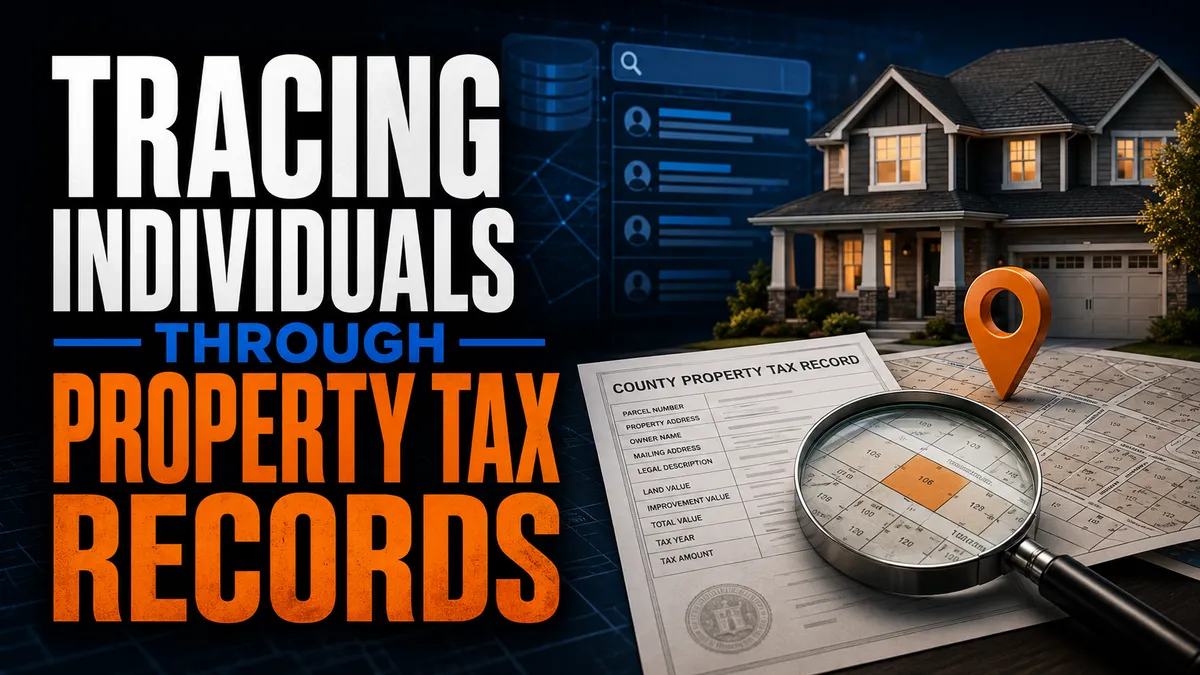
Tracing Individuals Through Property Tax Records
Your defendant's last known address is dead. The neighbor says they moved a year ago, the phone number is disconnected, and your client wants an answer by Friday. Before you pay for another database, go look at the county property tax records. They're public in most places, they're usually free, and they're one of the most overlooked skip tracing tools we've got.
Why? Because people move, but a lot of them don't sell. They keep the old house and rent it out. They buy a second place. They put it in a trust or an LLC. And wherever that property is, the county still has to send the tax bill somewhere. That "somewhere" is a lead.
This article covers what property tax records can tell you, how to search them, and how to use them without serving the wrong person or the wrong house.
Ownership Is Not Residence
Let's get the big rule out of the way first, because it's the one people break.
A property tax record tells you who the county thinks owns a parcel and where the county mails the bill. It does not tell you who lives there. A landlord owns the house the tenant lives in. An investor owns ten houses and lives in none of them. Somebody who moved across the country can still be on the deed.
So treat every address you pull from a tax record as a lead, not an answer. Verify it before you drive.
What's in a Property Tax Record
Property tax records are kept by the county, city, parish, borough, or town. Their job is to identify taxable property, set its value, track who owns it, and collect the tax. Depending on where you are, a record can show:
The owner's name
The physical property address
The tax mailing address
The parcel or assessor number
The legal description
Assessed and taxable values
Land and building details
Property classification (residential, commercial, agricultural, vacant land)
Ownership history
Sale date and price
Unpaid taxes
Exemptions or special assessments
Some counties also link to past owners, old assessments, deeds, and parcel maps. How much you get depends on local disclosure rules and how good the county website is. Some are great. Some look like they were built in 1998.
The Two Addresses That Matter
Every record has two addresses, and you need to know the difference.
The property address is the physical parcel. The tax mailing address is where the county sends the assessment notice and the bill.
When those two don't match, that's where it gets interesting. The property might be:
Rented to a tenant
A vacation home
An investment property
Managed by a property management company
Owned through a trust
Owned by someone who moved
Tied to a P.O. box
Handled by an accountant or tax preparer
The mailing address might be your subject's new house. It might also be their CPA's office, their property manager, their attorney, or their mom. Figure out what it is before you knock on that door.
How Tax Records Help You Find People
It starts with finding a property connected to your subject. From there, the records can help you:
Confirm they still own a known address
Find other real estate they own
Spot a possible current mailing address
Find property they own jointly with someone
Get the name of a spouse or co-owner
Tie the person to a business
Find a trust or property management company
See when a parcel was bought or sold
Build a timeline of where they've been
Develop a new address to verify
This is especially handy when the people-search databases are giving you three different "current" addresses and none of them agree.
I used to charge $75 or $150 for a skip trace. You don't need Social Security numbers or any deep private data to figure out where to serve somebody. Public records like these, plus a few good intake questions, get you most of the way there.
Where This Really Pays: Judgments
Property records aren't only for finding a defendant before service. They matter after the case, too.
When I was doing judgment recovery, there were two main ways to actually get paid: a wage garnishment, or a lien on something the debtor owns. Could be a boat, could be a trust, but a house is the most common one. You get the judgment, file the paperwork with the court, take it down to the county recorder's office, and record the lien on the property.
I also work in real estate, and here's what happens next. When that house sells, the title company runs a title search before the deed can transfer. A lien shows up as what they call a clouded title, and the deal sits in escrow until it's paid. So if the debtor owns property, you're going to get paid one way or another.
That's how you become the go-to person for attorneys and property managers. They start saying, "Go to Mike. He'll find him for you." And when you collect $2,000 an attorney thought was long gone, guess who they call next time.
Procedures for judgment liens vary a lot by state, so check your own state's rules and the county recorder's requirements before you file anything.
Are Property Tax Records Public?
Generally, yes. But how you get to them varies. Some counties let you search online by owner name, property address, mailing address, or parcel number. Others put very little online and want a records request or a visit to the assessor's office.
Some information is protected. Address confidentiality programs shield qualifying people, including survivors of domestic violence, stalking, sexual assault, and human trafficking. Some places also restrict records for judges, law enforcement, and other protected people.
Public doesn't mean anything goes. Use these records for a real assignment, not to harass or intimidate anybody, and never try to get around a confidential-address protection. If you hit one, stop and talk to your client.
How to Search, Step by Step
1. Find the right jurisdiction
Property records are local. Figure out the county, city, parish, or town where the known property sits, then find the official website for one of these offices:
County assessor
Property appraiser
Tax collector
County treasurer
Auditor
Recorder
Register of deeds
Go to the official government site first. The commercial sites that scrape and republish this data are often out of date.
2. Search by owner name
Enter the subject's full legal name and try variations:
Middle name or initial
Former name
Married name
Common misspellings
Jr. or Sr.
Business name
Trust name
A name match alone means nothing. Common names pull up a pile of unrelated people. Compare each hit against what you already know: old addresses, relatives, employer, business connections.
3. Search by the known address
An address search shows you the current owner of a property you already know about. It can also show when it was bought, transferred, or sold. If your subject shows up as a past owner, pull the ownership history and the recorded deed. A deed can give you a full legal name, a spouse's name, a trust name, or the address they used at the time of the sale.
4. Compare the mailing address
If the mailing address doesn't match the property address, follow it. It could lead to another home, a business, an accountant, an attorney, a property manager, or a relative. Find out why that address is on the record before you treat it as a place to serve.
5. Write down the parcel number
The parcel or assessor number is the property's fingerprint. Use it to pull tax documents, deeds, maps, liens, and assessment cards.
6. Check the date
Online assessment data lags. A recent sale or a new mailing address might not show up yet. Note the tax year, the date the database was last updated, and the most recent transaction.
Back It Up With a Second Source
A tax record by itself is a guess. Stack it with other lawful sources:
Recorded deeds
Mortgage documents
Liens
Business registrations
Court records
Probate filings
Professional licenses
Employer websites
Public social media
Phone directories
Maps
Lawful field observation
Here's how it fits together. A tax record shows Robert A. Johnson owns a property. The deed names his spouse. A business filing connects both of them to a company you already knew about. Now you've got three records pointing at the same person, and that's a lot stronger than one.
A free trick I use: Google search operators. Put the full name in quotes and Google keeps it in that exact order. Add "site:" and a county or business registry web address and you'll only get results from that site.
And don't skip the intake. When I take an order, I ask the same four questions every time. Do they work? What hours? What do they drive? Do you have a picture? The property record tells you where they might be. Those answers tell you when.
Reading the Parcel Before You Drive
Property records are great for field planning, too. They can tell you if a location is residential, commercial, agricultural, vacant land, or part of a bigger parcel. Assessment details may show:
The type of building
About when it was built
How many units
Whether there's any structure on it at all
Parcel boundaries
Property classification
Whether a company or trust owns it
That keeps you from driving out to an empty lot, or knocking on the neighbor's door because two parcels share a driveway. It also helps you plan for apartment buildings, multi-unit properties, commercial sites, and rural addresses.
LLCs, Trusts, and Co-Owners
A lot of property is held through an LLC, corporation, partnership, or trust.
If a company owns it, search the state business registry. You'll often find the registered agent, managers, principal office, mailing address, and filing history.
If a trust owns it, the tax record might only show the trust's name. The recorded deed may name a trustee or give you more to connect the trust back to your subject.
Co-owners help confirm identity. If a known spouse, relative, or business partner is listed on the same parcel, you've probably got the right person. But co-ownership doesn't prove either of them lives there. And a co-owner is not automatically someone you can leave papers with. Who qualifies for substitute service depends on your state's rules, so check them.
For Attorneys and Firms
Property records help attorneys build timelines, look into ownership interests, and find possible service locations. They come up in estates, debt cases, landlord-tenant matters, real estate disputes, business ownership questions, and judgment enforcement.
When you or your server write it up, keep facts and conclusions separate. Say the subject "is listed as an owner." Don't say they "reside at the property" unless somebody actually verified it.
Credit reports, DMV information, and other protected records fall under separate laws, and you need a legally permitted purpose to get them. Don't mix public tax data with restricted data you had no right to access.
And when you're hiring a server, give them everything up front: last known address, any property you know about, employer, hours, vehicle, and a photo. The more you hand over, the fewer attempts you pay for.
Online Records Have Errors
Lots of counties put property tax records online now, so the first pass is fast. Search options can include owner name, property address, mailing address, parcel number, subdivision, or a map. But online records still have:
Data entry mistakes
Shortened or abbreviated names
Late ownership updates
Old mailing addresses
Wrong parcel descriptions
Missing sale history
If a service decision rides on it, check the online entry against the recorded deed or call the county office.
Use a Local Server
A local server knows the county's assessor site, how parcels are numbered, how rural addressing works, which gated communities are a pain, and how the courthouse runs. That's huge when the online records are thin or somebody has to go look at a property to see if anyone lives there.
I had a pro per order a serve, an e-file, and a skip trace through my online order form for $147, and the addresses were out in the middle of nowhere. The hard part wasn't the research. It was finding someone who could get out there. I found a server who knew everybody in that part of the state, and we agreed to reciprocal rates. Driving two and a half hours to serve one paper wasn't going to happen. I'll break even on a paper all day if I don't have to make that drive.
That's what Mighty Process Server is built for. Servers set their own fee schedule, area by area, or upload it as a CSV, and clients get an instant quote. Address search covers more than 171,000 cities worldwide, so when the tax bill goes to an address in another state or another country, you can still find a server there and order the serve without calling around for a week.
Write Down How You Found It
Your client should be able to see why you picked an address. For every property lead, note:
The office or database you searched
Date and time of the search
Parcel number
Owner name exactly as listed
Property address and mailing address
Tax year and last update date
The other sources that confirmed it
How confident you are
What you're doing next
Mighty Process Server keeps all of that on the job itself, with your notes, attempts, GPS, and photos together. The affidavit builds from the job, the server signs their own, and when it needs a notary, the Mighty Notary integration gets it signed and notarized right in the app. Clients get their own private dashboard, so when they ask why you went to the address on the tax bill instead of the house, the answer is already there.
Mistakes to Avoid
Treating ownership as proof someone lives there
Mixing up the mailing address and the property address
Going off a name-only match
Ignoring the tax year
Skipping the recent deeds
Assuming an LLC's address belongs to your subject
Treating a co-owner as someone who can accept service
Attempting service before you verify occupancy
Trying to get around address confidentiality protections
Reporting a guess as a confirmed fact
Lying about who you are to get information. One of the attorneys I worked for warned me that misrepresenting yourself can get a case thrown out. Not worth it.
The Bottom Line
Property tax records can show you who owns what, where the bills go, who they own it with, and what businesses or trusts are attached. That's a lot of free information for a server or an attorney trying to find somebody.
Just remember the rule. Ownership isn't residence. Use the official county site, back it up with a second source, respect privacy protections, write down how you found it, and verify before you drive.
Be safe out there. Live Mighty!
Stay sharp. Stay informed. Live Mighty!
Read the full article at www.mightyprocessserver.com
This article is published by Process Server Daily, powered by MightyAutomation.ai, the leader in legal support intelligence.